


Sandy Yamamoto, violin
Anton Nel, piano
Farkhad Khudyev, conductor
Jarred Kennedy, guest conductor
Jonathan Thoma, guest conductor
This concert will last about 75 minutes with one intermission.
Please silence your electronic devices.
Photography, video, or recording of any part of this performance is prohibited
Program
Felix Mendelssohn
Concerto for Violin, Piano and Strings in D Minor, MWV O4
Allegro
Adagio
Allegro molto
Sandy Yamamoto, violin
Anton Nel, piano
intermission
Ludwig van Beethoven
Symphony No. 2 in D Major, op. 36
Adagio molto—Allegro con brio
Larghetto
Jarred Kennedy, conductor
Scherzo. Allegro
Allegro molto
Jonathan Thoma, conductor
About the Program
Program notes by Mark Bilyeu
Felix Mendelssohn
Concerto for Violin, Piano and Strings in D Minor, MWV O4
Born November 14, 1805, Hamburg, Germany
Died May 14, 1847, Berlin, Germany
Composed 1823
Premiered July 3, 1823, Berlin Schauspielhaus, Berlin, Germany
Published 1999
35 minutes
Felix Mendelssohn was a mere fourteen years old when he created his double concerto. It was originally conceived for a concert at his parents’ house in Berlin, alongside his violin teacher Eduard Rietz. After that successful performance, the (still fourteen year old) Wunderkind expanded the orchestration to include winds and timpani, and it was given its public premiere not two months later at the Berlin Schauspielhaus. In truth, however, the first in-home performance was ostensibly a public affair. The prominence of the Mendelssohn family was inescapable: the patriarch, Abraham, was on Berlin’s municipal council after incredible success during the Napoleonic Wars, and the family lived in a small palace in the middle of the city. There, they hosted political, social, and artistic elites (including Goethe, who was more impressed with the young Felix than he was with a young Mozart, whom he had also heard play). Regardless of venue, the work was a hit, but sat unpublished until well after the composer’s death when it became available in 1999.
The first movement is one of Mendelssohn’s longest, alternating flashy passagework with short staccato punctuations from the outset and continuing throughout. After the operatic violin recitative, there is a rather extraordinary double cadenza that might leave you forgetting there is even an orchestra on stage at all - until the movement’s exhilarating conclusion. The second movement is a gentle offering of lyricism before the finale’s virtuosic fireworks leave audiences (and perhaps even performers) breathless.
Ludwig van Beethoven
Symphony no. 2 in D Major, op. 36
Born December 16, 1770, Bonn, Germany
Died March 26, 1827, Vienna, Austria.
Composed 1801-1802
Premiered April 5, 1803, Theater an der Wien, Vienna, Austria, Ludwig van Beethoven, conductor
35 minutes
It was in the sleepy Vienna suburb of Heilegenstadt—whose name translates to ‘holy city’—where Beethoven, a rising star of international acclaim, spent the summer of 1802. He was sent there by his doctors, in hopes of combating the loss of hearing he was experiencing, by spending time in the quiet countryside. In October, he penned a letter to his two brothers we now know as the Heilegenstadt Testament. In it, we hear Beethoven begin to grapple with his increasing deafness: “What a humiliation when one stood beside me and heard a flute in the distance and I heard nothing, or someone heard the shepherd singing and again I heard nothing, such incidents brought me to the verge of despair, but little more and I would have put an end to my life.” The entire letter is not despairing, however! Despite his thoughts of suicide, his resilience is palpable: “Ah it seemed impossible to leave the world until I had produced all that I felt called upon me to produce, and so I endured this wretched existence.” It was just weeks later, with his conviction and misery co-mingling in the Austrian countryside, that he finished his second symphony. The work premiered the next year in a mega-concert which also featured his first symphony, and premieres of his oratorio Christ on the Mount of Olives, and his Piano Concerto No. 3, with the composer as the soloist.
The public, who had already heard and loved the first symphony, did not know what to make of Beethoven’s second. One Viennese critic wrote, “The 2nd symphony is a crass ogre, a stabbed, unbound writhing dragon that refuses to die, and although bleeding in the Finale, angrily beats about with tail erect.” while another critic complained that Beethoven's "anxiety to achieve something novel and surprising was much too evident" and that "the whole thing is too long, and overly-artificial in places." The listener can decide if it is, in fact, a crass ogre or unbound dragon, but it is impossible to ignore the symphony’s carefree and optimistic outlook, given the inner turmoil of the composer. In his 1884 publication of essays on the complete Beethoven symphonies, composer Hector Berlioz wrote of the second symphony:
In this work everything is noble, energetic and stately... [the] wonderful adagio leads to an allegro con brio which has a sweeping vitality. The scherzo is just as frankly gay in its capricious fantasy as the andante was completely happy and calm...even the warlike sallies of the first allegro being exempt from violence, so that one can trace in them no more than the youthful ardour of a noble heart which retains intact the most beautiful illusions of life... The composer still has faith in immortal glory, in love and self-sacrifice. What abandonment in his joy, what wit, what exuberance!” In short, quipped Berlioz, “everything in this symphony smiles.
About the Artists
Sandy Yamamoto
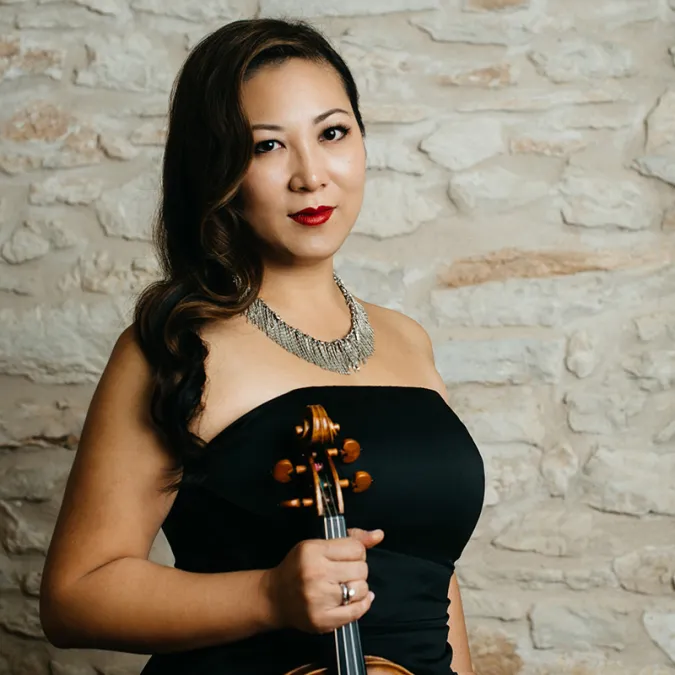
Violinist Sandy Yamamoto has dazzled audiences in concert performances around the globe for the past three decades as a soloist and as a member of the Miró Quartet. With the Miró Quartet, she performed on the major concert stages of the world, regularly concertizing in North America, South America, Europe and Asia. As a member of the Quartet, she was a recipient of the Naumburg Chamber Music and Cleveland Quartet Awards, won First Prize at the Banff International String Quartet Competition and was one of the first chamber musicians to be awarded an Avery Fisher Career Grant. Since leaving the Quartet in May 2011, she has been appointed Associate Professor of Practice in Violin Performance at the Butler School of Music and was the recipient of the Butler School of Music Teaching Excellence Award. For the 2024-25 season, she is Co-Concertmaster of the San Antonio Philharmonic under the artistic leadership of Jeffrey Kahane. Most recently, she has accepted a position as the new Artistic Director of the Austin Chamber Music Center.
Anton Nel
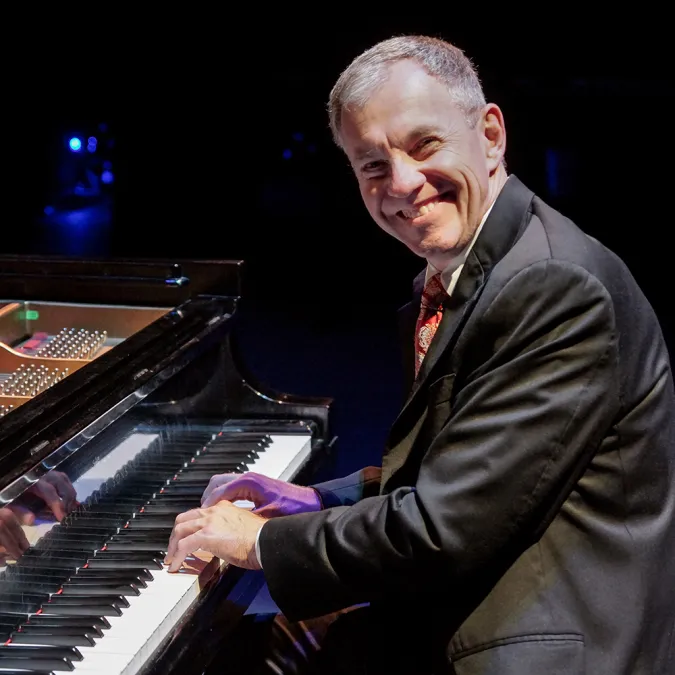
Winner of the 1987 Naumburg International Piano Competition at Carnegie Hall, Anton Nel continues to tour internationally as recitalist, concerto soloist, chamber musician and teacher. Highlights in the U.S. include performances with the Cleveland Orchestra, and the Chicago, San Francisco, Dallas, Seattle, and Detroit Symphonies (he has a repertoire of more than 100 works for piano and orchestra.) In addition to recitals in virtually every U.S. state he has appeared overseas at the Wigmore Hall in London, the Concertgebouw in Amsterdam, Suntory Hall in Tokyo, as well as major venues in China, Korea, and South Africa. Much sought after as a chamber musician he regularly appears with some of the world’s finest instrumentalists and singers at festivals on four continents. He holds the Joe R. and Teresa Lozano Long Endowed Chair at The University of Texas at Austin and also gives an annual series of masterclasses at the Manhattan School of Music and the Glenn Gould School in Toronto. During the summers he is on the artist-faculties at the Aspen Music Festival and School, the Steans Institute at the Ravinia Festival, and the Orford Music Academy in Quebec. Nel also frequently performs as harpsichordist and fortepianist. His recordings include four solo albums, chamber music recordings (including the complete Beethoven and Brahms cello/piano works with Bion Tsang), and works for piano and orchestra by Franck, Faure, Saint-Saens and Edward Burlingame Hill. The Johannesburg-born Mr. Nel is a graduate of the University of the Witwatersrand, where he studied with Adolph Hallis, and the University of Cincinnati where he worked with Bela Siki and Frank Weinstock. His website is antonnel.com.
Jarred Kennedy
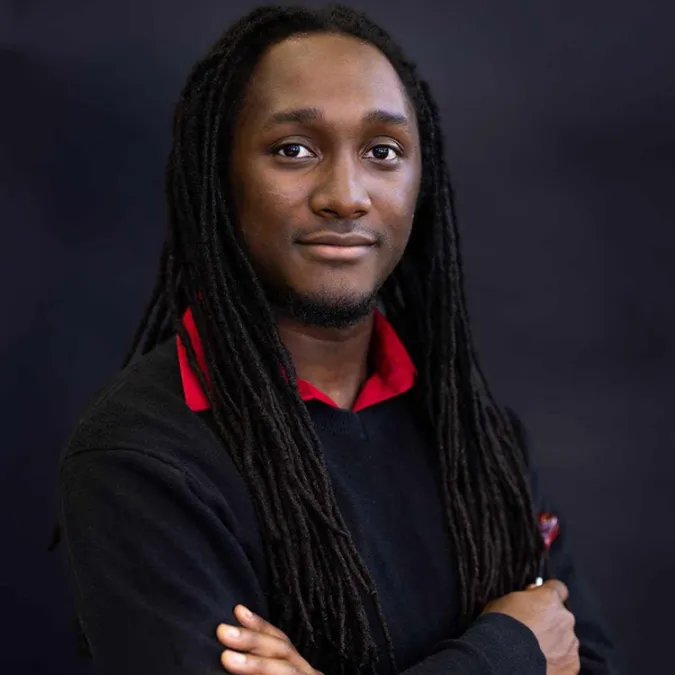
Jarred Kennedy is currently pursuing a doctorate in orchestral conducting at The University of Texas at Austin and serves as the assistant conductor fellow with the Reno Chamber Orchestra. He holds a master’s degree from Louisiana State University and a bachelor's degree in Music Education from Stephen F. Austin State University. As a guest conductor, Jarred has collaborated with the Austin Civic Orchestra, Renova Chamber Orchestra, and ensembles at the National Music Festival, as well as the LSU Symphony Orchestras. His recent professional distinctions include serving as the assistant conductor for the Rapides Symphony Orchestra and participating as a fellow of the Reynolds Conducting Institute at the 2025 Midwest Clinic.
Jonathan Thoma
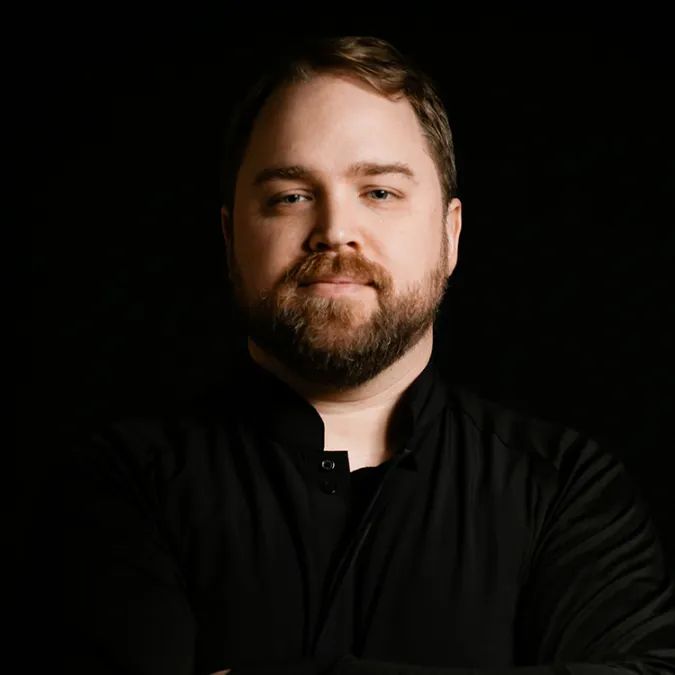
Jonathan Thoma is a first-year D.M.A. student in orchestral conducting, studying at The University of Texas at Austin with Farkhad Khudyev. He is an assistant conductor with the University of Texas Symphony and Chamber Orchestras and is a co-director of the University Orchestra.Born and raised in Fort Dodge, IA, Jonathan earned his bachelor's in music education from Iowa State University. Upon graduation, he became an orchestra director in Muscatine, IA. During his tenure, the Muscatine High School orchestras became the largest high school string program in the state of Iowa, and ensembles under his direction earned top ratings at state festivals. In 2024, Jonathan began working on his master's in orchestral conducting at Texas State University, studying with Jacob Harrison and Caroline Beatty. At Texas State, he guest conducted the Texas State Symphony, assisted with conducting classes, and was a founding director of the Texas State Camerata Orchestra. He graduated from Texas State University in 2026. He is blessed in life with his beautiful wife, Misha, and their kids, Gemma and Elliot.
Farkhad Khudyev
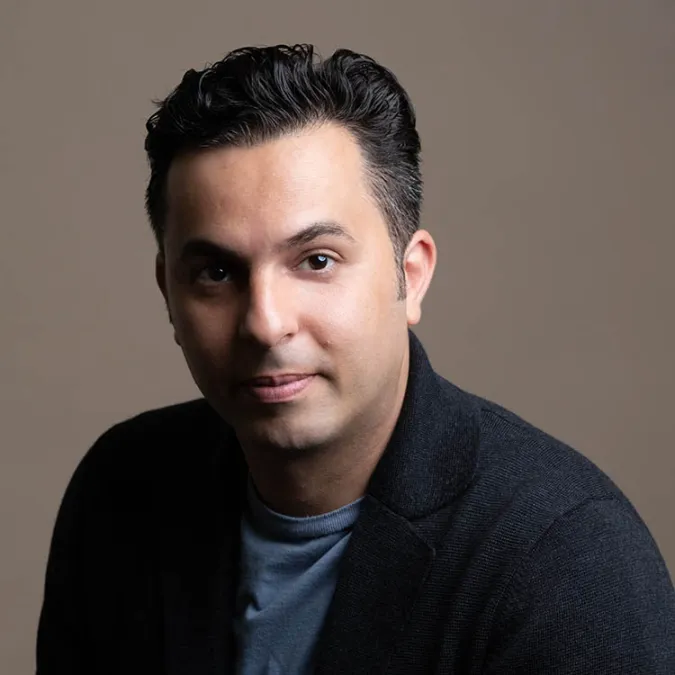
Farkhad Khudyev is the winner of the Gold Medal “Beethoven 250” at the 1st International Arthur Nikisch Conducting Competition; the Solti Foundation US 2018 and 2022 Career Assistance Award; the Best Interpretation Prize at the 1st International Taipei Conducting Competition; the 3rd prize at the 8th International Sir Georg Solti Conducting Competition; and the Gold Medal/Grand Prize at the 2007 National Fischoff Competition. Khudyev has worked with orchestras worldwide including the London Philharmonic Orchestra, Frankfurt Radio Symphony Orchestra, Frankfurt Opera Orchestra, Danish National Symphony Orchestra, Seattle Symphony, Dallas Symphony, Los Angeles Philharmonic, San Diego Symphony, Monterey Symphony, George Enescu Philharmonic Orchestra, Xi’an Symphony Orchestra and the State Taipei Chinese Orchestra. Farkhad was born in Turkmenistan, where he studied at the State Music School for gifted musicians, and then completed his studies at Interlochen Arts Academy, Oberlin Conservatory and Yale University. Khudyev serves as the Music Director of the University of Texas Symphony Orchestra in Austin, and the Orchestral Institute at the Hidden Valley Institute of the Arts in Carmel, California.
Chamber Orchestra
Violin I
Summer Bradshaw, concertmaster
Kai Lindsey
Sarah Horton
Noah Briones
Pedro Salas
Violin II
Jordan Bartel, principal
Yeolmae Pak
Cindy Kao
Lindy Feaster
Dean Guttman
Viola
Kyle Adams, principal
Gwendolyn Lay
Lilya Aljarrah
Maria Bulger
Cello
Iris Fang, principal
Christopher Tran
Saril Gupta
Connor Torres
Double Bass
Darrin Luong, principal
Lydia Chen
Flute
Elizabeth Alsenz2
Koustubh Galagali1
Oboe
Sarah Bird2
Elena Van Ronk1
Clarinet
Aiden Dellos
Natalie Eddings1,2
Bassoon
Grayson Bell1
Sabrina Pector2
Horn
Kannon Gregg
Alexander Rutkowski1,2
Trumpet
Anthony Ramirez1
Harrison Whitfield2
Timpani
Rosco Davis
Assistant Conductors
Jarred Kennedy
Jonathan Thoma
Principals
- Beethoven
- Mendellsohn
Upcoming Events

Ring in the season with the Butler School’s annual Holiday Concert with music for everyone to enjoy. You’ll hear traditional holiday carols and winter favorites across many genres, including excerpts from Bach’s Magnificat, jazz standards like “I’ll Be Home for Christmas,” and Hanukkah songs from Sephardic and Mizrahi Jewish traditions.
Featuring
Chamber Orchestra
Concert Chorale
University Chorus
Longhorn Singers
Bereket Middle Eastern Ensemble
Soha Quartet
Horn Choir
Bassoon Ensemble
Musical Theatre Workshop
Jazz Combos
Gregory Eaton, organ
Saturday, December 5, 7:30 p.m.
Sunday ,December 6, 4:00 p.m.
Bates Recital Hall
UNIVERSITY ORCHESTRA
Free Admission
Tuesday, October 6, 7:30 p.m.
Bates Recital Hall
SYMPHONY ORCHESTRA
Sunday, October 11, 7:30 p.m.
Bates Recital Hall
SYMPHONY ORCHESTRA
Friday, November 6, 7:30 p.m.
Bates Recital Hall
UNIVERSITY ORCHESTRA
Free Admission
Tuesday, November 17, 7:30 p.m.
Bates Recital Hall
CHAMBER ORCHESTRA
Selections from Le Faucon
Free Admission
Friday, February 26, 7:30 p.m.
Bates Recital Hall
Event Details
Free admission