


Farkhad Khudyev, conductor
This concert will last about one hour without intermission.
Please silence your electronic devices.
Photography, video, or recording of any part of this performance is prohibited
Program
Pyotr Ilyich Tchaikovsky
Symphony No. 6 in B Minor, op. 74, Pathétique
Adagio - Allegro non troppo
Allegro con grazia
Allegro molto vivace
Adagio lamentoso
About the Program
Program notes by Mark Bilyeu
Pyotr Ilyich Tchaikovsky
Symphony No. 6 in B Minor, op. 74, Pathétique
Born May 7, 1840 Votkinsk, Russia
Died November 6, 1893 Saint Petersburg, Russia
composed 1893
Premiered October 28, 1893, St. Petersburg, Russia, Pyotr Ilyich Tchaikovsky, conductor
50 minutes
It was at the request of Nadezhda von Meck, the noblewoman and major financial supporter of the composer, that Tchaikovsky wrote extensive program notes for his fourth symphony. This was the first time he had done so, having been skeptical of program music (music with extra-musical context and narrative), which he believed threatened to cheapen the music itself. Five years and two (rather programmatic) symphonies later, the composer wrote a letter to his beloved nephew, Vladimir:
During my journey I had the idea for another symphony, this time with a programme, but such a programme that will remain an enigma to everyone—let them guess; the symphony shall be entitled: A Programme Symphony (No. 6); Symphonie à Programme (No. 6); Programm-Symphonie (No. 6). The programme itself will be suffused with subjectivity, and not infrequently during my travels, while composing it in my head, I wept a great deal. Upon my return I sat down to write the sketches, and the work went so furiously and quickly that in less than four days the first movement was completely ready, and the remaining movements already clearly outlined in my head... The form of this symphony will have much that is new, and amongst other things, the finale will not be a noisy allegro, but on the contrary, a long drawn-out adagio. You can't imagine how blissful I feel in the conviction that my time is not yet passed, and to work is still possible. Of course I might be mistaken, but I don't think so.
So much of this sixth symphony’s magnetism is wrapped up in the life of the composer, and in the unanswered questions that remain regarding the work’s “subjectivity.” Ultimately, the music of Tchaikovsky speaks for itself: it continues to affect audiences and musicians, regardless of the composer’s personal life, his struggles, failures—and his triumphs—which keep musicologists and historians in business.
Tchaikovsky dedicated the symphony to his nephew Vladimir (who often went by “Bob,” the nickname given to him by his family). It is a fact that Tchaikovsky struggled with his homosexuality, as did his younger brother Modest, and their nephew Vladimir. As Vladimir grew into adulthood, Tchaikovsky’s affection towards (and longing for) his nephew also grew. While many an uncomfortable letter was penned, and while Vladimir also nurtured the relationship with his uncle, there is absolutely no evidence that the attraction moved beyond longing. When one considers this relationship, the work’s dedication, and the letter above describing the work as causing him to “weep a great deal,” it is an easy and logical line to draw from the composer’s intense struggle within himself to this symphony.
Another facet which has caused much skepticism and interest is the shocking timeline of Tchaikovsky’s death in relation to the premiere of this symphony. The work was first heard by public audiences in St. Petersburg on Saturday, October 28, 1893, and nine days later, on the following Monday, the composer died of cholera. Scholars have researched and argued for entire careers seeking to definitively say whether the cholera was a self-induced death sentence to escape a scandalous public outing, or if there are hidden codes of self-loathing within the music to support such an act of self harm. We also know that before his death, Tchaikovsky’s publishers wrote to confirm the new subtitle of “Pathétique,” which, unlike its English cognate, suggests an “impassioned suffering” rather than something weak or inadequate. While taken separately, none of these aspects might raise an eyebrow, yet it is hard to deny a certain amount of intrigue when these parts are taken as a whole.
The work itself, does, as Tchaikovsky wrote to his nephew, “have much that is new,” and has proven itself as a lynch pin for the work of other symphonists including Mahler and Shostakovich. The first movement opens with severity, alternating themes of stark bleakness and hopeful serenity, while also quoting part of the Russian Orthodox Requiem: a chant sung over the coffin “With thy saints, O Christ, give peace to the soul of thy servant” (another argument for the planned death of the composer?). Be also on guard for the bassoon solo leading into the development! The solo is marked as pppppp (pianissississississimo), and followed by an eruption from the full orchestra. You’ve been warned.
The middle two movements include a hiccuping waltz in 5/4 time and a third movement which, for many composers, would have served as an outstanding final movement to a symphony. The waltz pays homage to Tchaikovsky’s indelible mark as a ballet composer, while the third movement showcases a rather virile and obstinate side of the same composer. The movement’s epic conclusion often elicits early applause.
The final movement is where Tchaikovsky’s innovation blazes through, as he returns to the tempo of the opening movement, Adagio lamentoso, as if to declare that the suffering and despair have always been present, despite the passing moments of joy and hope. Annotator and composer Donald Francis Tovey described the movement as “a stroke of genius which solves all the artistic problems that have proved most baffling to symphonic writers since Beethoven.” There is a constant feeling of descent as the symphony concludes: a gong strikes, muted string basses pulsate, and the symphony sinks into silence.
“I absolutely consider it to be the best, and in particular, the most sincere of all my creations,” Tchaikovsky wrote in a letter to his nephew, “I love it as I have never loved any of my other musical offspring."
About the Conductor
Farkhad Khudyev
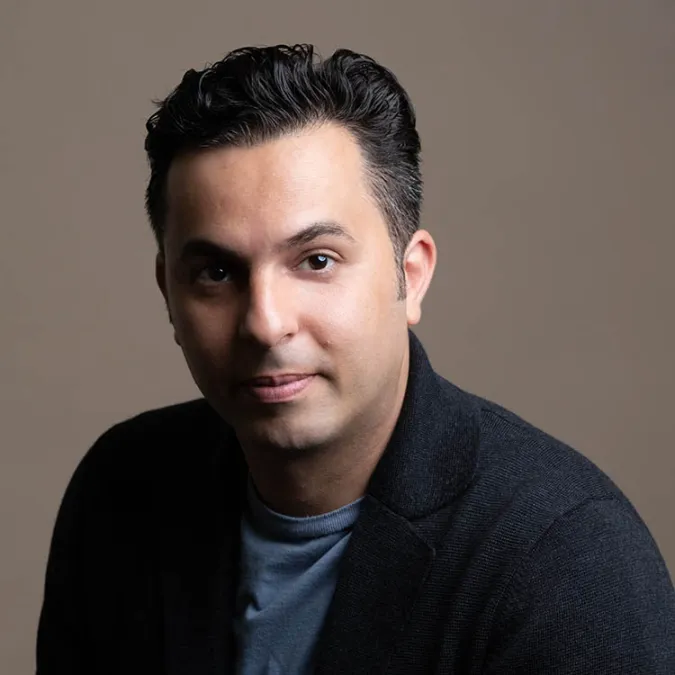
Farkhad Khudyev is the winner of the Gold Medal “Beethoven 250” at the 1st International Arthur Nikisch Conducting Competition; the Solti Foundation US 2018 and 2022 Career Assistance Award; the Best Interpretation Prize at the 1st International Taipei Conducting Competition; the 3rd prize at the 8th International Sir Georg Solti Conducting Competition; and the Gold Medal/Grand Prize at the 2007 National Fischoff Competition. Khudyev has worked with orchestras worldwide including the London Philharmonic Orchestra, Frankfurt Radio Symphony Orchestra, Frankfurt Opera Orchestra, Danish National Symphony Orchestra, Seattle Symphony, Dallas Symphony, Los Angeles Philharmonic, San Diego Symphony, Monterey Symphony, George Enescu Philharmonic Orchestra, Xi’an Symphony Orchestra and the State Taipei Chinese Orchestra. Farkhad was born in Turkmenistan, where he studied at the State Music School for gifted musicians, and then completed his studies at Interlochen Arts Academy, Oberlin Conservatory and Yale University. Khudyev serves as the Music Director of the University of Texas Symphony Orchestra in Austin, and the Orchestral Institute at the Hidden Valley Institute of the Arts in Carmel, California.
Symphony Orchestra
Violin I
Yida An, concertmaster
Zi Wang
Jackie Shim
Georgia Halverson
Yusong Zhao
Brandon Garza
Suhaas Patil
Peter Kim
Ivan Arras Morales
Qiyan Xing
Violin II
Shijie Li, principal
Suhyun Lim
Wai Shan Ma
Jimmy Shim
Wells Gjerlow
Mia Zajicek
Dyer McLeod
Leiana Campanaro
Nicholas Hammel
Zhengnan Wang
Viola
Zhe Cao, principal
Nelle Joung
Michael Lee
Alexis Mitrushi
Hannah Thompson
Cecilia Nguyen
Aiden Flora
Kamran Merritt
Grace Dias
Cello
Kuan Yu Huang, principal
Aidan Bolding
Javy Liu
Hongjoo Nam
Savva Wagner
Seungyeon Oh
Yeh Hsuan Pu
Tristan Ramon
Benedict Ventura
Double Bass
Juan Hernandez Labra, principal
Lucas Scott
Shiying Feng
Ema Deguchi-Kelli
Flute
Kyndahl Britton, principal
Logan Crocker
Eunha Kim
Piccolo
Eunha Kim
Oboe
Noah O’Brien, principal
Sara Brown
Clarinet
Sadie Murray, principal
Maja Pechanach
Bass Clarinet
Maja Pechanach
Bassoon
Rishabh Sajjan, principal
George Alazar
Horn
Daniela Garcia, principal
Andrew Clarkson
Jordan Perkins
Austin Waldbusser
Samuel Stephenson
Trumpet
Americo Zapata, principal
Shashe Hossain
Trombone
Cristian Cantu, principal
Nicolas Castillo
Jackson Quevado
Tuba
Haley Pauzus
Percussion
Aaryn, Avila, principal
Erin Lockhart
Michael Rivera Gonzalez
Assistant Conductors
Chris Tran
Jarred Kennedy
Jonathan Thoma
Upcoming Events

Ring in the season with the Butler School’s annual Holiday Concert with music for everyone to enjoy. You’ll hear traditional holiday carols and winter favorites across many genres, including excerpts from Bach’s Magnificat, jazz standards like “I’ll Be Home for Christmas,” and Hanukkah songs from Sephardic and Mizrahi Jewish traditions.
Featuring
Chamber Orchestra
Concert Chorale
University Chorus
Longhorn Singers
Bereket Middle Eastern Ensemble
Soha Quartet
Horn Choir
Bassoon Ensemble
Musical Theatre Workshop
Jazz Combos
Gregory Eaton, organ
Saturday, December 5, 7:30 p.m.
Sunday ,December 6, 4:00 p.m.
Bates Recital Hall
UNIVERSITY ORCHESTRA
Free Admission
Tuesday, November 17, 7:30 p.m.
Bates Recital Hall
Symphony Orchestra
Wednesday, February 10, 7:30 p.m.
Bates Recital Hall
UNIVERSITY ORCHESTRA
Free Admission
Tuesday, February 23, 7:30 p.m.
Bates Recital Hall
CHAMBER ORCHESTRA
Selections from Le Faucon
Free Admission
Friday, February 26, 7:30 p.m.
Bates Recital Hall
SYMPHONY ORCHESTRA
with Leah Crocetto, soprano & Emil Khudyev, clarinet
Friday, April 2, 7:30 p.m.
Bates Recital Hall
Event Details
$5 – 15
All University of Texas at Austin students are allowed one free ticket as long as they are available. Student tickets must be picked up at the Box Office with valid student I.D. Seating is unassigned.
If you are a patron with specific seating needs, please email tickets@mail.music.utexas.edu and we will reserve ADA seating for you.