




Jerry Junkin, conductor
The Mariachi Paredes de Tejastitlán, Greg Cavazos, director
Jimmy Santos-Rivera, guest conductor
This concert will last about 90 minutes with one intermission.
Please silence your electronic devices.
Photography, video, or recording of any part of this performance is prohibited
Program
Arturo Márquez
arr. Nickel
Danzon No. 2
Jimmy Santos-Rivera, conductor
various
Selections by The Mariachi Paredes de Tejastitlán
To be announced from stage
Greg Cavazos, director
H. Owen Reed
La Fiesta Mexicana
Prelude and Aztec Dance
Mass
Carnival
Arturo Márquez
Sinfonía Nómada consortium premiere
Marcha Natura
Faro Verde (Sahuaro)
Looking South
About the Program
Arturo Márquez
Danzon No. 2
Born December 20, 1950 Álamos, Mexico
Composed 1994
Premiered 1994, Orchestra Filarmonica de la UNAM, Mexico City
10 minutes
The idea of writing the Danzón No. 2 originated in 1993, during a trip to Malinalco with the painter Andrés Fonseca and the dancer Irene Martínez, both of whom are experts in salon dances with a special passion for the danzón, which they were able to transmit to me from the beginning, and also during later trips to Veracruz and visits to the Colonia Salon in Mexico City. From these experiences onward, I started to learn the danzón’s rhythms, its form, its melodic outline, and to listen to the old recordings by Acerina and his Danzonera Orchestra. I was fascinated and I started to understand that the apparent lightness of the danzón is only like a visiting card for a type of music full of sensuality and qualitative seriousness, a genre which old Mexican people continue to dance with a touch of nostalgia and a jubilant escape towards their own emotional world; we can fortunately still see this in the embrace between music and dance that occurs in the state of Veracruz and in the dance parlors of Mexico City.
The Danzón No. 2 is a tribute to the environment that nourishes the genre. It endeavors to get as close as possible to the dance, to its nostalgic melodies, to its wild rhythms, and although it violates its intimacy, its form and its harmonic language, it is a very personal way of paying my respects and expressing my emotions towards truly popular music. Danzón No. 2 was written on a commission by the Department of Musical Activities at Mexico’s National Autonomous University and is dedicated to my daughter Lily.
– Arturo Márquez
H. Owen Reed
La Fiesta Mexicana
Born June 17, 1910, Odessa, MO
Died January 6, 2014, Athens, GA
Composed 1949
Premiered 1949, U.S. Marine Band, Lt. Col. William F. Santelmann, conductor
23 minutes
In the summer of 1947, H. Owen Reed received a fellowship to study with Bohuslav Martinu, and contemporary music with Aaron Copland, Leonard Bernstein at Tanglewood, and the following summer, he was awarded a Guggenheim Fellowship which funded an opportunity for him to study folk music in Mexico for six months. He would go on to study the the folk music of Norway, the Caribbean, and Native American music throughout New Mexico and Arizona. HIs most popular work for wind band remains La Fiesta Mexicana, the result of his first trip to Mexico. The work is highly programmatic, as the composer explains:
Prelude and Aztec Dance — The tolling of the church bells at midnight officially announces the opening of the Fiesta, which has previously been unofficially announced by the setting off of fireworks, the drinking of tequila and pulque, and the migration of thousands of Mexicans and Indians to the center of activity — the high court surrounding the cathedral. After a brave effort at gaiety, the celebrators settle down to a restless night, until the early quiet of the Mexican morning is once more shattered by the church bells and fireworks. At mid-morning a band is heard in the distance. However, attention is soon focused upon the Aztec dancers, brilliantly plumed and masked, who dance in ever-increasing frenzy to a dramatic climax.
The second movement, Mass, presents the tolling of the bells, reminding that the Fiesta is a religious celebration. The rich and poor slowly gather within the walls of the old cathedral for contemplation and worship. Mexico is at its best on the days of the Fiesta in which passion governs the love, hate and joy of the Mestizo and the Indio. The third movement, Carnival, reflects the entertainment for both young and old — the itinerant circus, the market, the bullfight, the town band, and always the cantinas with their band of mariachis.
– Mark Bilyeu
Arturo Márquez
Sinfonía Nómada
Born December 20, 1950, Alamos, Sonora, Mexico
Composed 2026
Premiered May 23, 2026, Dartmouth College Wind Ensemble, Brian E. Messier, conductor
23 minutes
Sinfonía Nómada (Nomadic Symphony) is a work centered on migration, approached not as a single narrative but as a series of perspectives. Across its three movements, the symphony moves from the natural world to the human experience, ultimately confronting one of the most urgent issues of our time: immigration. Framing the entire work is a recurring batucada-inspired rhythmic language that opens each movement and returns with heightened meaning in the finale, where its character is revealed in full.
The first movement, Marcha Natura: Pole to Pole (“Natural March”), reflects the vast cycles of natural migration that define life on Earth. Its steady, processional character evokes the movement of species across great distances: caribou traversing the tundra, salmon returning upstream to the waters of their birth, and the arctic tern’s extraordinary annual journey between the poles. The music unfolds with patience and inevitability, suggesting motion not as urgency, but as necessity, embedded in the rhythms of the natural world.
The second movement, Faro Verde: Sahuaro (“Green Lighthouse”), draws inspiration from the poem Saguaros by Salvadoran poet Javier Zamora. In Saguaros, Javier reflects on his journey on foot from El Salvador through the Sonoran Desert into the United States. Undertaken in an effort to be reunited with his parents, the journey took two months, with the poem set at the moment of his arrival at the U.S. border. In the Sonoran Desert, the composer's birthplace, the towering saguaro cactus stands as both witness and guide. These behemoths grow slowly, approximately one meter every sixty years, with some living for centuries and reaching heights of over sixty feet. Márquez translates this imagery into sound through a gradual unfolding of musical material: a long crescendo shaped by shifting meters that mirrors the slow growth of the saguaro. This rise is later reversed, the music fading as if the landscape itself is falling away. This expansion and decay can be heard as the life cycle of the cactus, a reflection on environmental loss, or perhaps the saguaros serving as sentinels, rising before by Javier Zamora, only to recede as he leaves them behind him.
The final movement, Looking South, addresses contemporary human migration directly. Márquez, himself an immigrant during his studies in California, has described this subject as inescapable: “How could I write anything else?” Yet rather than framing the movement in present-day rhetoric, he turns to the words of William Shakespeare, written over four centuries ago. The movement is structured around “The Strangers’ Case” speech from Sir Thomas More, in which Sir Thomas asks his listeners to imagine themselves as the very strangers they seek to expel. Though the text is never spoken, it is embedded musically, first in the trumpets and later in the clarinets. The final word of the speech, “inhumanity,” is revealed as the fundamental motive, not only of the movement, but of the batucada drumming that frames the entire symphony. Here, in the third movement, the drumming is accompanied by whistles. These whistles are not — as I first believed — the police responding to rioters, but rather a warning call to the community that dangerous, inhuman forces are descending.
– Brian Messier, May 2026
About the Artists
Jimmy Santos-Rivera

Jimmy Santos-Rivera (he/him) is currently pursuing a master of music in wind conducting at The University of Texas at Austin, where he serves as a graduate teaching assistant. In this role, he assists in conducting and managing the university’s concert bands, athletic bands, and conducting courses. He earned his bachelor of arts in music education, with a minor in percussion, from the University of Puerto Rico, Río Piedras. Born and raised in Puerto Rico, his career has been deeply rooted on the island. Prior to moving to Austin, Santos-Rivera spent eight years teaching concert band, percussion, and music theory at Escuela Especializada en Bellas Artes Pablo Casals. As a performer, he has played in the percussion section of the Puerto Rico Symphony Orchestra, the Puerto Rico Wind Symphony, and the Puerto Rico Philharmonic Orchestra. In 2019, he joined the 248th Army Band in San Juan, Puerto Rico, where he currently serves as a percussionist in various ensembles and as the principal conductor of the concert band. His mentors include Carlos Ávila, Eddy Marcano, Karlo Flores, and Carmen Acevedo.
Greg Cavazos
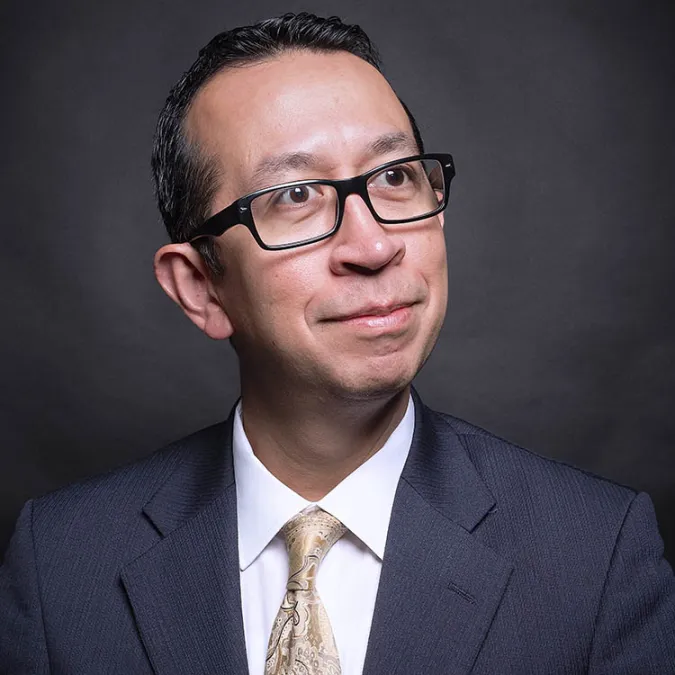
Greg Cavazos is a highly respected mariachi director with nearly two decades of experience in education and performance throughout Texas. He has held key positions as a mariachi director at Eagle Pass High School, Cavazos Middle School, and Lubbock High School, where he cultivated vibrant mariachi programs and inspired countless students to pursue their musical passions. Mr. Cavazos holds a bachelor of music in Music Education from Texas A&M University-Kingsville where he directed Mariachi Javelina from 1998 to 2003 and a master of music in Musicology from Texas Tech University, focusing on the development of mariachi trumpet in his thesis, "The Development of Mariachi Trumpet within the Son Jalisciense." As an active member of the Texas Music Adjudicators Association, he evaluates mariachi ensembles statewide and has served as a clinician for All-Region Mariachi ensembles in TMEA Regions 20, 15, 11, and 8. Currently, he directs the Mariachi Ensembles at The University of Texas at Austin and is a part of the Music and Human Learning faculty. Through his extensive experience and contributions, Cavazos is a passionate advocate for mariachi music, dedicated to nurturing young talent and preserving this rich cultural tradition.
Jerry Junkin
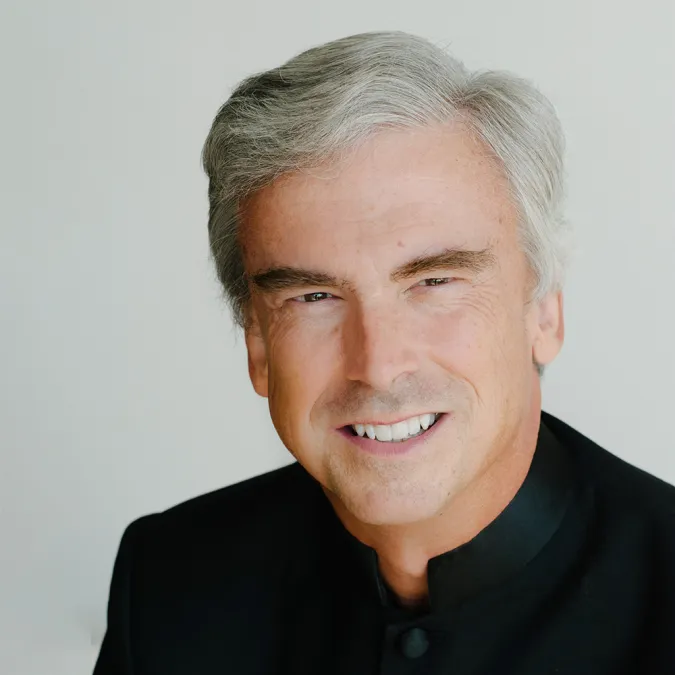
Serving since 1988 on the faculty of The University of Texas at Austin, where he holds the Vincent R. and Jane D. DiNino Chair for the Director of Bands, in addition to serving as a University Distinguished Teaching Professor, Jerry Junkin is recognized as one of the world’s most highly regarded wind conductors. Previously, he served on the faculties of both the University of Michigan and the University of South Florida. In addition to his responsibilities as professor of music and conductor of the Texas Wind Ensemble, he serves as head of the conducting division and teaches courses in conducting and wind band literature. He has served as music director and conductor of the Hong Kong Wind Philharmonia since 2003, and as artistic director and conductor of the Dallas Winds since 1993. He also serves as visiting professor at the Senzoku Gakuen College of Music Wind Ensemble in Tokyo, Japan. Mr. Junkin has conducted All-State bands and festivals in forty-eight states and five continents, and is a Yamaha master educator.
Wind Ensemble
Flute
Juan Fajardo
Leilani Foreman
Elizabeth Alsenz
David Ma
Subin Oh
Oboe
Genevieve Britten
Caden Thomas Cromer
Jonah Richardson
Luke Sanchez
Clarinet
Andrew Battaglia
Tan Charintranont
Juhyun Lee
Yonghun Lim
Kerry Morgan
Katelyn Nguyen
Alayna Rosas
Johnny To
Alexander Vo
Bassoon
Jose Gutierrez Martinez
Benjamin Miller
Isabella Perez
Allison Rogers
Bailey Workman
Saxophone
Ethan Ashley
Quinlan Collins
Jacob Feldman
Levi Pena
Alexis Santana
Andrew Stine
Horn
Charlotte Allen
Owen Clark
Elena Rose Elorreaga
Dylan Estella
Andrew Ryan
Trumpet
Samuel Acosta
Harmon Byerly
Carson Michael Frank
Cameryn Key
Jax Latham
Enrique Lopez
Mehdi Mercier
Aiden Spicer
Trombone
Jace Byrd
Caleb Andrew Collins
Ross Ganske
Ryan Smalley
Mary Bailey
Euphonium
Henry Otts
Troy Rosales
Tuba
Jeffrey Fields
Chancellor Joseph
Percussion
Matthew Garcia
Randy Griner
Khaden Joyner
Marcos Jurado
Meghan Lawson
Chia Yu (Erica) Lin
Isabella Scotti
Antonio Valadez
Double Bass
Kaitlyn Ruiter
Harp
Cicy Chen
My Tran
keyboard
Shao-Chu Pan
Upcoming Events
WIND SYMPHONY
Free Admission
Wednesday, November 4, 7:30 p.m.
Bates Recital Hall
WIND ENSEMBLE
Sunday, November 8, 4:00 p.m.
Bates Recital Hall
SYMPHONY BAND
Free Admission
Sunday, November 15, 7:30 p.m.
Bates Recital Hall
WIND ENSEMBLE
Adam Schoenberg, visiting composer
Sunday, February 7, 4:00 p.m.
Bates Recital Hall
WIND ENSEMBLE
with Epoch Percussion Quartet
Wednesday, March 10, 7:30 p.m.
Bates Recital Hall
Event Details
$5 – 15
All University of Texas at Austin students are allowed one free ticket as long as they are available. Student tickets must be picked up at the Box Office with valid student I.D. Seating is unassigned.
If you are a patron with specific seating needs, please email tickets@mail.music.utexas.edu and we will reserve ADA seating for you.