


Douglas Henderson, conductor
Emily Warren & Blake Hordé, guest conductors
This concert will last about one hour without intermission.
Please silence your electronic devices.
Photography, video, or recording of any part of this performance is prohibited
Program
Ryan Lindveit
Brilliant Brushstrokes
Roshanne Etezady
Anahita
The Flight of Night
Night Mares
Sleep and Repose / The Coming of Light
Emily Warren, conductor
Warren Benson
The Leaves are Falling
Blake Hordé, conductor
Ottorino Respighi
arr. Nefs
Pini di Roma
I pini di Villa Borghese (The Pines of the Villa Borghese)
Pini presso una catacomba (Pines Near a Catacomb)
I pini del Gianicolo (The Pines of the Janiculum)
I phi della Via Appia (The Pines of the Appian Way)
About the Program
Program notes by Mark Bilyeu except where noted.
Ryan Lindveit
Brilliant Brushstrokes
Born 1994, Houston, TX
Composed 2025
Premiered March 27, 2025, University of Tennessee, Knoxville Wind Ensemble, John Zastoupil, conductor
6 minutes
Brilliant Brushstrokes is inspired by an overwhelmingly colorful and bold painting that the Knoxville-born artist Beauford Delaney (1901-1979) painted on a fragment of his old raincoat when he was living in Paris in 1954. Delaney’s raincoat fragment overflows abstractly with swirls, rings, splotches, and lines of forest green, deep orange, bright yellow, fire-engine red, hazy gray, spacious white, peaceful azure, and deep ocean blue. Upon closer viewing, the seams and pockets of the cut-up raincoat are also visible, revealing that the fanciful artwork is the result of Delaney’s resourcefulness in the face of limited money and art supplies. As a fellow artist, I find Delaney’s unrelenting and restless impulse to be creative even when he lacked proper materials to be almost as inspiring as the painting itself. Although Brilliant Brushstrokes is tightly constructed around only a few melodic gestures, the music constantly cycles through changes in instrumental texture, density, harmony, and energy. Musical phrases are often cut-off abruptly with a quick down-up gesture that I view as related to the stitched seams on the raincoat. Overall, the composition uses the vast and variegated color palette of the wind ensemble to capture the inventive spirit and brilliant dynamism of Delaney’s brushstrokes, splatters, and daubs
Roshanne Etezady
Anahita
Born 1973
Composed 2005
15 minutes
In the Assembly Chamber of the State Capitol Building in Albany, New York, there are two murals that were completed in 1878 by the New England painter William Morris Hunt. These works are enormous . . . and are considered the culminating works of the artist’s career. One of these murals, The Flight of Night, depicts the Zoroastrian Goddess of the Night, Anahita, driving her chariot westward, fleeing from the rising sun. However, if you travel to Albany today, you won’t see The Flight of Night. Two years after Hunt completed the giant murals, the ceiling in the Assembly Chamber began to leak. . . . Only the lowest inches of the original painting are still visible. Anahita draws inspiration from photographs of Hunt’s masterpiece before its decay as well as from the Persian poem that inspired Hunt originally. The first movement, ‘The Flight of Night,’ is characterized by dramatic, aggressive gestures that are meant to evoke the terrifying beauty of the goddess herself. Movement two, ‘Night Mares,’ is a scherzo-like movement that refers to the three monstrous horses that pull the chariot across the sky. In the final movement, ‘Sleep and Repose/The Coming of Light,’ we hear the gentler side of the night, with a tender lullaby that ends with trumpets heralding the dawn.
– Roshanne Etezady
Warren Benson
The Leaves are Falling
Born January 26, 1924, Detroit, MI
Died October 6, 2005, Rochester, N.Y
Composed 1964
Premiered May 1964, by the Eastman Wind Ensemble, Clyde A. Roller, conductor
12 minutes
While an undergraduate student at the University of Michigan, Warren Benson played timpani under such conductors as Fritz Reiner, Eugene Ormandy, and Leonard Bernstein. A very accomplished percussionist, he was a largely self-taught composer who went on to hold faculty positions in both arenas at institutions such as Southern Methodist University, Ithaca College, and finally the Eastman School of Music. A founding member of the World Association for Symphonic Bands and Ensembles, his compositions have been widely recorded by ensembles around the globe. His 1964 The Leaves are Falling was commissioned by Kappa Gamma Psi, a small national music fraternity, spearheaded by Frank L. Battisti. The work was among the first of its kind: a direct response to the assassination of JFK, and inspired by Rainer Maria Rilke‘s poem Herbst (Autumn):
The leaves are falling, falling as if from afar,
as though far gardens withered in the skies;
They are falling with denying gestures.
And in the nights the heavy earth is falling
from all the stars down into loneliness.
We all are falling. This hand falls.
And look at the others: it is in them all.
And yet there is one, who holds this falling
with infinite gentleness in his hands.
Ottorino Respighi
Pini di Roma
Born July 9, 1879. Bologna
Died April 18, 1936. Rome
Composed 1923-24
Premiered December 14, 1924. Bernardino Molinari led the Augusteo Orchestra, in Rome
23 minutes
Italian composer Ottorino Respighi composed his blockbuster Roman Trilogy over the course of twelve years. His education and early career took him to Russia where he studied with composer and master orchestrator Rimsky-Korsakov for a brief stint while working as the principal violinist at the Russian Imperial Theatre, returning to Italy for a teaching position at the St. Cecilia Conservatory of Music in Rome in 1913. Though he was briefly captivated with the radical music of French Modernism, he ultimately retreated to a style which was more conservative, leaning on the lush orchestrations he learned in Russia while honoring the Italian music of the distant past. With the success of his 1916 Fountains of Rome, he began composing the Pines of Rome, the composer sent along these notes for the American premiere by the New York Philharmonic: “While in his preceding work, Fountains of Rome, the composer sought to reproduce by means of tone an impression of Nature, in Pines of Rome he uses Nature as a point of departure, in order to recall memories and vision. The centuries-old trees which so characteristically dominate the Roman landscape become witnesses to the principal events in Roman life.” The following depictions of the movements are also given by the composer:
The Pines of the Villa Borghese — Children are at play in the pine groves of the Villa Borghese, dancing the Italian equivalent of “Ring around a Rosy.” They mimic marching soldiers and battles. They twitter and shriek like swallows at evening, coming and going in swarms. Suddenly the scene changes.
The Pines Near a Catacomb — We see the shadows of the pines, which overhang the entrance of a catacomb. From the depths rises a chant, which echoes solemnly, like a hymn, and is then mysteriously silenced.
The Pines of the Janiculum — There is a thrill in the air. The full moon reveals the profile of the pines of Gianicolo’s Hill. A nightingale sings.
The Pines of the Appian Way — Misty dawn on the Appian Way. The tragic country is guarded by solitary pines. Indistinctly, incessantly, the rhythm of unending steps. The poet has a fantastic vision of past glories. Trumpets blare, and the army of the Consul bursts forth in the grandeur of a newly risen sun toward the Sacred Way, mounting in triumph the Capitoline Hill.
About the Artists
Emily Warren
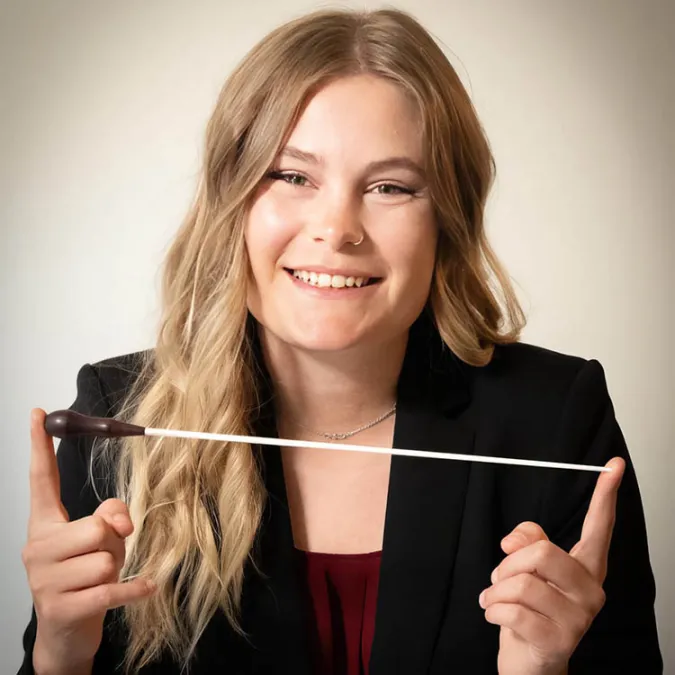
Emily Warren attends The University of Texas at Austin, where she is currently pursuing a doctor of musical arts degree in wind conducting. As a graduate teaching assistant, she works with the university’s athletic and concert bands, assisting with administrative duties and conducting the ensembles. Additionally, she teaches courses in conducting and wind band literature. Prior to her graduate studies, Emily lived in Massachusetts where she spent four years as a public school music educator. She is a specialist in electroacoustic repertoire for wind ensemble and has been invited to present her research internationally, most recently at the IGEB (International Society for the Promotion and Research of Wind Music) conference in Valencia, Spain. Emily holds a bachelor's degree in music education from Indiana University and a master's degree in wind conducting from the University of Kansas, where she studied under the direction of Dr. Paul Popiel. She is an active member of various professional music organizations, including CBDNA, TMEA, IGEB, and is an honorary member of Kappa Kappa Psi.
Blake Hordé

A native of Marietta, Georgia, Blake Hordé currently serves as a graduate teaching assistant at The University of Texas at Austin, where he is actively pursuing a Doctor of Musical Arts in wind conducting. Prior to his graduate studies, he served as a middle school and high school band director in multiple states, most recently as the associate director of bands at Sebastian River High School in Sebastian, FL. Blake previously served as an ensemble director at Harmony Project KC, where he conducted the Wind Ensemble. Harmony Project KC is a nonprofit organization that seeks to provide music education experiences, mental health resources, and academic support to students within the Kansas City area that may not have access to them. Blake maintains an active career as a guest clinician and conductor, having worked with ensembles in Alabama, Florida, Georgia, Kansas, Missouri, and Nebraska. He earned a Master of Music in wind conducting from the University of Missouri-Kansas City Conservatory, and a Bachelor of Music Education from Columbus State University (Columbus, GA). His professional affiliations include The National Association for Music Education, Phi Mu Alpha Sinfonia, and the Texas Music Educators Association.
Douglas Henderson

Douglas Henderson serves as associate director of bands at The University of Texas at Austin, where his responsibilities include conducting the Wind Symphony, teaching advanced undergraduate and graduate conducting, and teaching band literature. Prior to joining the UT faculty, Dr. Henderson was an associate professor, associate director of bands, and director of athletic bands at Oklahoma State University. Dr. Henderson is active as a guest conductor, adjudicator, and clinician throughout the United States, and he has guest conducted in Austria and Japan. He is a frequent guest conductor of the World Youth Wind Orchestra Project (WYWOP), in Schladming, Austria. Dr. Henderson received his bachelor of music degree in music studies from The University of Texas at Austin, his master of music degree in wind conducting from Michigan State University, and his doctor of musical arts degree in wind conducting from The University of Texas at Austin. From 2003-2006, he was the associate director of bands at J.J. Pearce High School in Richardson, Texas.
Wind Symphony
Flute
Koustubh Galagali
Alexi Heroux
Katie Lee
Khanh Nguyen
Ai Ni Einez Wu
Patrick Umanzor
Oboe
Annabeth Barrow
Charlotte Grandstaff
AJ Hasse
Mohit Nagelli
Clarinet
Abiel Barrera
Aiden Cole Dellos
Diego Freire
Michael Golston
Aaron Huang
Brooks Wesley Parker
Christian Isaac Vasquez
Bassoon
Elijah Bergstrom
Naomi Kitamura
Judith Salas
Saxophone
Luke Thomas Callanen
Diego Cruz
Corey Gutierrez
Lucas Ingle
Chantal Lee
Jason Shimer
Horn
Lauren Alaniz
David Chi-Quang Le
William Nabors
Andrew Ryan
Trumpet
Rowan Anthony
Allison Davis
Adam Dimas
Matthew Nichols
Victoria Taylor
Trombone
Joshua Gault
Michael Newell
Benjamin Valliere
Euphonium
Javier Bustillos
Adrian Jimenez Murat
Matthew Puente
Tuba
Troy Mackabee
Michael Revilla
Michael Anthony Vangeli
Percussion
Brooks Bell
Zach Cunningham
Rosco Davis
Jamar Kahlil Gooden
Ty Keller
Jacob Laguna
Double Bass
Andrés Hernández
Harp
Carrie Levenhagen
Angelina Mason
Keyboard
Chih-An Lin
Ryan Aguilar
Upcoming Events

Ring in the season with the Butler School’s annual Holiday Concert with music for everyone to enjoy. You’ll hear traditional holiday carols and winter favorites across many genres, including excerpts from Bach’s Magnificat, jazz standards like “I’ll Be Home for Christmas,” and Hanukkah songs from Sephardic and Mizrahi Jewish traditions.
Featuring
Chamber Orchestra
Concert Chorale
University Chorus
Longhorn Singers
Bereket Middle Eastern Ensemble
Soha Quartet
Horn Choir
Bassoon Ensemble
Musical Theatre Workshop
Jazz Combos
Gregory Eaton, organ
Saturday, December 5, 7:30 p.m.
Sunday ,December 6, 4:00 p.m.
Bates Recital Hall
SYMPHONY BAND
Free Admission
Sunday, November 15, 7:30 p.m.
Bates Recital Hall
WIND ENSEMBLE
Adam Schoenberg, visiting composer
Sunday, February 7, 4:00 p.m.
Bates Recital Hall
WIND SYMPHONY & SYMPHONY BAND
Free Admission
Monday, February 8, 7:30 p.m.
Bates Recital Hall
WIND ENSEMBLE
with Epoch Percussion Quartet
Wednesday, March 10, 7:30 p.m.
Bates Recital Hall
WIND ENSEMBLE
with Michael Sachs, trumpet
Friday, April 9, 7:30 p.m.
Bates Recital Hall
Event Details
Free admission