



January 14, 2026

Former Butler composition faculty member and alumnus Russell Podgorsek has received second place in the 2025 American Prize for Composition (orchestra, professional division) for his Steel Drum Concerto. The nationally recognized work was premiered in 2023 by the Butler Symphony Orchestra, featuring fellow Butler School alumni Diana Loomer as steel drum soloist and Tamara Dworetz as conductor.
While steel drum concertos are rare within the orchestral repertoire, Podgorsek’s inspiration might be even more rare. His introduction to the steel drum came not from the Caribbean, but in an unexpected place: Connecticut. “I came across the steel drum in Connecticut,” Podgorsek recalled. There, he was introduced to the instrument by steel drummer Murray Mast, for whom Podgorsek wrote several chamber works. Mast played a lower-pitched steel drum known as double seconds, which shaped Podgorsek’s early writing for the instrument.
The concerto, however, was written for lead pan, the highest-pitched steel drum, with a range spanning from middle C to two octaves above. Even then, the process was far from straightforward. “Steel drums are not standardized,” Podgorsek explained, “so it was written specifically for Diana Loomer’s instrument.” This close collaboration ensured that the solo part was tailored precisely to the sound and layout of Loomer’s steel drum.
Russell Podgorsek's Steel Drum Concerto
Each movement of the concerto draws inspiration from different musical influences and personal connections. The first movement is loosely based on Claude Debussy’s Girl with the Flaxen Hair, a choice Podgorsek describes as ironic, and intentional, given that Loomer herself has flaxen-colored hair. As a subtle “Easter egg,” the tempo markings in the movement are direct English translations of Debussy’s original French markings. “It makes sense, but it looks odd on the page,” Podgorsek said. “I did this on purpose so that only the musicians would figure it out.”
If the first movement reflects the soloist, the second reflects the composer. Though widely known as a classical composer and violinist, Podgorsek is also an accomplished guitarist. “The second movement is based off guitar,” he explained. “It follows the same scales and patterns of a jazz guitarist.” While the steel drum part is fully notated, Podgorsek wrote it to sound as though the soloist is improvising, blurring the line between classical and contemporary idioms.
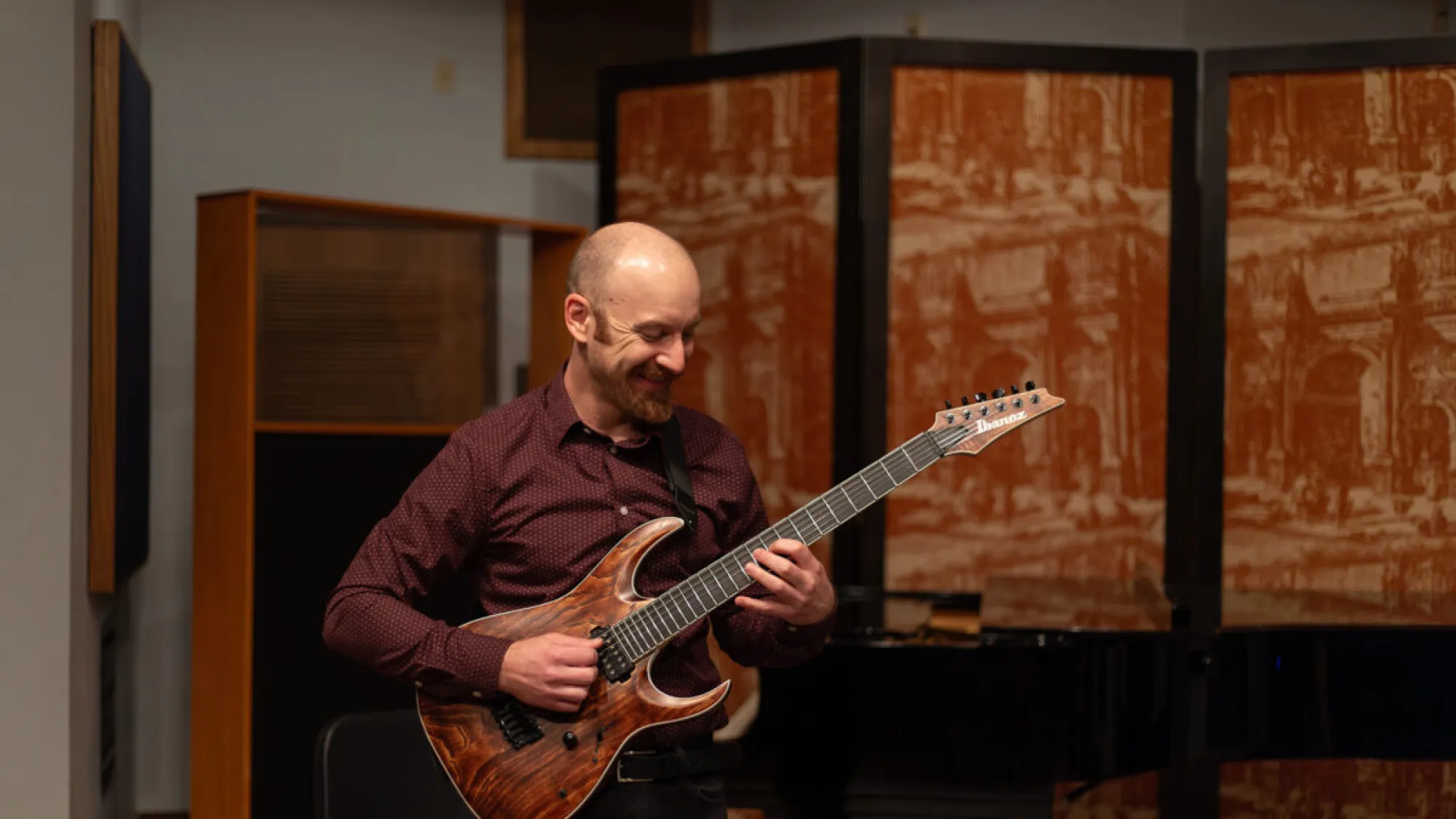
Russell Podgorsek playing guitar
The third movement draws inspiration from Ravel, emphasizing simplicity and directness, while the fourth and final movement launches into high-energy sixteenth-note syncopations. Despite its rollercoaster intensity, the concerto ends quietly. “It ends the same way a note from a steel drum ends,” Podgorsek said. “Lightly.”