



April 27, 2026

When people picture a university music theory class, they often imagine dense equations on a board, complex, almost mathematical attempts to break down a piece of music. These are courses that challenge even the strongest students. But in one sophomore theory class, something unexpected took place.
Associate Professor of Music Theory Chelsea Burns traded the usual lecture format for a live bluegrass jam session.
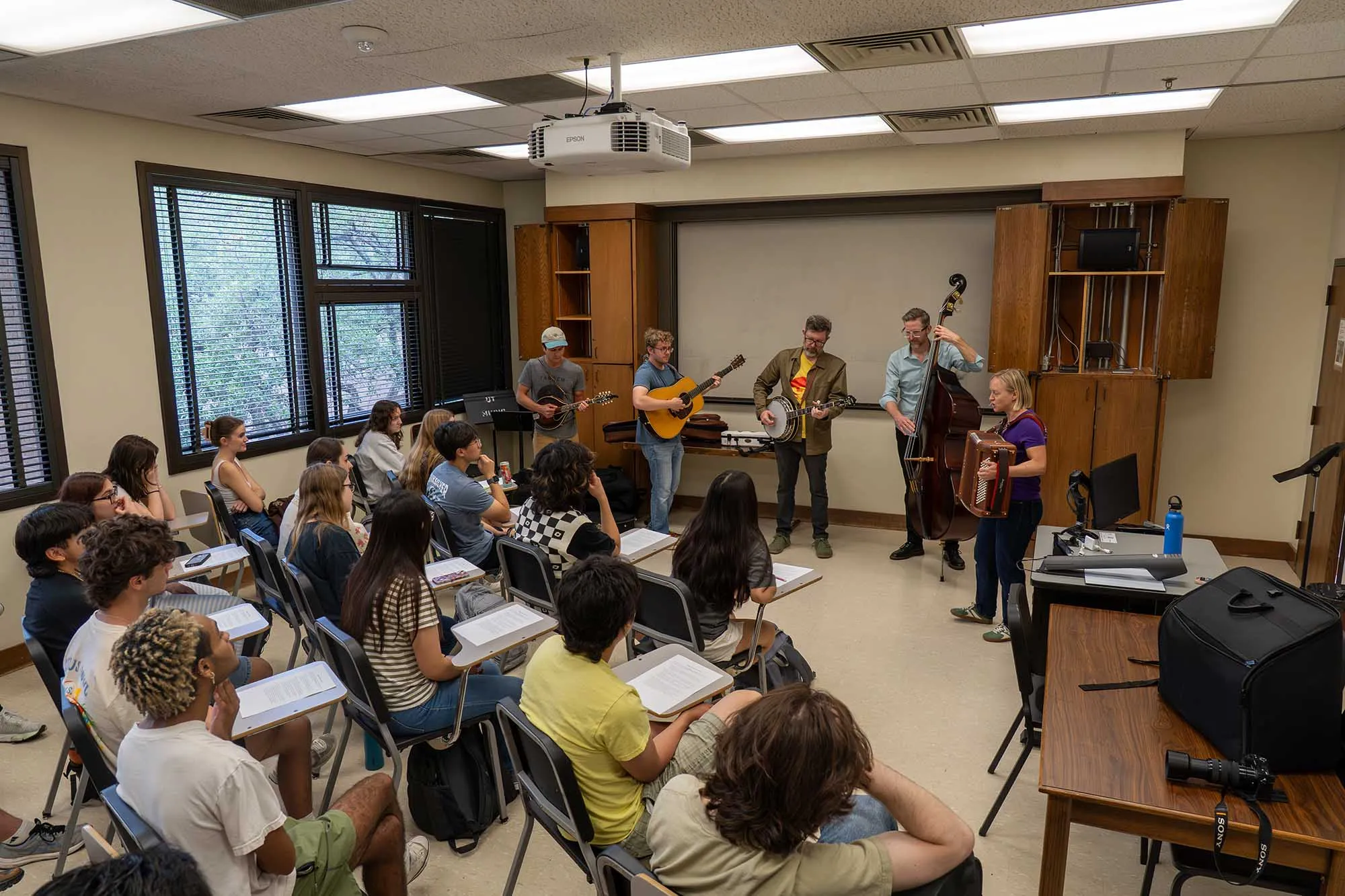
Associate Professor of Music Theory, Chelsea Burns, Demonstrating a Bluegrass Jam session
For those familiar with Austin’s local music scene, the idea might not be so surprising. Burns is a regular host of a Sunday afternoon bluegrass jam. What is surprising, however, is her instrument of choice. She doesn’t play guitar, banjo, bass, or mandolin; she plays the accordion, an instrument not typically associated with bluegrass.
That unusual pairing does have historical precedent. In the mid-1940s, Wilene “Sally Ann” Forrester played accordion with Bill Monroe and his Blue Grass Boys, an anomaly not only because of her instrument, but also because she was a woman in a band that was otherwise entirely male. Her presence was groundbreaking at a time when bluegrass was just beginning to take shape. After she retired, the accordion largely disappeared from the genre.
That history is not lost on Burns, who sees herself navigating a similar space. “I think about how I want to fit into a genre that is very prescribed,” she said. “I try not to intrude, and I try to fit in with the texture. Sometimes I play a role that is similar to the mandolin, sometimes I am playing a role that is similar to the fiddle.”
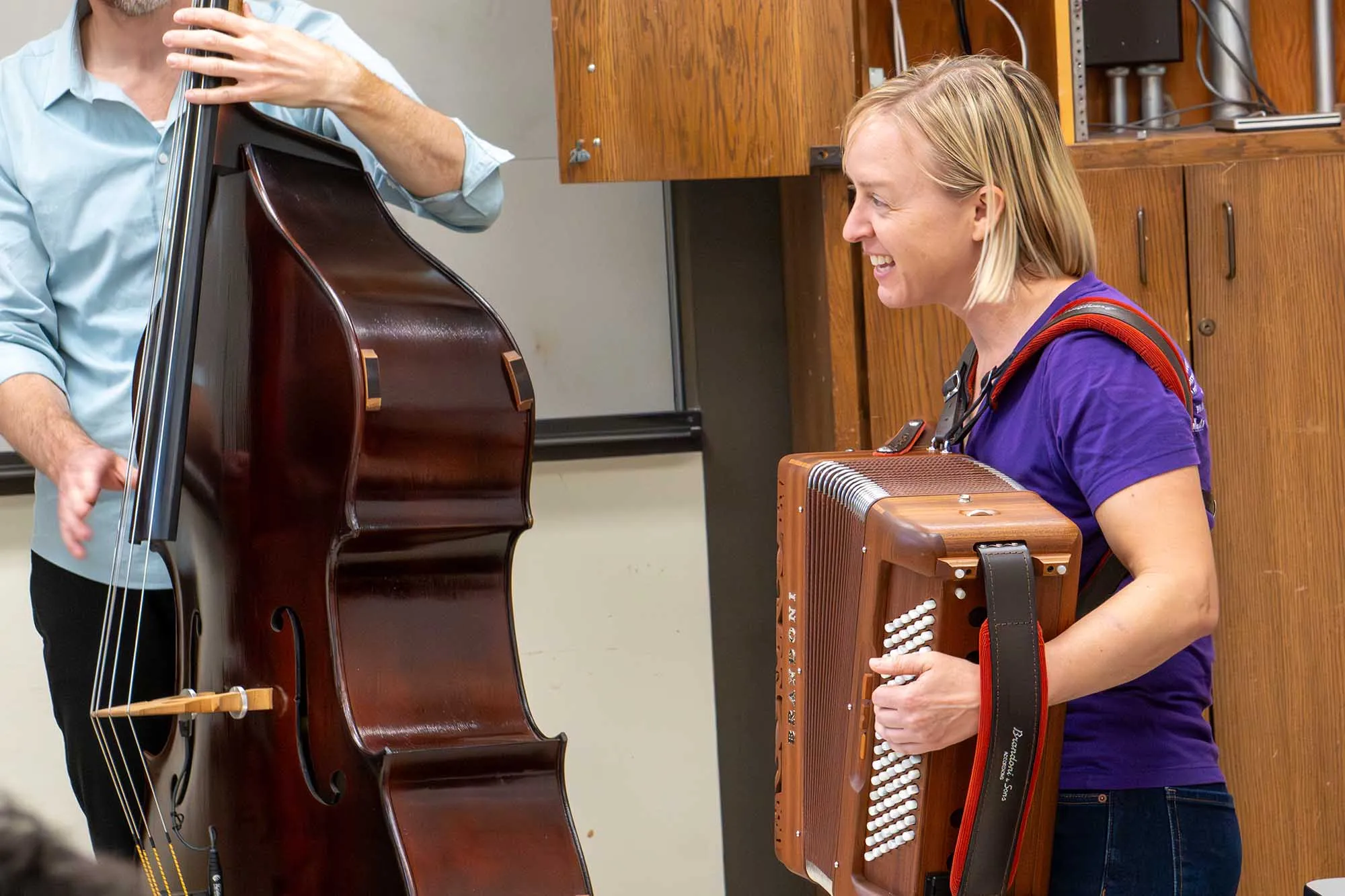
Associate Professor of Music Theory, Chelsea Burns taking a solo.
That perspective mirrors the experience of her students, many of whom come from a classical background and are encountering bluegrass for the first time.
To bring that experience into the classroom, Burns assembled a group of musicians: Kyle Kline on bass, Ken Powers on mandolin, Jon Lundbom on banjo, Christopher Cheek on guitar, and herself on accordion. Despite their expertise, they were not a pre-formed band. In fact, Burns noted, “Some of them had never met each other before that day.”
That was intentional.
“I wanted the students to see how you negotiate playing together when you're not a band, you have not arranged a bunch of stuff, and maybe not everyone knows all the tunes or songs,” Burns said. The goal was to expose students to the spontaneity of a true jam session, musicians listening, reacting, and creating in real time.
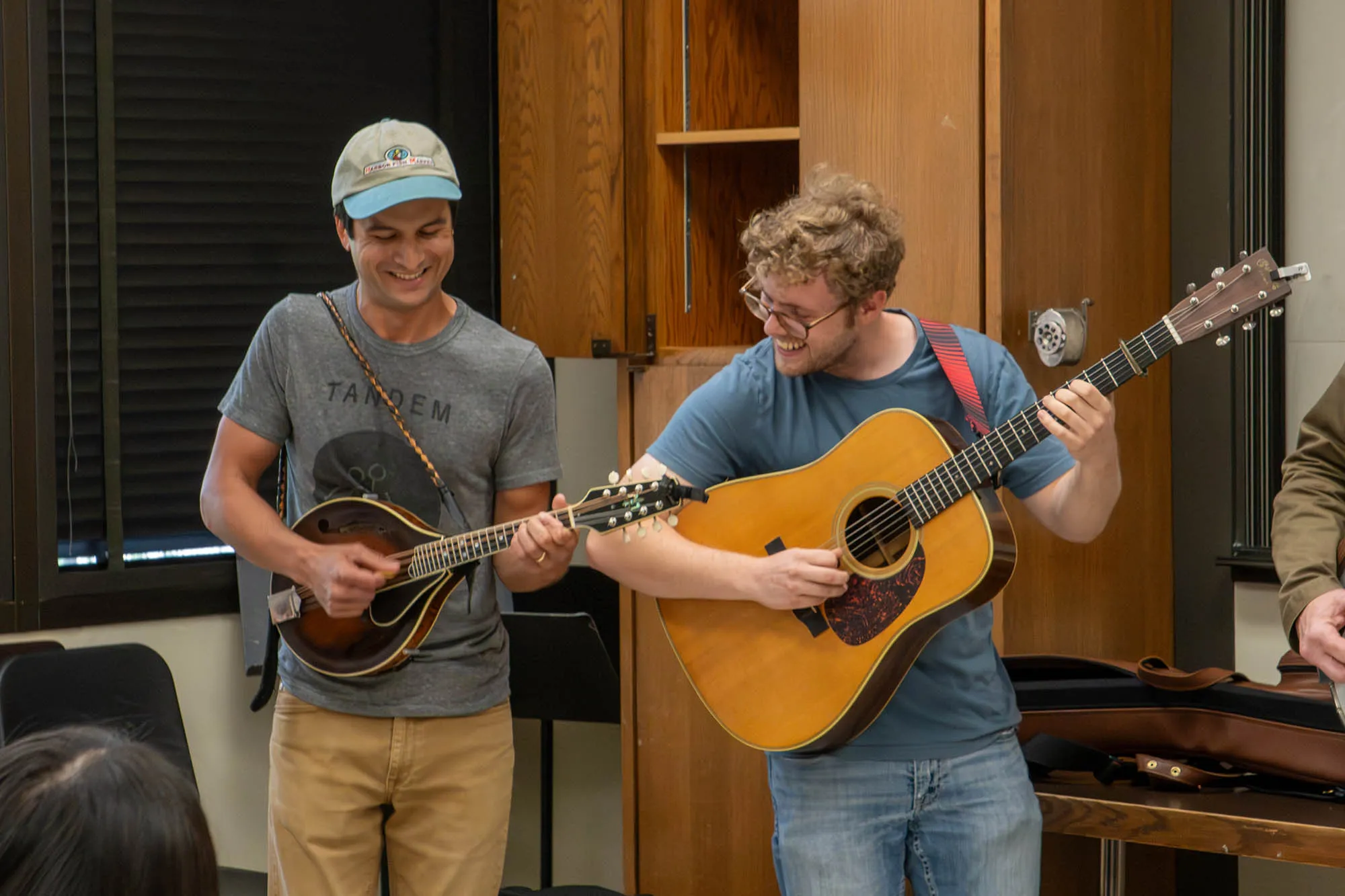
Mandolinist Ken Powers and guitarist Christopher Cheek try to figure out a song on the fly and enjoy the challenge.
“I wanted the students to see what was happening and what to look for in the group so they could learn to understand some jam dynamics,” she added, emphasizing that those dynamics are “Socially as well as musically.”
For students steeped in classical training, the experience highlighted just how different musical priorities can be across genres. According to Burns, there is little direct overlap. “That is why I wanted them to see how the things that your paying attention to as a classical musician might not be the same things your paying attention to as a bluegrass musician.”
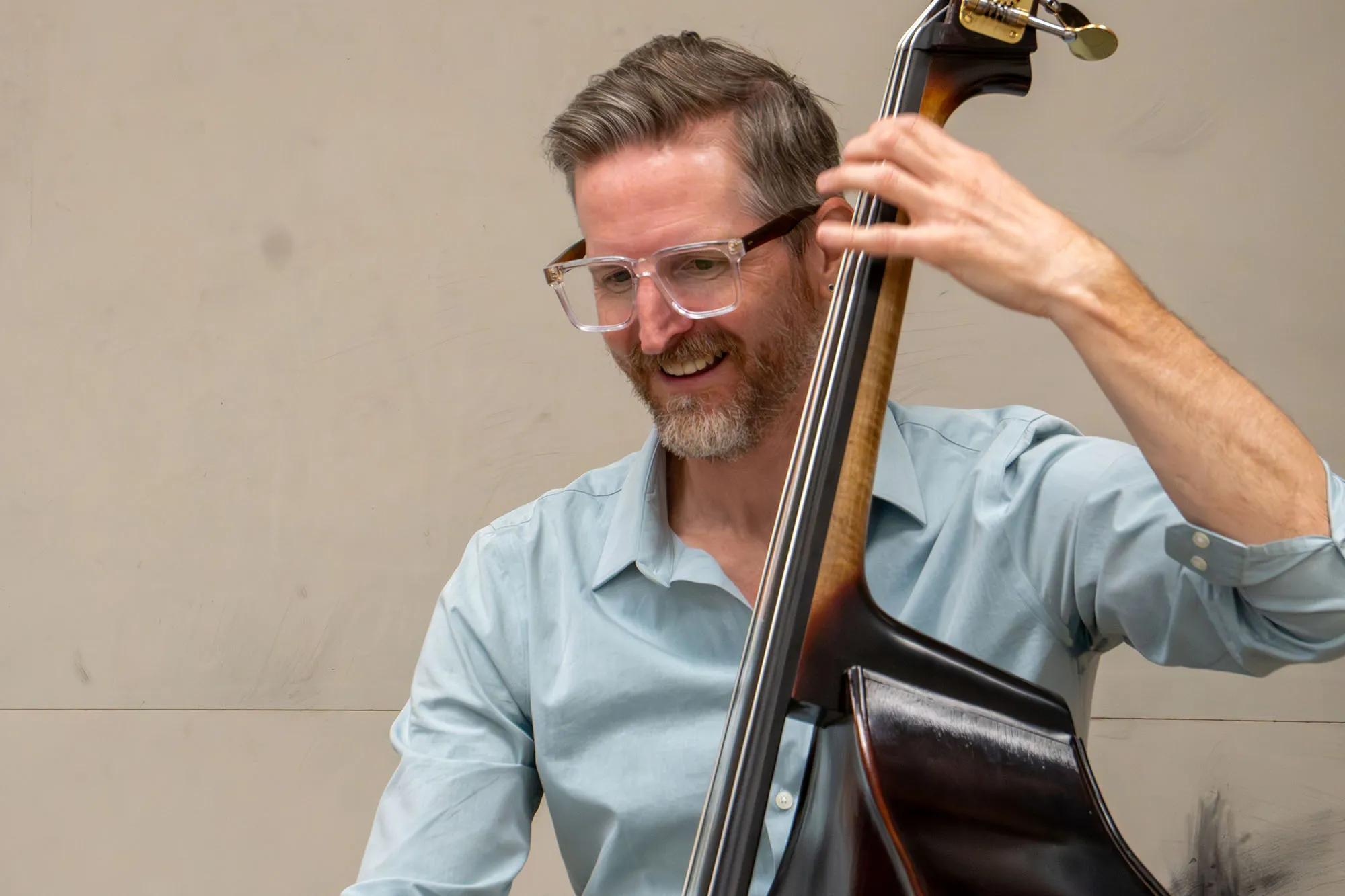
Bassist Kyle Kline
During the session, students were especially curious about the similarities between jazz and bluegrass. Musicians explained that while both rely heavily on improvisation, bluegrass follows its own structures and conventions, giving it a distinct sound.
One key element of bluegrass, they noted, is the importance of weaving the melody into improvised solos. Because many songs share similar chord progressions, maintaining a connection to the melody helps listeners stay oriented. Without it, a string of solos can blur together, making it difficult to recognize the song when the group returns to the chorus.
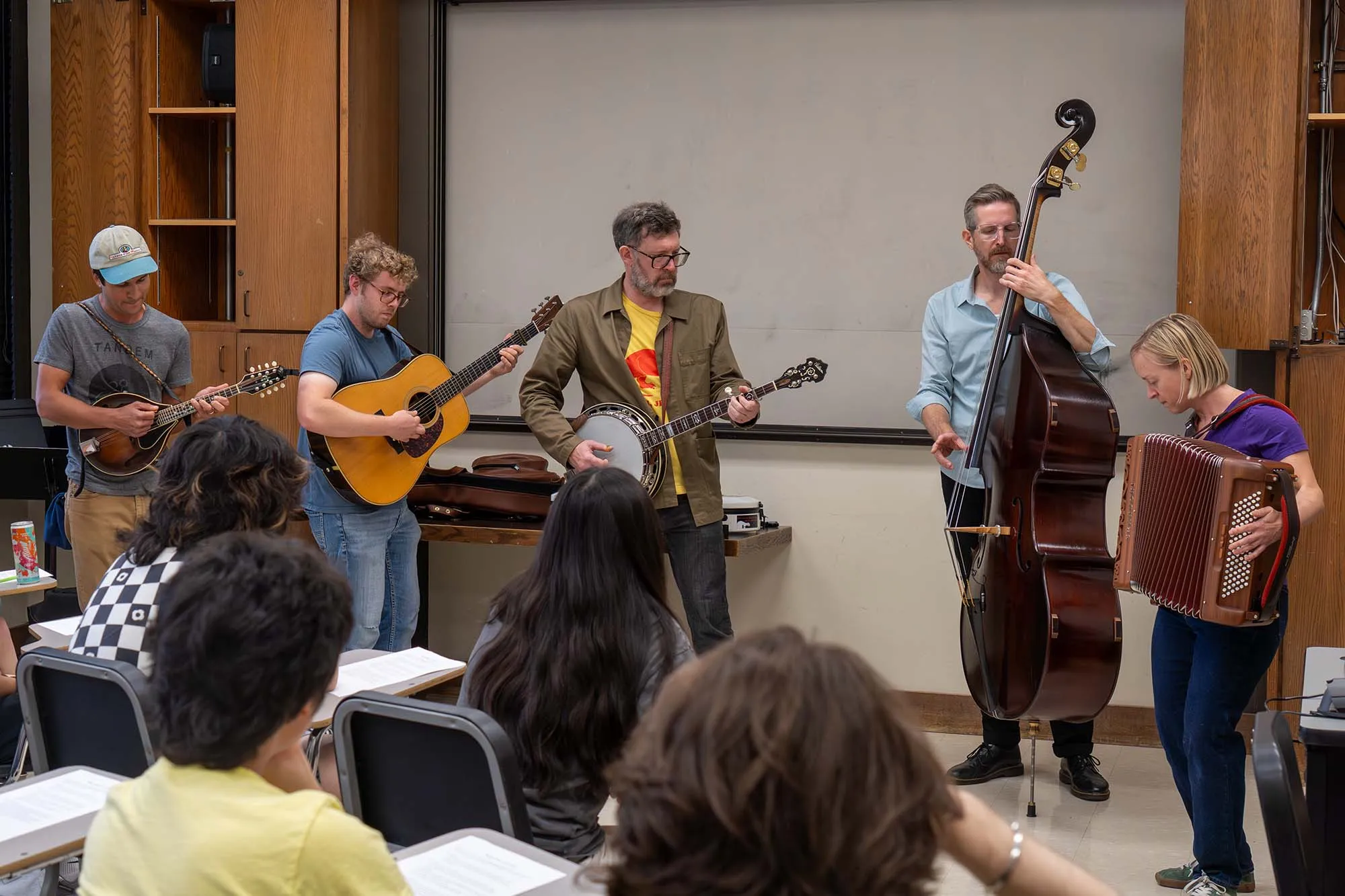
The band members use eye contact to let Chelsea Burns know to take a solo
In a classroom usually defined by analysis and precision, the jam session offered something different: a lesson in listening, collaboration, and the unpredictable art of making music in the moment.