




This concert will last about 90 minutes with one intermission.
Please silence your electronic devices.
Photography, video, or recording of any part of this performance is prohibited
Program
Franz Schubert
Quartettsatz, D. 703
Caroline Shaw
Entr'acte
Anton Webern
Langsamer Satz
intermission
Antonín Dvořák
String Quartet No. 12 in F Major, op. 96, American
Allegro ma non troppo
Lento
Molto vivace
Finale. Vivace ma non troppo
About the Program
Program notes by Mark Bilyeu
Franz Schubert
Quartettsatz, D. 703
Born January 31, 1797, in Vienna
Died November 19, 1828, in Vienna
Composed 1820
Premiered March 1, 1867
10 minutes
Just weeks after one of those famous “Schubertiade” house parties hosted by Franz Schubert’s friend Ignaz von Sonnleithner, a 23-year-old Schubert set out to craft another string quartet. He had already written several, most in an 1816 teenage flurry, and this time (feeling perhaps emboldened by experience) chose the very Beethovian key of C minor. He finished the first movement in short order, but never composed its remaining movements (save 40-ish bars of a slow sketch). Four years later, Schubert returned to the genre, composing a triptych of quartets now known as his late string quartets, but never returning to that single movement of 1820. The unfinished work remained unpublished until 1870—over forty years after Schubert’s early death—and was heard only several years before that, thanks primarily to Johannes Brahms.
Caroline Shaw
Entr’acte
Born August 1, 1982
Composed 2011
Premiered April 2011, Brentano Quartet at Princeton University
11 minutes
Caroline Shaw is a composer, vocalist, producer, violinist, improviser, and teacher who prefers to identify simply as a musician. The youngest recipient of the Pulitzer Prize in music in 2013 for her choral work Partita for 8 Voices, she is also the recipient of numerous Grammy Awards, for her work as a vocalist with Roomful of Teeth, performances with Sō Percussion, and her collaborations with the Attacca Quartet, including the 2020 Grammy-winning album “Orange,” which featured her 2011 work “Entr’acte.” According to Shaw, the work was inspired by a performance of Haydn’s string quartet op. 77 no. 1, especially the minuet, with its “spare and soulful shift to the D-flat major trio.” She writes that her work “is structured like a minuet and trio, riffing on that classical form but taking it a little further. I love the way some music (like the minuets of op. 77) suddenly takes you to the other side of Alice’s looking glass, in a kind of absurd, subtle, technicolor transition.”
Anton Webern
Langsamer Satz
Born December 3, 1883, Vienna, Austria
Died September 15, 1945, Mittersill, Austria
Composed June, 1905
Premiered May 27, 1962, University of Washington String Quartet, Seattle, WA
9 minutes
In 1905, a twenty-one year old Anton Webern was in love. "To walk forever like this among the flowers, with my dearest one beside me, to feel oneself so entirely at one with the Universe, without care, free as the lark in the sky above—Oh what splendor...when night fell (after the rain) the sky shed bitter tears but I wandered with her along a road," he wrote in his diary after a hike with Wilhelmine Mörtl, his newly-found muse who was also his cousin. Langsamer Satz (“slow movement”) offers a snapshot into the luxurious Romanticism of Webern before his studies with Arnold Schoenberg radicalized him into the seminal Serialist of his adulthood. The work, one of Webern’s longest, unfolds in four sections, with the fourth serving as a recap to the opening, reminiscent of his predecessors Brahms and Strauss. Webern saw the quartet as a student work (it would take him another three years before assigning opus numbers to his scores), and it was never given a public premiere. Sixty years later, in 1960, Webern scholars Hans and Rosaleen Moldenhauer discovered the work in an Austrian attic. When the scholars moved to Seattle, the city became the epicenter for all things Webern, thanks in large part to the international Webern Festival held between 1962-1978, which hosted the world premiere of Langsamer Satz to launch its inaugural festival.
Antonín Dvořák
String Quartet No. 12 in F Major, op. 96, American
Born September 8, 1841 Nelahozeves, Bohemia
Died May 1, 1904, Bohemia
Composed Summer, 1893
Premiered January 1, 1894, Kneisel Quartet, Boston, MA
25 minutes
"I have been on vacation since 3 June here in the Czech village of Spillville and I won't be returning to New York until the latter half of September,” wrote Antonín Dvořák in the summer of 1893. “The children arrived safely from Europe and we're all happy together. We like it very much here and, thank God, I am working hard and I'm healthy and in good spirits." A year before, Dvořák had uprooted his life to take the helm at the National Conservatory in New York City as its director, and upon the invitation of the fellow Czech violinist Josef Jan Korařík, made the pilgrimage to the Czech enclave of Spillville, Iowa to spend his first summer vacation. It was there in Spillville where Dvořák penned his ninth symphony he titled From the New World, and shortly after, began work on his twelfth string quartet, now known as the “American.” As he wrote in the program of the symphony’s London premiere, "As to my opinion I think that the influence of this country (it means the folk songs as are Negro, Indian, Irish, etc.) is to be seen, and that this and all other works (written in America) differ very much from my other works as well as in couleur as in character.” While the use of Negro Spiritual is undoubted in the symphony—Harry T. Burleigh would often sing these Spirituals to the composer, who would notate them down—the direct quotations of any such songs in the quartet are elusive at best. The use of the pentatonic scale (that is, a scale composed of five notes) is prominent, but not unique to American folk music. Listen for it in the first movement’s opening theme played by the viola, the opening melody of the second movement, and the finale’s primary theme. The second movement includes a high-pitched bird call that drove Dvořák nuts: the red-eyed vireo, a uniquely American songbird. The work was premiered privately in Spillville with Dvořák and Korařík as the violinists, and given its first public outing on New Year’s Day, 1984. Its New York premiere came just two weeks later, in which a reviewer wrote "there is none of the soaring or the yearning of the mighty Beethoven," yet noted the work contained "the spirit of eternal sunshine" which was "the soul of Mozart's music." Later, Dvořák reflected on his own work, writing, "When I wrote this quartet in the Czech community of Spillville in 1893, I wanted to write something for once that was very melodious and straightforward, and dear Papa Haydn kept appearing before my eyes, and that is why it all turned out so simply. And it's good that it did.”
About the Artists
Miró Quartet
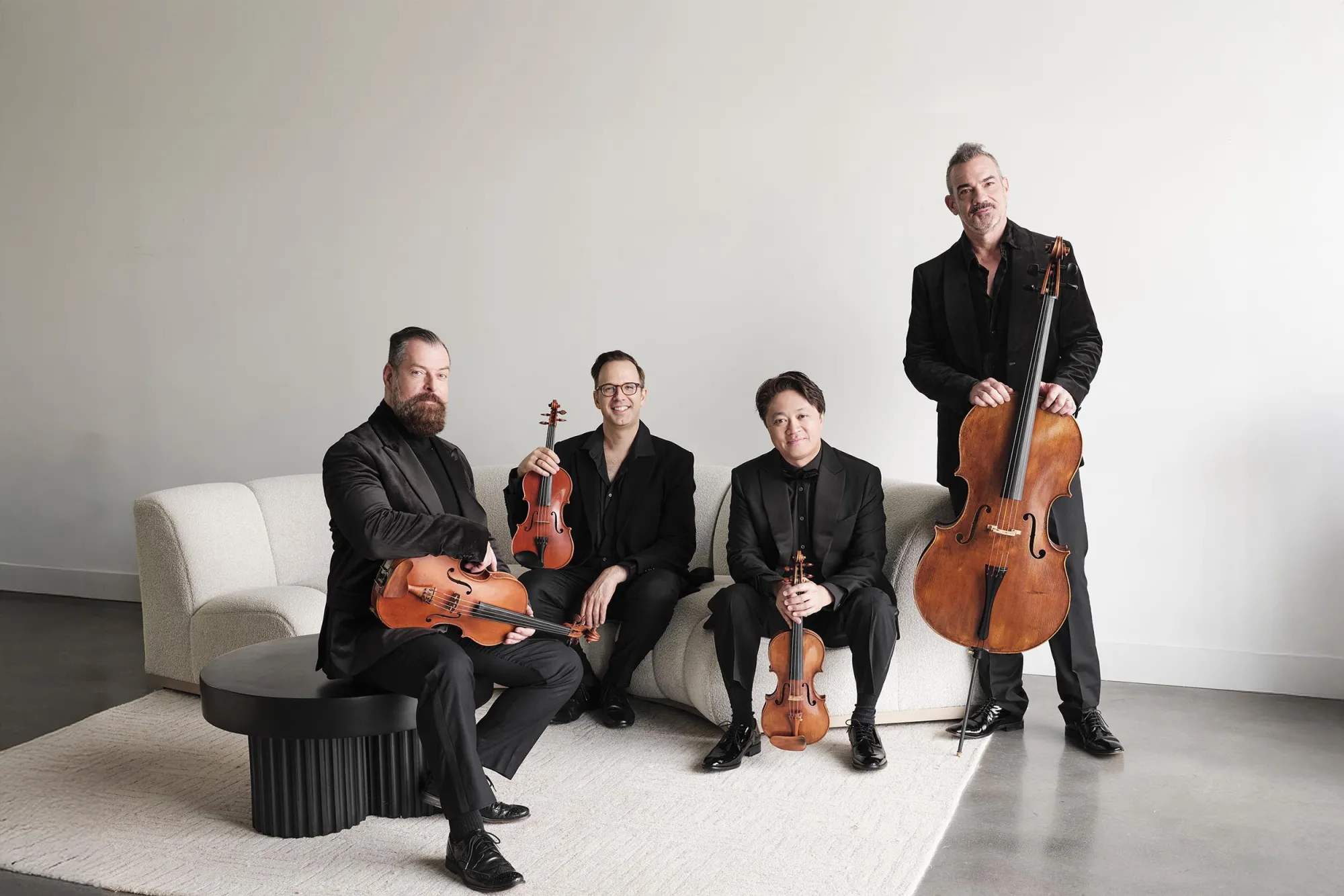
The Miró Quartet is one of America’s most celebrated string quartets, praised as "furiously committed" by The New Yorker and recognized for its "exceptional tonal focus and interpretive intensity" by the Cleveland Plain Dealer. Marking its 30th anniversary in 2025, the quartet has performed on the world's most prestigious concert stages, earning accolades from critics and audiences alike. Based in Austin, TX, and thriving on the area’s storied music scene, the quartet takes pride in finding new ways to communicate with audiences of all backgrounds while cultivating the longstanding tradition of chamber music. Since 2003, Miró has served as the quartet-in-residence at The University of Texas at Austin Sarah and Ernest Butler School of Music.
The Miró Quartet’s newest album, an acclaimed recording of Ginastera’s complete String Quartets, was released on PENTATONE in July 2025. Among its many previous recordings for a variety of global labels, the quartet was nominated for a 2025 GRAMMY® Award for Best Chamber Music/Small Ensemble Performance for its album Home (PENTATONE, 2024) featuring two new commissions by Kevin Puts and Caroline Shaw, as well as works by George Walker and Samuel Barber. It was also nominated for a 2024 GRAMMY® Award for its album House of Belonging, created in collaboration with Austin-based choral group Conspirare. The quartet’s recent and upcoming projects include Here on Earth with pianist Lara Downes, the premiere of a new version of Kevin Puts’ Credo, and collaborations with composers Steven Banks, Tamar-Kali, and Gabriel Kahane, as well as soprano Karen Slack and the Isadore Quartet.
The Miró Quartet took its name and its inspiration from the Spanish artist Joan Miró, whose Surrealist works—with subject matter drawn from the realm of memory, dreams, and imaginative fantasy—are some of the most groundbreaking, influential, and admired of the 20th century. Visit miroquartet.com for more information.
Upcoming Events
EBONEE THOMAS, flute & COLETTE VALENTINE, piano
Monday, September 14, 7:30 p.m.
Bates Recital Hall
SYMPHONY ORCHESTRA
with Laura Downes, piano & Donnie Ray Albert, baritone
Friday, September 18, 7:30 p.m.
Bates Recital Hall
MIRÓ QUARTET
Saturday, November 7, 7:30 p.m.
Bates Recital Hall
MIRÓ QUARTET
with Mallory McHenry, harp & Joel Braun, double bass
Friday, January 29, 7:30 p.m.
Bates Recital Hall
Event Details
$10 – 20
All University of Texas at Austin students are allowed one free ticket as long as they are available. Student tickets must be picked up at the Box Office with valid student I.D. Seating is unassigned.
If you are a patron with specific seating needs, please email tickets@mail.music.utexas.edu and we will reserve ADA seating for you.