


Daniel Ching, violin
William Fedkenheuer, violin
John Largess, viola
Joshua Gindele, cello
This concert will last about 90 minutes with one intermission.
Please silence your electronic devices.
Photography, video, or recording of any part of this performance is prohibited
Program
Franz Joseph Haydn
String Quartet in D Major, op. 71, no. 2, Hob. III: 70
Adagio—Allegro
Adagio cantabile
Menuetto: Allegro
Finale: Allegretto
Kevin Puts
Home
intermission
Giacomo Puccini
Crisantemi
Alberto Ginastera
String Quartet No. 2, op. 26
Allegro rustico
Adagio angoscioso
Presto magico
Libero e rapsodico
Furioso
About the Program
Program notes by Mark Bilyeu
Franz Joseph Haydn
String Quartet in D Major, op. 71, no. 2, Hob. III: 70
Born March 31, 1732, Rohrau, Austria
Died May 31, 1809, Vienna, Austria
Composed 1793
20 minutes
In 1790, after 30 years of working in relative isolation as the Kapellmeister for the Esterhazy estate, the man who would come to be known as “Papa Haydn,” left for London, with a generous pension in his bank account and a new-born sense of freedom in his music. Although revered throughout Europe as a leading musical figure, the majority of his output had been intended for private gatherings; for the parlors of the wealthy, and the audiences of the few. During his first visit to London in 1790, the violinist-impresario Johann Peter Salomon presented the six string quartets of Haydn, known as Op. 64, and it was Salomon who premiered the set of quartets from which this D major work is taken, the Op. 71, No, 2. This opus – three quartets all together – is believed to be the first set Hayn wrote which was intended to be heard by public audiences in public spaces. All three included a new component: a sort of opening fanfare, which plays a much more important role than simply announcing the start of the work. It offers an initial statement of thematic material which follows. Be also on the lookout for the third movement’s minuet, in which he cranks up the tempo from his usual allegretto to a full-on allegro. The set is often referred to as the “Apponyi Quartets,” dedicated to Count Anton George Apponyi, a man with a great interest in the music of Bach and Handel, and who, just a few years later, would write to Beethoven, inviting him to write his first quartet.
Kevin Puts
Home
Born January 3, 1972, St. Louis, MO
Composed 2019
Premiered August 15, 2019, Miró Quartet
17 minutes
“The refugee crisis in Europe, documented in recent media by horrific stories and photos of displaced families, led me to compose ‘Home,’” said the Pulitzer Prize-winning composer Kevn Puts. In the interview with Chamber Music Tulsa, he said “[It] is a reality I have never faced. I thought I could never express that feeling because it’s not something that I’ve experienced, but perhaps I could do something that is abstractly about the notion of feeling homeless or unmoored or like there is no ground under you, and the search for something stable and real.”
The work begins in what is essentially C Major, or with a tonal center of “C”, which I intended as a sonic representation of 'home' and one which is abandoned after the idyllic atmosphere of the work’s first several minutes in search of new and unfamiliar harmonic terrain. As is my way, I worked through the piece in a linear fashion, never certain what lay around each corner. My only hope was that I would find my way back to the musical idea heard at the opening, and that it would present itself in a way that suggested this material (or one’s perception of it) had been altered in some way by the journey the work represents."
Giacomo Puccini
Crisantemi
Born December 22, 1858
Died November 29, 1924
Composed 1890
6 minutes
Crisantemi was written on a single night, according to a letter dated February 6, 1890, from composer Giacomo Puccini to his brother. Puccini had just received the news of the sudden death of Amadeo di Savoia, the Duke of Savoy, and was moved to write an elegy for his friend. Known as the leading composer of large-scale Italian opera (the composer himself believed his talents lay “only in the theater”), small-scale works such as Crisantemi — “Chrysanthemums” in English — stand as outliers in the composer’s canon. Yet, Puccini re-used both themes of this elegiac miniature in his opera Manon Lescautjust three years later. Although this stand-alone work for quartet became very popular as a work for string orchestra (much like Samuel Barber’s Adagio for Strings), it is heard on this program in its original quartet configuration, which premiered just days after it was written.
Alberto Ginastera
String Quartet No. 2, op. 26
Born April 11, 1916, Buenos Aires, Argentina
Died June 25, 1983, Geneva Switzerland
Composed 1958
Premiered April 19, 1958, The Juilliard String Quartet, Washington, D.C.
26 minutes
It is rare for an artist to publicly name their artistic phases during their careers; this is usually a task for musicologists and historians. For the Argentine composer Alberto Ginastera, however, the dividing lines of his work were clear, and so, he named them himself: Objective Nationalism (1934 –1948), Subjective Nationalism (1948 –1958), and Neo-Expressionism (1958 –1983). The first two phases were driven by the landscape of his homeland of Argentina — its sights, sounds, and traditional folk elements — and his third and final phase moved towards the experimental techniques being used by his European colleagues, including surrealism and dodecaphony. He crafted his second string quartet on the cusp of this final phase, although still heavily inspired by the Argentine dance rhythms he incorporated throughout his career. Commissioned by the Elizabeth Sprague Coolidge Foundation for their first Inter-American Music Festival in Washington, D.C., the work was premiered by the Juilliard String Quartet and was an immediate success. The quartet’s structure of five palindromic movements is a nod to the six quartets of Béla Bartók, who was a large influence on Ginastera (the nod is so clear that some jokingly refer to this quartet as “Bartok’s Seventh”). The first movement opens with an in-your-face allegro, filled with insistent repeated notes that gives you the impression we have just entered a ride that we are not in control of. The second movement opens with a tightly-wound viola solo which builds towards a quadruple-forte climax. The middle movement —and the center of the palindrome —is a mad dash of extended techniques and creepy night sounds. The fourth is a set of free variations introduced by the violin, before the final movement sees a return to the rhythmic mania of the first. Ginastera cranks up the freneticism in this closing movement by dividing the repeated notes into four per beat (rather than the opening’s three per beat), ramping up the intensity barrelling towards this quartet’s wildly decisive conclusion.
About the Artists
Miró Quartet
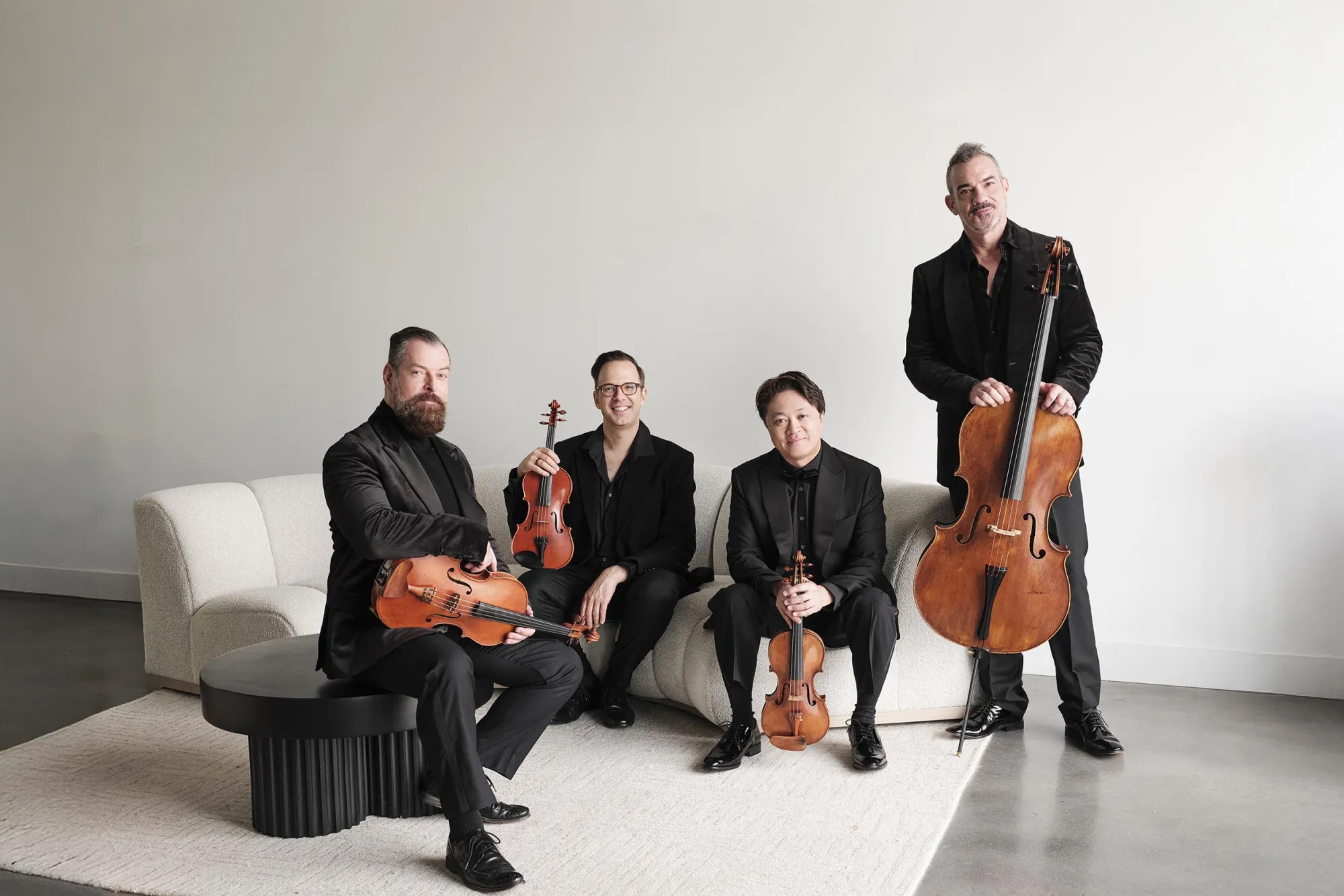
The Miró Quartet is one of America’s most celebrated string quartets, praised as "furiously committed" by The New Yorker and recognized for its "exceptional tonal focus and interpretive intensity" by the Cleveland Plain Dealer. Marking its 30th anniversary in 2025, the quartet has performed on the world's most prestigious concert stages, earning accolades from critics and audiences alike. Based in Austin, TX, and thriving on the area’s storied music scene, the quartet takes pride in finding new ways to communicate with audiences of all backgrounds while cultivating the longstanding tradition of chamber music. Since 2003, Miró has served as the quartet-in-residence at The University of Texas at Austin Sarah and Ernest Butler School of Music.
The Miró Quartet’s newest album, an acclaimed recording of Ginastera’s complete String Quartets, was released on PENTATONE in July 2025. Among its many previous recordings for a variety of global labels, the quartet was nominated for a 2025 GRAMMY® Award for Best Chamber Music/Small Ensemble Performance for its album Home (PENTATONE, 2024) featuring two new commissions by Kevin Puts and Caroline Shaw, as well as works by George Walker and Samuel Barber. It was also nominated for a 2024 GRAMMY® Award for its album House of Belonging, created in collaboration with Austin-based choral group Conspirare. The quartet’s recent and upcoming projects include Here on Earth with pianist Lara Downes, the premiere of a new version of Kevin Puts’ Credo, and collaborations with composers Steven Banks, Tamar-Kali, and Gabriel Kahane, as well as soprano Karen Slack and the Isadore Quartet.
The Miró Quartet took its name and its inspiration from the Spanish artist Joan Miró, whose Surrealist works—with subject matter drawn from the realm of memory, dreams, and imaginative fantasy—are some of the most groundbreaking, influential, and admired of the 20th century. Visit miroquartet.com for more information.
Upcoming Events

Ring in the season with the Butler School’s annual Holiday Concert with music for everyone to enjoy. You’ll hear traditional holiday carols and winter favorites across many genres, including excerpts from Bach’s Magnificat, jazz standards like “I’ll Be Home for Christmas,” and Hanukkah songs from Sephardic and Mizrahi Jewish traditions.
Featuring
Chamber Orchestra
Concert Chorale
University Chorus
Longhorn Singers
Bereket Middle Eastern Ensemble
Soha Quartet
Horn Choir
Bassoon Ensemble
Musical Theatre Workshop
Jazz Combos
Gregory Eaton, organ
Saturday, December 5, 7:30 p.m.
Sunday ,December 6, 4:00 p.m.
Bates Recital Hall
MIRÓ QUARTET
with Mallory McHenry, harp & Joel Braun, double bass
Friday, January 29, 7:30 p.m.
Bates Recital Hall
Symphony Orchestra
Wednesday, February 10, 7:30 p.m.
Bates Recital Hall
SANDY YAMAMOTO, violin & ANTON NEL, piano
Monday, February 22, 7:30 p.m.
Bates Recital Hall
CHAMBER ORCHESTRA
Selections from Le Faucon
Free Admission
Friday, February 26, 7:30 p.m.
Bates Recital Hall
SYMPHONY ORCHESTRA
with Leah Crocetto, soprano & Emil Khudyev, clarinet
Friday, April 2, 7:30 p.m.
Bates Recital Hall
Event Details
$10 – 20
All University of Texas at Austin students are allowed one free ticket as long as they are available. Student tickets must be picked up at the Box Office with valid student I.D. Seating is unassigned.
If you are a patron with specific seating needs, please email tickets@mail.music.utexas.edu and we will reserve ADA seating for you.