


Jarred Kennedy, conductor
Jonathan Thoma, conductor
Chris Tran, conductor
This concert will last about one hour without intermission.
Please silence your electronic devices.
Photography, video, or recording of any part of this performance is prohibited
Program
Hamish MacCunn
The Land of the Mountain and the Flood
Jarred Kennedy, conductor
Antonín Dvořák
Symphony No. 6 in D Major, op. 60
Allegro non tanto
Adagio
Jonathan Thoma, conductor
Scherzo (Furiant). Presto
Finale. Allegro con spirito
Chris Tran, conductor
About the Program
Program notes by Mark Bilyeu
Hamish MacCunn
The Land of the Mountain and the Flood
Born March 22, 1868, Greenock, Scotland
Died August 2, 1916, London, England
Composed 1887
Premiered November 5, 1887, Crystal Palace, London, England
9 minutes
Hamish MacCunn was born in Greenock, Scotland in the west central Lowlands of Scotland. At the age of eight, his parents took him to London to attend a full season of classes by the maverick German conductor August Mann at the Crystal Palace. At the age of fifteen, MacCunn won a scholarship to return to London and study at the newly established Royal College of Music. There, he studied the piano, viola, and composition with Hubert Parry and Charles Villiers Stanford. In 1886, MacCunn gave up his scholarship in what we might now call a “diva moment,” and the following year composed “The Land of Mountain and Flood,” which (forgive the geographical pun:) put the composer on the map. The work premiered in the same London venue MacCunn had studied music—he Crystal Palace—and The Musical Times review of the premiere said “The work—which is spirited and bold in conception and brilliantly scored—was finely played and enthusiastically received." George Bernard Shaw, possibly aware of MacCunn’s recent separation from his mentors, wrote “Mr MacCunn's Land of the Mountain and the Flood, a charming Scotch overture that carries you over the hills and far away, was much applauded. I object, by the bye, to the "working out" section, which Mr MacCunn would never have written if his tutors had not put it into his head. I know a lady who keeps a typewriting establishment. Under my advice she is completing arrangements for supplying middle sections and recapitulations for overtures and symphonies at twopence a bar, on being supplied with the first section and coda.” The work would remain MacCunn’s most successful, and is still heard in concert halls today.
Antonín Dvořák
Symphony No. 6 in D Major, op. 60
Born September 8, 1841 Nelahozeves, Bohemia
Died May 1, 1904, Bohemia
Composed 1880
Premiered March 25, 1881. Prague: Czech Philharmonic Orchestra, Adolf Čech, conductor
40 minutes
In 1897, the Vienna Philharmonic performed the Czech composer Antonin Dvořáks Third Slavonic Rhapsody to great acclaim. In a letter, Dvorak recounted the event:
“ was present at the performance of my Third Rhapsody, which was liked very much...I sat next to Brahms by the organ in the orchestra, and Richter [the conductor] drew me out... I immediately won the sympathy of the whole orchestra and that out of all the new works they tried over, and Richter said there were sixty of them, they liked my Rhapsody best of all. Richter kissed me on the spot and told me he was very glad to know me...
This response from such an influential organization encouraged the thirty-five year old composer to dedicate his first large-scale symphonic work to Richter and his orchestra. The premiere, however, slated for the following year, was delayed several times by Richter himself. A frustrated—and rather suspicious—Dvořák then brought his work to the Czech Philharmonic Orchestra, who premiered his first symphony (now known as Symphony No. 6). The composer’s suspicions were later confirmed: in Vienna’s increasingly Germanic-centric culture, the idea of performing two works by a Czech composer in such close succession was not acceptable to the members of the orchestra. In reality, the up-and-coming composer’s musical language was Germanic. His respect for Beethoven, Wagner, and Liszt was well-known, and his personal relationship with Brahms is documented in the letter above. And while this symphony does invoke the Czech folk song "Já mám koně", nearly everything else within the work speaks to German influences. It would take the Vienna Philharmonic nearly fifty years to perform this work, originally intended for them, but audiences elsewhere throughout Europe loved it. As the English critic Joseph Bennet wrote, “Dvořák’s success in England affords matter for much congratulation. We have from him that which is new and not mischievous…The more of Dvořák the better, therefore, and the indications are that a good deal of him awaits us.”
About the Artists
Jarred Kennedy
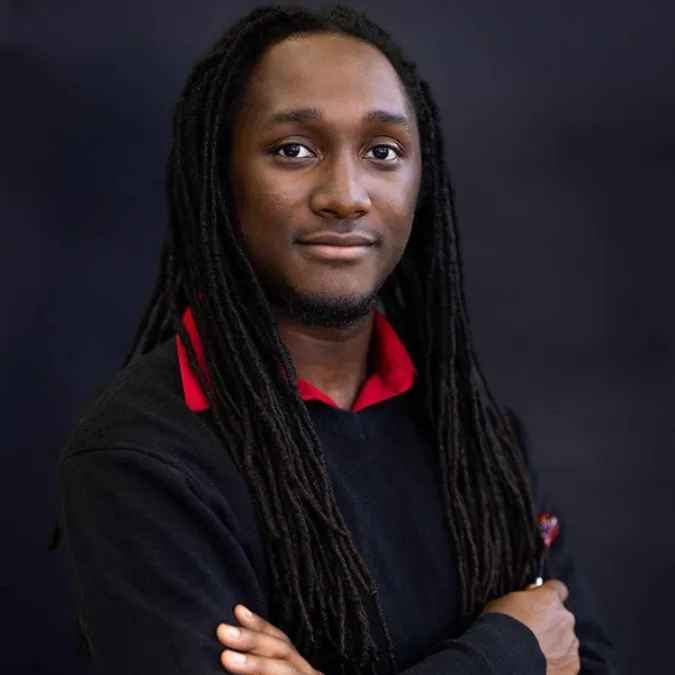
Jarred Kennedy is currently pursuing a doctorate in orchestral conducting at The University of Texas at Austin and serves as the assistant conductor fellow with the Reno Chamber Orchestra. He holds a master’s degree from Louisiana State University and a bachelor's degree in Music Education from Stephen F. Austin State University. As a guest conductor, Jarred has collaborated with the Austin Civic Orchestra, Renova Chamber Orchestra, and ensembles at the National Music Festival, as well as the LSU Symphony Orchestras. His recent professional distinctions include serving as the assistant conductor for the Rapides Symphony Orchestra and participating as a fellow of the Reynolds Conducting Institute at the 2025 Midwest Clinic.
Jonathan Thoma
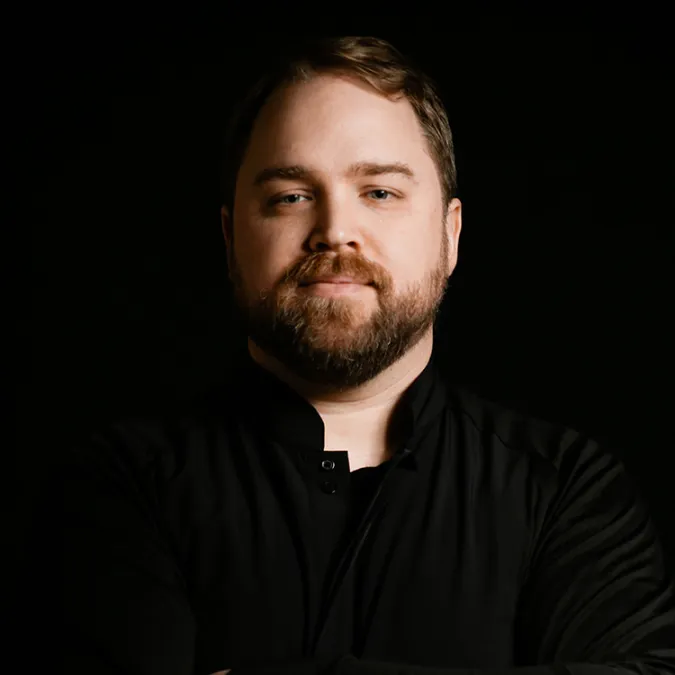
Jonathan Thoma is a first-year D.M.A. student in orchestral conducting, studying at The University of Texas at Austin with Farkhad Khudyev. He is an assistant conductor with the University of Texas Symphony and Chamber Orchestras and is a co-director of the University Orchestra.Born and raised in Fort Dodge, IA, Jonathan earned his bachelor's in music education from Iowa State University. Upon graduation, he became an orchestra director in Muscatine, IA. During his tenure, the Muscatine High School orchestras became the largest high school string program in the state of Iowa, and ensembles under his direction earned top ratings at state festivals. In 2024, Jonathan began working on his master's in orchestral conducting at Texas State University, studying with Jacob Harrison and Caroline Beatty. At Texas State, he guest conducted the Texas State Symphony, assisted with conducting classes, and was a founding director of the Texas State Camerata Orchestra. He graduated from Texas State University in 2026. He is blessed in life with his beautiful wife, Misha, and their kids, Gemma and Elliot.
Chris Tran

Chris Tran is co-director of The University of Texas University Orchestra, graduate teaching assistant for the University of Texas Orchestras, and is currently pursuing a doctor of musical arts in orchestral conducting with Farkhad Khudyev at The University of Texas at Austin. Mr. Tran has been an invited conductor at several masterclasses and workshops in Boulder, Los Angeles, Eugene, St. Andrews (Scotland), as well as the Cabrillo Festival of Contemporary Music with Cristian Măcelaru, Thomas Sleeper, and Leonard Slatkin, and the International Conducting Workshop and Festival with the late Larry Rachleff and Donald Schleicher. He has also worked with conductors Neil Thomson, Jeff Grogan, and Sian Edwards. Mr. Tran earned a master of music in orchestral conducting from the University of Colorado Boulder with Gary Lewis, and a bachelor of music in music education from Southern Methodist University. His conducting mentors include Nicholas Carthy and Paul Phillips. He studied violin with Charles Wetherbee, former concertmaster of the Boulder Philharmonic, and Diane Kitzman, former principal violin of the Dallas Symphony.
University Orchestra
Violin I
Avelyn Lee, concertmaster
Alexander Yu
Emily Tando
Brandon Mendoza
Jackson Belobrajdic
Thomas Feng
Quan Dau
Jessica Lin
Rudran Sathish
Peter Stone
Page Tan
Jia Chun
Michelle Chen
Jasmine Chou
Vivian Pang
Violin II
Kylie Hung, principal
Truman Sun
Lauren Heyde
Will Jia
Faizan Masroor
Mu Lan Feng
Joaquin Alvarez
Jailyn Barnuevo
Cole Mason
Matthew Taylor
Agustin Martinez
Ursula Weissfeld
Vedanth Hariharan
Yoobin Kim
Adam To
Gage Edwards
Mohini Bhave
Jacob Hanson
Viola
Rachel Su, principal
Leonardo Fazzini
Edward Visaya
Randy Guo
Tanav Raghavan
Amy Ning
Shota Sawada
Isaiah Kim
Zhenyi Song
Advika Harihar
Alex Yim
Ash Roberts
Cello
Kunal Manish, principal
Daniel Tepedino
Casey Chang
Aarya Patel
Edward Mou
Drew Warninghoff
Emile Meyrat
Angie Wang
Rei Iwahara
Mia Chang
Ricardo Chacon
Midori Osawa
Caden Ho
Douyi Liang
Sylvia Valdez
Double Bass
Aravind Shandilya, principal
Lucas Schleweis
Chloe Mamitag
Flute
Moriah Reeves
Ethan Sarwar1,2
Oboe
Noah Bihan1,2
Vibya Immedisetty
Clarinet
Jusun Chung2
Thomas Ingram-May
Kunal Katiyar1
Bassoon
Dale Munster
Gavin Remo
Owen Schaefer1,2
Horn
Ellie Howard1
Dhanush Jain2
Joshua Nicketta
Uri Reyes
Trumpet
Mishra, Shresha1,2
Wei, Aiden
Trombone
Jan Campos
Erick Galicia1,2
Bass Trombone
Hudson Pedrotti
Tuba
Chancellor Joseph
Timpani
Michael Rivera-Gonzalez
Percussion
Michael Rivera-Gonzalez, principal
Peyton Stephens
Principals
- MacCunn
- Dvořák
Upcoming Events

Ring in the season with the Butler School’s annual Holiday Concert with music for everyone to enjoy. You’ll hear traditional holiday carols and winter favorites across many genres, including excerpts from Bach’s Magnificat, jazz standards like “I’ll Be Home for Christmas,” and Hanukkah songs from Sephardic and Mizrahi Jewish traditions.
Featuring
Chamber Orchestra
Concert Chorale
University Chorus
Longhorn Singers
Bereket Middle Eastern Ensemble
Soha Quartet
Horn Choir
Bassoon Ensemble
Musical Theatre Workshop
Jazz Combos
Gregory Eaton, organ
Saturday, December 5, 7:30 p.m.
Sunday ,December 6, 4:00 p.m.
Bates Recital Hall
SYMPHONY ORCHESTRA
Wednesday, February 10, 7:30 p.m.
Bates Recital Hall
UNIVERSITY ORCHESTRA
Free Admission
Tuesday, February 23, 7:30 p.m.
Bates Recital Hall
CHAMBER ORCHESTRA
Selections from Le Faucon
Free Admission
Friday, February 26, 7:30 p.m.
Bates Recital Hall
SYMPHONY ORCHESTRA
with Leah Crocetto, soprano & Emil Khudyev, clarinet
Friday, April 2, 7:30 p.m.
Bates Recital Hall
UNIVERSITY ORCHESTRA
Free Admission
Tuesday, April 20, 7:30 p.m.
Bates Recital Hall
Event Details
Free admission