


Douglas Henderson, conductor
Jimmy Santos-Rivera, guest conductor
Alec Rodriguez, guest conductor
This concert will last about one hour without intermission.
Please silence your electronic devices.
Photography, video, or recording of any part of this performance is prohibited
Program
Nicole Piunno
Bright Shadow Fanfare
Roger Dickerson
Essay for Band
Donald Grantham
Circa 1600
Jimmy Santos-Rivera, conductor
Adam Schoenberg
Cool Cat
Alec Rodriguez, conductor
Paul Hindemith
Symphony in B-flat
Moderately Fast, with Vigor
Andante grazioso
Fugue
About the Program
Program notes by Mark Bilyeu
Nicole Piunno
Bright Shadow Fanfare
Born 1985
2021
Premiered April 9, 2022, Nevada All-State Band, Gary Brown, conductor
3 minutes
Nicole Piunno is a composer who views music as a vehicle for seeing and experiencing the realities of life. Her music reflects the paradoxes in life and how these seemingly opposites are connected as they often weave together. Her harmonic language and use of counterpoint mirrors the complexity of our world by acknowledging the light and dark, past and present, beauty and brokenness, confinement and freedom, chaos and order, spiritual and physical, life and death. She writes of her Bright Shadow Fanfare: “The intense contrast in Bright Shadow Fanfare refers to two possible meanings. It could mean bringing our darkness into the light in order to integrate it with our true self. It could also mean revealing our positive traits and gifts that we may not allow ourselves to show or give to others.”
Roger Donald Dickerson
Essay for Band
Born August 24, 1934, New Orleans, Louisiana
Composed 1958
Published 1971
9 minutess
By the age of 15, Roger Dickerson was the frontman for his New Orleans band ‘Roger Dickerson and His Groovy Boys.’ They played throughout the Vieux Carré (French Quarter) performing everything from classic jazz to bebop. Dickerson was introduced to these styles by his uncle, the trumpeter Wallace Davenport, who, when he wasn’t recording with Count Basie or Ray Charles, was teaching his nephew the musical building blocks of counterpoint, harmony, and orchestration. Dickerson studied music at Dillard University and received a master’s degree from Indiana University where he studied with Bernhard Heiden, an ardent devotee of German composer Paul Hindemith. Following his studies, Dickerson joined the U.S. Army, playing the trombone in service bands that traveled Europe, and in 1959, he returned to Europe on a Fulbright Fellowship and studied at the Akademie für Musik in Vienna. He then chose to return to New Orleans, teaching at Dillard University, Xavier University, and Southern University of New Orleans. It was during his army service that he wrote his Essay for Band, dedicating it to “Sergeant First Class Brown, director of the 449th BTU, Fort Chaffee, Arkansas.”
Conductor and scholar Mryon D. Moss describes Essay for Band: “It’s a serious and dramatic composition. . . The work embodies idiomatic familiarity with the instruments, formal complexity based on contrapuntal development of material, and it matches fresh and distinctive harmonic and melodic materials within allegiance to traditional affect, resulting in new music for both the mind and the heart.” To chronicle the premiere of Dickerson’s New Orleans Concerto (a work that would earn him his second Pulitzer Prize nomination), PBS created an hour-long documentary by the same name. In it, Dickerson describes his own music as “Personal expression: an expression of inner devotion and freedom, comprising love of art with human relationships and the sense of Godly duty.”
Donald Grantham
Circa 1600
Born 1947
Composed 2018
Premiered 2018
10 minutes
From the composer’s website: “Donald Grantham, Professor of Composition, is the recipient of numerous awards and prizes in composition, including the Prix Lili Boulanger, the Nissim/ASCAP Orchestral Composition Prize, First Prize in the Concordia Chamber Symphony's Awards to American Composers, a Guggenheim Fellowship, three grants from the National Endowment for the Arts, and First Prize in the National Opera Association's Biennial Composition Competition. Dr. Grantham's music has been praised for its "elegance, sensitivity, lucidity of thought, clarity of expression and fine lyricism" in a Citation awarded by the American Academy and Institute of Arts and Letters. In recent years his works have been performed by the orchestras of Cleveland, Dallas, Atlanta and the American Composers Orchestra among many others, and he has fulfilled commissions in media from solo instruments to opera. Dr. Grantham's music is published by Peer-Southern, E. C. Schirmer and Mark Foster, and a number of his works have been commercially recorded. With Kent Kennan, Professor Grantham is coauthor of The Technique of Orchestration (Prentice-Hall). . . . Circa 1600 for wind ensemble is based on three eleventh-century German chorales and was commissioned by the Ronald Reagan HS (San Antonio, TX) and Texas A&M University for premiere at the 2018 Midwest Clinic.”
Adam Schoenberg
Cool Cat
Born November 15, 1980
2023
Premiered December 20, 2023. "The President's Own" United States Marine Band
5 minutes
“Cool Cat is inspired by the extraordinary life of P-22, the mountain lion that captured the heart of Los Angeles and beyond,” writes composer Adam Schoenberg. According to the National Park Service, “P-22 persisted for more than 10 years in the smallest home range that has ever been recorded for an adult male mountain lion. What made P-22 especially unique is that he somehow made his way into Griffith Park, the eastern flank of the Santa Monica Mountains, from the western side. That meant he likely crossed two major Los Angeles freeways, the 405 and 101, a feat other lions have died trying to do.” Schoenberg is an Emmy Award-winning and Grammy®-nominated composer who has twice been named among the top 10 most performed living composers by orchestras in the United States. His works for wind band have garnered special attention from some of the world’s leading ensembles, like “The President’s Own,” which commissioned and premiered Cool Cat, described by Schoenberg as a “playful and celebratory concert-opener...meant to get the party started.”
Paul Hindemith
Wind Symphony in B-flat for Concert Band
Born November 16, 1895, Hanau, Germany
Died December 28, 1963, Frankfurt, Germany
Composed 1951
Premiered April 5, 1951, United States Army Band, Paul Hindemith, conductor (Washington, D.C.)
19 minutes
In December 1934, Nazi Germany’s infamous Minister of Propaganda, Joseph Goebbels, denounced Paul Hindemith as an “atonal noisemaker” and banned the composer’s music just a few years later. To be sure, Hindemith’s music was envelope-pushing. Trained as a violist, and later as a composer, his early career focused on Kammermusik (Chamber Music) where he wrote for unique, often obscure, instruments: a trio for viola, piano and heckelphone, and seven different trios for three trautoniums (an electronic, key-less synthesizer) are the most distinct Hindemith works of this time. Because of his complicated relationship with the Nazi party and his international recognition as a forward thinker, Hindemith was often on the move. He was integral in the reorganization of music education in Turkey, helping to found the Turkish State Opera and Ballet, and then moved to Switzerland, where he continued his theoretical writings, developing a compositional language which took more and more inspiration from Baroque counterpoint than from the expressionist music of Schoenberg which so influenced his earlier works. Leaving Switzerland, he spent a significant amount of time touring the United States both as a viola soloist and composition professor, holding positions at Cornell, the University of Buffalo, and Yale, where he co-founded the Yale Collegium Musicum. It was during his time in the U.S. when he wrote his Symphony in B-Flat, his only work originally conceived for concert band. Commissioned and premiered by the “Pershing's Own” United States Army Band, the work is a tent pole of the symphonic band repertoire. The writing shows a Hindemith who is more interested in contrapuntal Bach-like musical language than his “atonal noise” which was so hated by the Nazis only twenty years earlier.
About the Artists
Jimmy Santos-Rivera
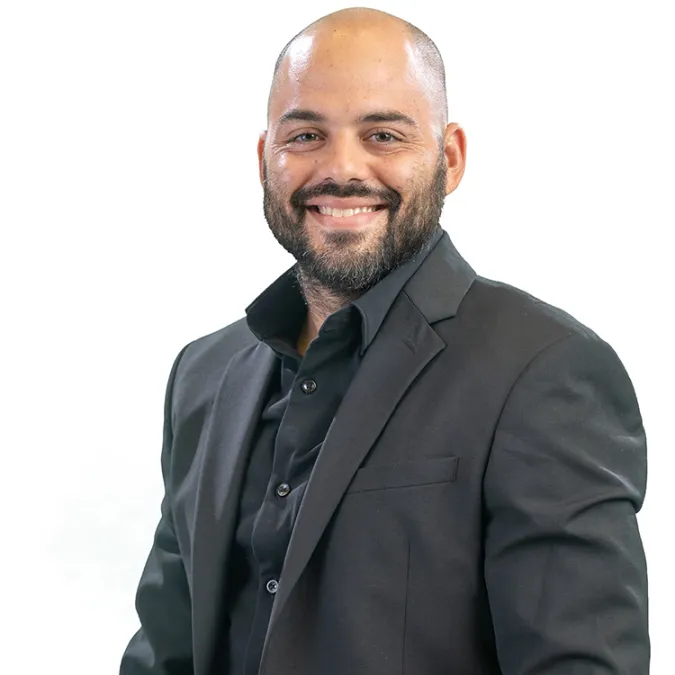
Jimmy Santos-Rivera (he/him) is currently pursuing a master of music in wind conducting at The University of Texas at Austin, where he serves as a graduate teaching assistant. In this role, he assists in conducting and managing the university’s concert bands, athletic bands, and conducting courses. He earned his bachelor of arts in music education, with a minor in percussion, from the University of Puerto Rico, Río Piedras. Born and raised in Puerto Rico, his career has been deeply rooted on the island. Prior to moving to Austin, Santos-Rivera spent eight years teaching concert band, percussion, and music theory at Escuela Especializada en Bellas Artes Pablo Casals. As a performer, he has played in the percussion section of the Puerto Rico Symphony Orchestra, the Puerto Rico Wind Symphony, and the Puerto Rico Philharmonic Orchestra. In 2019, he joined the 248th Army Band in San Juan, Puerto Rico, where he currently serves as a percussionist in various ensembles and as the principal conductor of the concert band. His mentors include Carlos Ávila, Eddy Marcano, Karlo Flores, and Carmen Acevedo.
Alec Rodriguez
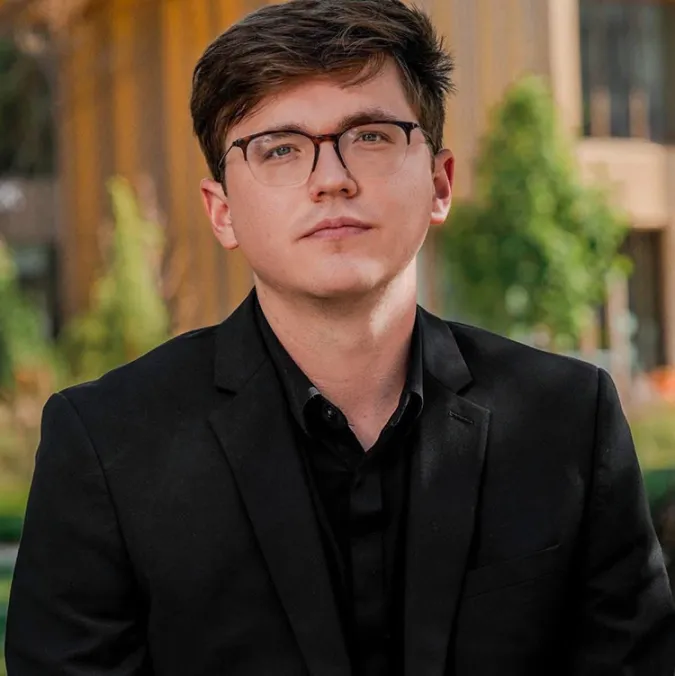
Alec Rodriguez is a conductor and music educator pursuing a Doctor of Musical Arts in Wind Band Conducting at the University of Texas at Austin, where he serves as a Graduate Assistant with the University Bands. In this role, he assists with conducting, ensemble operations, and undergraduate teaching while advancing his artistry and scholarship. From 2022 to 2025, Rodriguez was Associate Director of Instrumental Music at Clovis High School (CA), conducting the Symphonic Band and String Orchestra, leading the percussion program, and managing transportation and facility operations. Previously, he taught at Independence High School (2019–2022), directing the Symphonic Band and Indoor Percussion Ensemble, which earned first place at the 2022 WGI Merced Regional. Rodriguez holds a Master of Arts in Music – Conducting and a Bachelor of Music in Music Education from California State University, Fresno. A passionate advocate for student-centered, inclusive music-making, he emphasizes emotional authenticity, technical excellence, and diversity in repertoire. Active in the marching arts, Rodriguez serves as Front Ensemble Coordinator for Blue Devils B and has worked with Red Wave Indoor, Golden Empire Drum and Bugle Corps, and Bakersfield College Indoor. His research focuses on expanding wind band repertoire to reflect diverse and LGBTQIA+ voices.
Douglas Henderson

Douglas Henderson serves as associate director of bands at The University of Texas at Austin, where his responsibilities include conducting the Wind Symphony, teaching advanced undergraduate and graduate conducting, and teaching band literature. Prior to joining the UT faculty, Dr. Henderson was an associate professor, associate director of bands, and director of athletic bands at Oklahoma State University. Dr. Henderson is active as a guest conductor, adjudicator, and clinician throughout the United States, and he has guest conducted in Austria and Japan. He is a frequent guest conductor of the World Youth Wind Orchestra Project (WYWOP), in Schladming, Austria. Dr. Henderson received his bachelor of music degree in music studies from The University of Texas at Austin, his master of music degree in wind conducting from Michigan State University, and his doctor of musical arts degree in wind conducting from The University of Texas at Austin. From 2003-2006, he was the associate director of bands at J.J. Pearce High School in Richardson, Texas.
Wind Symphony
Flute
Jane Anderson
Juan Fajardo
Koustubh Galagali
Mia Rodriguez
Oboe
Emma Ball
Spencer Dwyer
Luke Sanchez
Elena Von Ronk
Clarinet
Madison Bookman
Brynn Carl
Georgia Castillo
Natalie Eddings
Caleb Healy
David Leal Jr.
Darien Salter
Bassoon
AB Brown
Naomi Kitamura
Sabrina Pector
Ally Rogers
Saxophone
Quinlan Collins
Diego Cruz
Austin Davidson
Corey Gutierrez
Daniel Kim
Chantal Lee
Joseph Lowry
Sasha Sanchez
Horn
Benjamin Cummings
Kannon Gregg
Dylan Marquez
Bianca Miller
William Nabors
Trumpet
Rowan Anthony
Adam Dimas
Nathan Harward
Matthew Nichols
Anthony Ramirez
Harrison Whitfield
Trombone
Lilli Bailey
Luis Cadena
Antonio Gamez
Landon Reimer
Euphonium
Nicolas Love
Adrian Jimenez-Murat
Troy Rosales
Tuba
Chancellor Joseph
Troy Mackabee
Jayden Medina
Percussion
Aaryn Avila
Zach Cunningham
Spencer Frismanis
Daniel Hernandez
Erica Lin
Frederico Lopez
Antonio Valadez
Harp
Angelina Mason
Keyboard
Seonhyeong Yeo
Bass
Reilly Curren
Mike Lebrias
Event Details
Free admission