


Chris Tran, conductor
Matthew Pavon, conductor
This concert will last about one hour with one intermission.
Please silence your electronic devices.
Photography, video, or recording of any part of this performance is prohibited
Program
Johann Strauss II
Overture to Die Fledermaus
Chris Tran, conductor
Isaac Albéniz
Suite from The Magic Opal
Overture
Prelude to Act II
Ballet, Act II
Chris Tran, conductor
intermission
Nikolai Rimsky-Korsakov
Overture to The Tsar’s Bride
Matthew Pavon, conductor
Manuel de Falla
El Sombrero de tres picos, Suite No. 2
Seguidillas (The Neighbor’s Dance)
Farruca (The Miller’s Dance)
Jota (Final Dance)
Matthew Pavon, conductor
About the Program
Program notes by Mark Bilyeu
Johann Strauss II
Overture to Die Fledermaus
Born October 25, 1825, Vienna Austria
Died June 3, 1899, Vienna Austria
Composed 1874
Premiered April 5, 1874, Theater an der Wien, Vienna, Austria
8 minutes
Little else elicits such carefree joy than a late-nineteenth century Viennese operetta. By the 1860s, Jacques Offenbach’s can-can-filled productions had taken hold of the musical zeitgeist, and Johann Strauss II (son of Johann Strauss, and no relation to Richard) was beautifully positioned to build on that popularity. Strauss Jr. had seen his father’s success as he toured his orchestra playing dance music of all styles, and developed his own brand of musicianship. While the elder Strauss was seen largely as a businessman who also composed, his son’s gift for creating memorable melodies meant his business was melodies. He crafted 16 operettas between 1871 and 1897, but none as universally popular as Die Fledermaus, a staple of opera houses around the world, most especially during the holiday season. The overture incorporates not only the show’s iconic waltz, but additional tunes that are each inimitably whistle-able and sure to linger in your ear well beyond the concert.
Isaac Albéniz
Suite from The Magic Opal
Born May 29, 1860, Camprodon, Spain
Died May 18, 1909, Cambo-les-Bains, France
Composed 1982
Premiered January, 1893, Lyric Theatre, London, England
15 minutes
Born in Spain, Isaac Albéniz was considered a child prodigy: offering his first public performance at the age of 4, he passed the playing exam to study at the Paris Conservatory three years later, but was denied entrance because the administration did not feel a 7 year-old was equipped to study at the esteemed institution. He would go on to build an international career as a virtuoso pianist and become a leading compositional figure of his generation. His use and incorporation of Spanish folk music captured imaginations across Europe and the Americas, and by 1890 he had moved to London where he was especially well-received by the public. It was there where he ventured into opera and operetta when he was offered a contract by the manager Henry Lowenfeld to write a comic opera based on a libretto by Arthur Law which was to premiere at the Lyric Theater. The story is a madcap tale about Spanish bandits seeking a ring with powers to incite immediate sexual infatuation for its wearer. Set in Greece, the music incorporates much more Spanish-inspired music than Greek, which no one (not even the critics) seemed to mind. The work made an immediate transition to another London theater where it remained popular during his stay, but has since fallen away. The music, however, remains an evocative and entertaining example of Albéniz’s unique musical language.
Nikolai Rimsky-Korsakov
Overture to The Tsar’s Bride
Born March 18, 1844, Tikhvin, Russia
Died June 21, 1908, Liubensk, Russia
Composed 1869-1899
Premiered 1899, Private Opera Society, Moscow, Russia
6 minutes
Although The Tsar’s Bride was the tenth opera Rimsky-Korsakov wrote, the idea for the opera was pitched to him thirty years prior to its premiere, before his first opera was even begun. Based on the book by Lev Mey, and with a libretto by Ilia Tyumenev, the opera tells the story of how Tsar Ivan the Terrible chose his third bride, Marg Sobakina, out of over two thousand women. After the wedding, she and her family were raised to noble stature, and she died just two weeks later. With Russian historians suggesting foul play, Mey took this theory, built out additional storytelling, and published his book in 1949. In 1868, The composer Balakirev suggested the story to Rimsky-Korsakov, who worked on his opera for the next thirty years before its premiere in 1899. The music, according to Rimsky-Korsakov, was a direct rebuttal of Richard Wagner’s operas, and was intended as a “cantilena par excellence."
Manuel de Falla
El Sombrero de tres picos, Suite No. 2
Born November 23, 1876, Cadiz, Spain
Died November 14, 1946, Alta Gracia, Cordoba, Argentina
Composed 1917
Premiered July 22, 1919, Alhambra Theatre in London, England
12 minutes
During World War I, Spain became a haven for creatives seeking new, politically-neutral, markets. Artistic maverick Serge Diaghilev was among those who had garnered favor with the Spanish King, and he began exploring collaborations with the country’s most prominent musical figure: Manuel de Falla. The ballet impresario asked de Falla to craft a ballet score based on Pedro Antonio de Alarcón’s comic novella El sombrero de tres picos (The Three-Cornered Hat), which would feature his ballet troupe, the Ballets Russes, the dancer/choreographer Léonide Massine, and sets by Pablo Picasso. As John Henken explains, “Alarcón’s novella contains a confusing amount of incident, but the central narrative follows the traditional characters of a jealous miller, his beautiful young wife, and a lecherous corregidor (the local magistrate, whose position was symbolized by his three-cornered hat). The oafish but persistent corregidor is thwarted at every turn, is mistakenly arrested by his own constables, and suffers the peasant justice of being tossed in a blanket for a finale of general merriment.” de Falla extracted two suites from his original score. The second suite includes the celebration of the Feast of St. John, a flamenco-inspired dance, concludes with a combustion that can only occur when all the ballet’s themes intersect in a fiery climax.
About the Artists
Chris Tran

Chris Tran is co-director of The University of Texas University Orchestra, graduate teaching assistant for the University of Texas Orchestras, and is currently pursuing a doctor of musical arts in orchestral conducting with Farkhad Khudyev at The University of Texas at Austin. Mr. Tran has been an invited conductor at several masterclasses and workshops in Boulder, Los Angeles, Eugene, St. Andrews (Scotland), as well as the Cabrillo Festival of Contemporary Music with Cristian Măcelaru, Thomas Sleeper, and Leonard Slatkin, and the International Conducting Workshop and Festival with the late Larry Rachleff and Donald Schleicher. He has also worked with conductors Neil Thomson, Jeff Grogan, and Sian Edwards. Mr. Tran earned a master of music in orchestral conducting from the University of Colorado Boulder with Gary Lewis, and a bachelor of music in music education from Southern Methodist University. His conducting mentors include Nicholas Carthy and Paul Phillips. He studied violin with Charles Wetherbee, former concertmaster of the Boulder Philharmonic, and Diane Kitzman, former principal violin of the Dallas Symphony.
Matthew Pavon
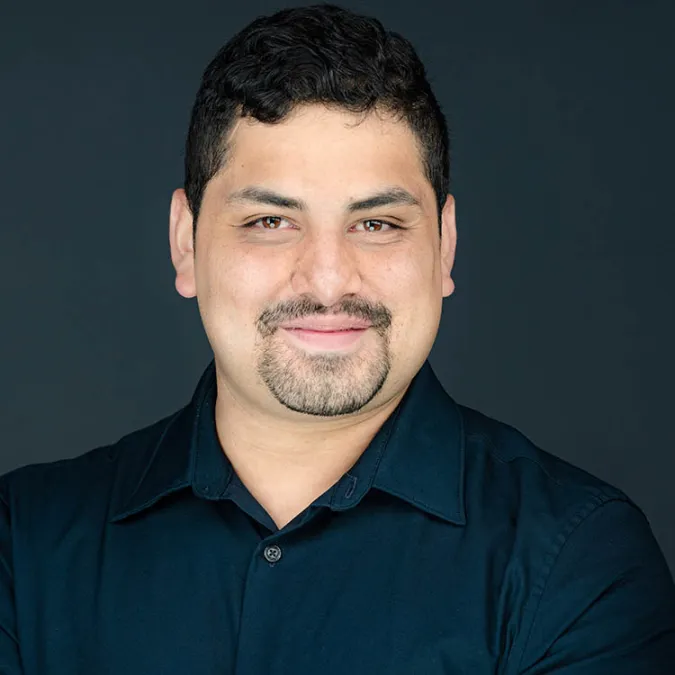
Matthew Pavon is a conductor and violist studying orchestral conducting under Farkhad Khudyev at The Butler School of Music. In his role as assistant instructor for university orchestras, Matthew is an active conductor and administrator for Symphony Orchestra. He also serves as Co-Director for University Orchestra. Matthew holds viola performance degrees from Evangel University (B.M. '19) and Missouri State University (M.M. '22). Guest conducting appearances have included concerts with the Austin Civic, Kansas City Civic, Missouri State University Symphony, Drury University, and Kansas City Youth Symphony, and Missouri Philharmonic Orchestras. As a violist, he was an active member of the Springfield Symphony Orchestra for seven years and a substitute violist for the Symphony of Northwest Arkansas. Matthew’s passion is connecting with people of all ages and backgrounds through music. He lives in Austin, TX, with his wife, Leianna, and their two mini-Australian Shepherds, Koda and Ellie.
University Orchestra
Violin I
Avelyn Lee, concertmaster
Emily Tando
Brandon Mendoza
Felipe Benitez
Jeffery Li
Thomas Feng
Angelica Sharma
Joaquin Alvarez
Quan Dau
Cannon Bates
Jasmine Chou
Peter Stone
Joseph McPeek
Ursula Weissfeld
Violin II
Kylie Hung, principal
Rudhran Sathish
Jailyn Barnuevo
Jessica Lin
Lauren Heyde
Eric Liang
Mohini Bhave
Jacob Hanson
Ximena Cazares
Jack Johnson
Sonya Shah
Holden Tom
Page Tan
Viola
Rachel Su, principal
Amy Ning
Edward Visaya
Shota Sawada
Wonkuk Lee
Audrey Sohn
Ash Roberts
Randy Guo
Caroline Hughes
Jaela Barrera
Angela Zhang
Gauri Binup
Daniel Kim
Cello
James Tabanado, principal
Anthony Hermez
Rei Iwahara
Michael Chung
Daniel Tepedino
Irene Benavides-Perez
Kunal Manish
Emile Meyrat
Drew Warninghoff
Allison Tseng
Double Bass
Dezhou Gao, principal
Chloe Mamitag
Ryan Webster
Aravind Shandilya
Emily Layton
Brandon Chiu
Darrin Luong
Piccolo
Anna Tumanova
Flute
Ethan Sarwar, principal
Camila Martinez
Anna Tumanova
Oboe
Noah Bihan, principal
Kyra Ullman
Vibha Immedisetty
English Horn
Vibha Immedisetty
Clarinet
Jusun Chung, principal
Brian Kim
Bassoon
Owen Schaefer, principal
Gavin Remo
Horn
Owen Clark, principal
Uriel Reyes
Dhanush Jain
David Finecy
Trumpet
Harmon Byerly1,4
Americo Zapata2,3
Rowan Anthony
Trombone
Erick Galicia, principal
Jingchun Liu
Bass Trombone
Hudson Pedrotti
Tuba
Chancellor Joseph
Timpani
Marcus Alvarado
Philip Kaufinger
Percussion
Marcus Alvarado
Spencer Frismanis
Philip Kaufinger
Michael Stephens
Aizen West
Harp
Hannah Beeler
Kirsten Karamihan
Piano
Soojin Kim
Principals
- Strauss
- Albéniz
- Rimsky-Korsakov
- De Falla
Event Details
Free admission