




Douglas Henderson, conductor
Cody Ray, guest conductor
This concert will last about 60 minutes without intermission.
Please silence your electronic devices.
Photography, video, or recording of any part of this performance is prohibited
Program
David Biedenbender
Enigma
Adolphus Hailstork
American Guernica
Cody Ray, conductor
Susan Atefat-Peckham, audio
Scott Lindroth
Passage
John Philip Sousa
Sabre and Spurs
About the Program
Program notes by Mark Bilyeu
David Biedenbender
Enigma
Born 1984, Waukesha, WI
Composed 2024
Premiered January 28, 2024, St. Olaf Band, Dr. Henry Dorn, conductor, Plymouth, Minnesota
12 minutes
The Composer writes:
Enigma comes from a Greek word that means “to speak in riddles,” and in this piece, the riddle — or theme — is revealed gradually. The theme comes from the Passacaglia and Fugue in C minor by Johann Sebastian Bach, which is one of my favorite pieces of music, and, once the theme is revealed, it is repeated cyclically with 21 variations, just like in Bach’s original. This piece is dedicated to my former teacher, José-Luis Maúrtua, a composer, theorist, conductor, and teacher with whom I studied at Central Michigan University. José-Luis was an extraordinary musician and teacher who was tirelessly dedicated to his students and to pushing them to do their best. I am forever grateful for the lessons I learned from him, and my music and my life are far better for having known him. Unfortunately, he was taken from this earth far too young — at the age of 57 — by pancreatic cancer in the spring of 2022. I miss him dearly, and this music is for him.
Adolphus Hailstork
American Guernica
Born: April 17, 1941, Rochester, New York
Composed 1982
Premiered 1983
7 minutes//sp
Around 4:30 p.m. on Monday, April 26, 1937, Nazi warplanes bombed the Spanish city of Guernica in the Spanish Basque Country. Located nearly ten miles from the war’s front lines, and populated mostly by women and children (as the men were largely on those front lines), it was seen as a cruel and calculated act of violence against the innocent. Pablo Picasso, so moved by the senseless loss of innocent life, responded with one of the most famous anti-war paintings in history: Guernica. Not thirty years later, on September 15, 1963, racially-motivated domestic terrorists fire-bombed the 16th Street Baptist Church in Birmingham, Alabama, killing four young girls attending Sunday school (Carol Robertson, 14, Addie Mae Collins, 14, Cynthia Wesley, 14, and Denise McNair, 11). Adolphus Hailstork composed American Guernica in remembrance of that attack in Birmingham, using spatial notation, and extended techniques for the performers. “What would that moment (and music reflecting that moment) contain?” writes Hailstork, “Sunday School music, explosion sounds, chaos, anguish, screaming. Eventually, there would be a funeral.” In a eulogy for a joint funeral service, Rev. Dr. Martin Luther King Jr. said, "These children-unoffending, innocent, and beautiful-were the victims of one of the most vicious and tragic crimes ever perpetrated against humanity. And yet they died nobly. They are the martyred heroines of a holy crusade for freedom and human dignity. And so this afternoon in a real sense they have something to say to each of us in their death ...Their death says to us that we must work passionately and unrelentingly for the realization of the American dream."
Scott Lindroth
Passage
Born 1958
Composed 2010
Premiered December 15, 2010, United States Marine Band ("The President's Own") Captain Michelle Rakers, conductor
11 minutes
The Composer writes:
Passage was composed in 2010, but the music looks back at earlier times in my life. A prominent four-note theme, first heard as the harmonized melody in the woodwinds, comes from a piece I composed in 1990 called Duo for Violins. In the duo, the theme appears at a climactic moment and is filled with passionate intensity. In Passage, the theme is set with rich harmonies that shift with each repetition, and the rhythmic character is supple and nuanced. To me, it's like, encountering an old friend who has changed with age, hopefully for the better. Composing for symphonic band was another occasion for retrospection. My formative musical experiences began in 1970, when I played in public school bands and jazz ensembles directed by men who offered instruction, mentorship, and priceless opportunities to discover myself as a composer and musicians. And so it is with gratitude that I dedicate this piece to Robert C. Shirek, Calvin D. Moely, and Raymond C. Wifler, three American bandmasters who revealed to me what it could mean to live a life in music.
John Philip Sousa
Sabre and Spurs
Born November 6, 1854, Washington, D.C.
Died March 6, 1932, Reading, PA
Composed 1918
3 minutes
With a title like “Sabre and Spurs,” it’s easy to believe Sousa dedicated this 1918 march to the officers of the 311th Cavalry. He himself was a member of the U.S. Navy, organizing bands for duty aboard ships and stations. Much of his output at that time was focused on supporting the U.S. military and bolstering the morale of the troops during the first World War. Sousa was in his sixties at this point while often leading bands full of twenty-somethings; feeling the need to not only lead, but also connect with these young men, he once shaved off his (rather famous) beard. Later, he joked that it was because of this singular act of grooming that caused Germany to surrender and end the war, saying that “Kaiser Wilhelm realized that a nation made up of men willing to make such sacrifices could not be defeated.”
About the Artists
Cody Ray

Cody Ray is currently pursuing a doctor of musical arts in wind conducting at The University of Texas at Austin where he studies with professor Jerry Junkin and serves as a graduate teaching assistant for University Bands. He received his bachelor of arts in music education from the University of Alabama at Birmingham under the mentorship of Dr. Sue Samuels, Dr. Gene Fambrough, Dr. Cara Morantz, and Dr. Sean Murray, and a master of music in wind conducting from Tte University of South Carolina (’24) studying under Dr. Cormac Cannon, Dr. Jay Jacobs, and Dr. Quintus Wrighten. Prior to his graduate studies, Cody served as the assistant director of bands at Cairo High School in Cairo, GA from 2020-2022. Before coming to Cairo, he also served as director of bands at Sipsey Valley High/Middle School from 2019-2020 and director of bands at Sulligent High School from 2018-2019. His professional affiliations include the National Association for Music Education, the College Band Directors National Association, and the National Band Association.
Douglas Henderson

Douglas Henderson serves as associate director of bands at The University of Texas at Austin, where his responsibilities include conducting the Wind Symphony, teaching advanced undergraduate and graduate conducting, and teaching band literature. Prior to joining the UT faculty, Dr. Henderson was an associate professor, associate director of bands, and director of athletic bands at Oklahoma State University. Dr. Henderson is active as a guest conductor, adjudicator, and clinician throughout the United States, and he has guest conducted in Austria and Japan. He is a frequent guest conductor of the World Youth Wind Orchestra Project (WYWOP), in Schladming, Austria. Dr. Henderson received his bachelor of music degree in music studies from The University of Texas at Austin, his master of music degree in wind conducting from Michigan State University, and his doctor of musical arts degree in wind conducting from The University of Texas at Austin. From 2003-2006, he was the associate director of bands at J.J. Pearce High School in Richardson, Texas.
Wind Symphony
Flute
Jane Anderson
Juan Fajardo
Koustubh Galagali
Eunha Kim
Oboe
Emma Ball
Spencer Dwyer
Luke Sanchez
Elena Von Ronk
Clarinet
Madison Bookman
Brynn Carl
Georgia Castillo
Natalie Eddings
Caleb Healy
David Leal Jr.
Darien Salter
Bassoon
AB Brown
Naomi Kitamura
Sabrina Pector
Ally Rogers
Saxophone
Quinlan Collins
Diego Cruz
Austin Davidson
Corey Gutierrez
Daniel Kim
Chantal Lee
Joseph Lowry
Sasha Sanchez
Horn
Benjamin Cummings
Kannon Gregg
Dylan Marquez
Bianca Miller
William Nabors
Trumpet
Rowan Anthony
Adam Dimas
Nathan Howard
Matthew Nichols
Anthony Ramirez
Harrison Whitfield
Trombone
Lilli Bailey
Luis Cadena
Antonio Gamez
Hunter Irwin
Landon Reimer
Euphonium
Nicolas Love
Adrian Jimenez-Murat
Troy Rosales
Tuba
Chancellor Joseph
Troy Mackabee
Jayden Medina
Percussion
Zach Cunningham
Daniel Hernandez
Khaden Joyner
Kevin Luo
Michael Rivera-Gonzalez
Antonio Valadez
Harp
Angelina Mason
Keyboard
Mingchen Chu
Weizhen Lai
Bass
Reilly Curren
Upcoming Events
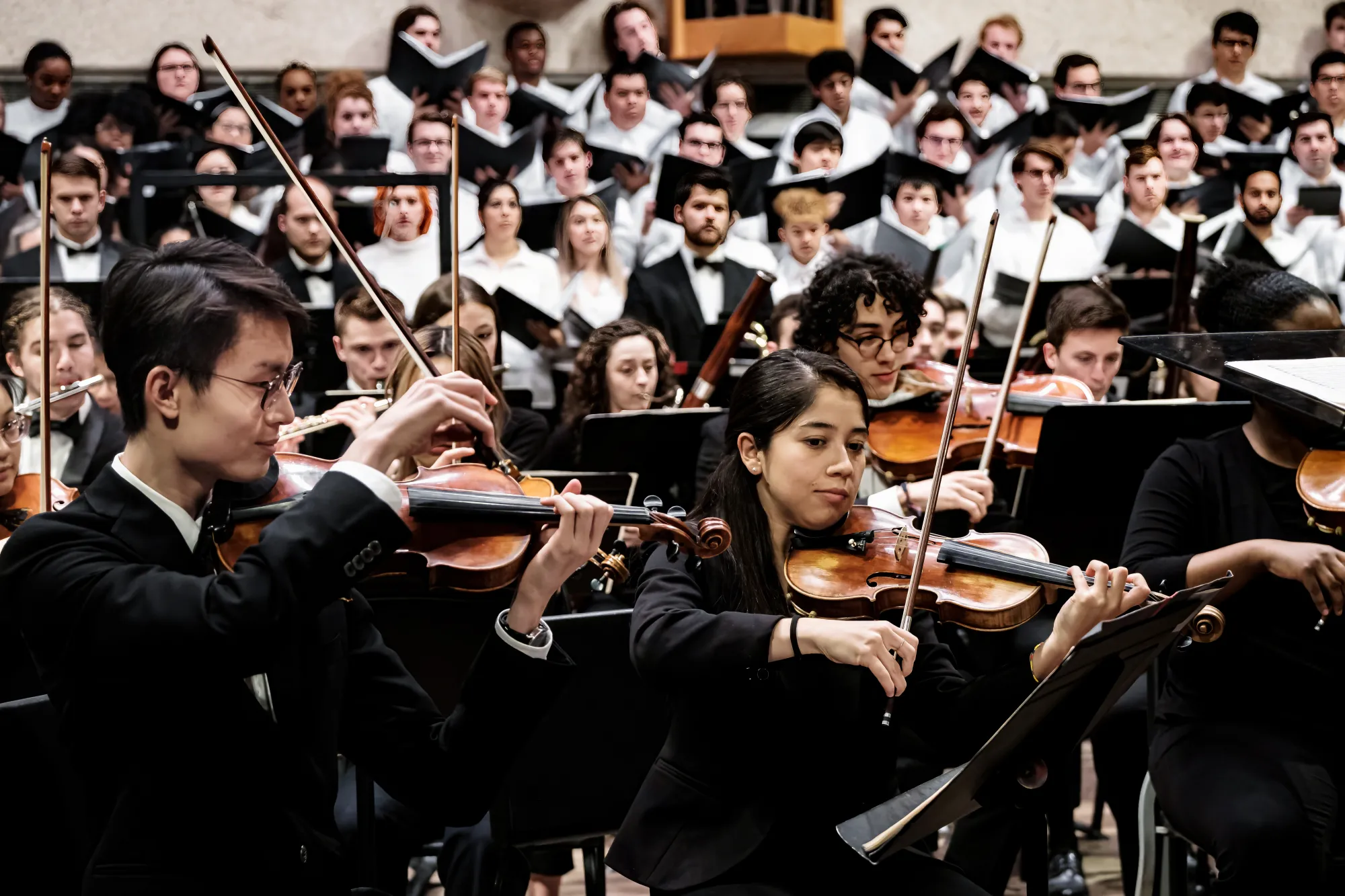
Mahler Symphony No. 2
Resurrection
Symphony Orchestra & Combined Choirs
Leah Crocetto, soprano
Sophio Dzidziguri, mezzo soprano
One of the most beloved symphonies in the canon, Mahler's "Resurrection" symphony boasts a large orchestra, mezzo and soprano soloists, and similarly to Beethoven's 9th Symphony, a large choir in the final movement. For this performance, the Butler School's Concert Chorale and University Chorus ensembles will join forces; they will be joined by Butler School alumni singers and community choral singers from around Austin.
Tuesday, March 31, 8:00 p.m.
Long Center for the Performing Arts
Event Details
Free admission