




Farkhad Khudyev, conductor
Chris Tran, guest conductor
Isabella Perez, bassoon
This concert will last about 70 minutes with one intermission.
Please silence your electronic devices.
Photography, video, or recording of any part of this performance is prohibited
Program
Ludwig van Beethoven
Overture to Egmont, op. 84
W.A. Mozart
Bassoon Concerto in B-flat Major, K.191/186e
Allegro
Andante ma adagio
Rondo: Tempo di menuetto
Isabella Perez, bassoon
intermission
Franz Schubert
Symphony No. 5 in B-flat Major, D.485
Allegro
Andante con moto
Menuetto: Allegro molto
Allegro vivace
Chris Tran, conductor
About the Program
Ludwig van Beethoven
Overture to Egmont, op. 84
Born December 16, 1770, Bonn, Germany
Died March 26, 1827, Vienna, Austria.
Premiered June 15, 1810
Composed 1809-1810
8 minutes
In 1809, Beethoven was commissioned to write new incidental music for the remounting of Egmont, the play by Johann Wolfgang von Goethe. The work was a fictionalized retelling of the 16th century Count Egmont’s struggle for Dutch liberty against the autocratic rule of Spain. In the work, Egmont is captured, imprisoned, and sentenced to death. His mistress Klärchen is unable to rescue him, and dies by suicide. Egmont’s own demise is preceded by an epic speech which transforms his death from the demise of a nobleman into the glorious death of a hero. Beethoven’s overture opens with a slow saraband (perhaps depicting the heavy steps of Spanish authoritarianism) before opening up to the triumph of martyrdom. Beethoven used material from the final coda again at the end of the play, which he titled “Symphony of Victory.”
Franz Schubert
Symphony No. 5 in B-flat Major, D. 485
Born January 31, 1797, Himmelpfortgrund, Vienna, Austria
Died November 19, 1828, Vienna, Austria
Composed 1816
30 minutes
In 1816, at the age of 19, Franz Schubert was doing it all. With pressure from his family, he had begun studying at the Teacher’s Training College while simultaneously serving as an assistant teacher at his father’s school; he enrolled in a law degree program, and by the end of that year, had written at least 110 songs, a choral mass, opera, string quartet, three violin sonatas, and two symphonies. Whoa. Those 1910 symphonies were his fourth and fifth, and they show a great deal about Schubert’s influence as a still-developing (yet unquestionably singular) composer. He dubbed his fourth symphony “Tragic,” and while we can pull from any number of anecdotes to decipher why, the work’s uniquely brooding mood points to an hommage to — or perhaps an escape from — Beethoven. His fifth symphony, however, makes a full 180-degree turn with its bright, airy, and unending buoyancy much more akin to Mozart than Beethoven. In June of that year, just four months before he began composing, Schubert wrote in his diary “O Mozart! Immortal Mozart! what countless impressions of a brighter, better life hast thou stamped upon our souls!”
The symphony opens directly with an allegro (no slow opener here, like all of his previous symphonies!), and spins two separate themes, simultaneously singable and jaunty. The second movement offers a respite from the toe tapping, while the third movement requires us to move our feet once again, as the minuet begins. This movement has been identified as the most Mozartian, as the similarities between this and Mozart’s Symphony No. 40 are striking. The final movement has a courtly aura that might remind you of Haydn, but it’s the unmistakable chromaticism that betrays it as something exclusively Schubertian.
W.A. Mozart
Bassoon Concerto in B-flat Major, K. 191/186e
Born January 27, 1756 in Salzburg, Austria
Died December 5, 1791 in Vienna, Austria
Composed 1774
16 minutes
While it’s unknown who first premiered Mozart’s bassoon concerto (it could have been either of the bassoon players in the Salzburg Court Orchestra), we can safely say that nearly every bassoon player since has studied, practiced, and performed this iconic work. In its first movement, Mozart offers us a showcase of virtuosity: fleet fingers and expansive leaps offer opportunities for the soloist to showcase their prowess. The second movement, closely resembling his aria “Porgi amor from Le nozze di Figaro showcases why in the nineteenth century, the publication Koch’s Musikalishces Lexicon described the bassoon as “Ein Instrument der Liebe’ (‘an instrument of love’). The finale is the triple-metered minuet crafted in rondo form with its repeating refrain. Here, the bassoon shines with its interjections of triplets and spritely sixteenth notes which barrel towards the final tutti refrain which closes the work.
About the Artists
Isabella Perez
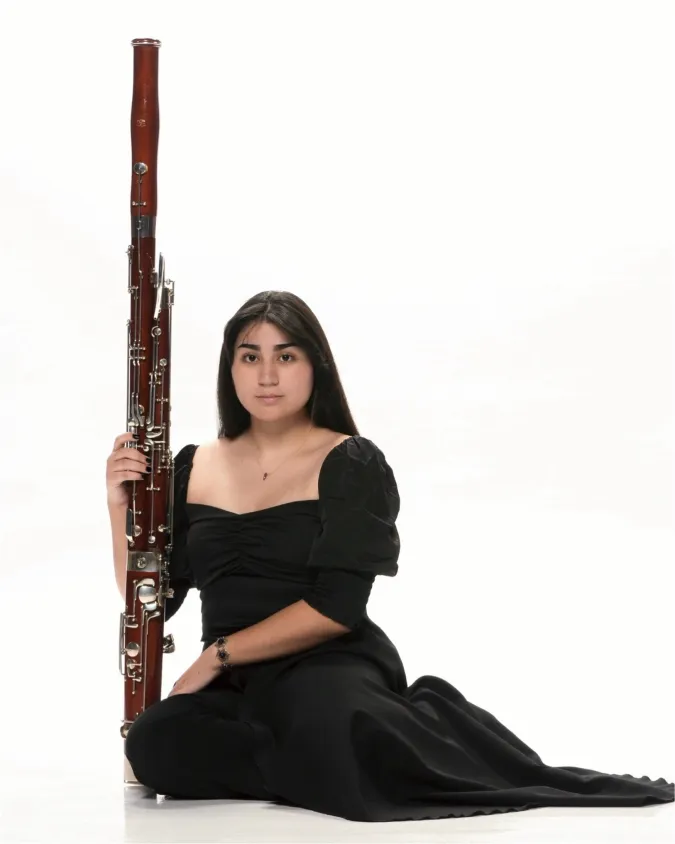
Isabella Perez is a Mexican-American bassoonist and fourth-year undergraduate music performance major at The University of Texas at Austin, where she studies with Kristin Wolfe Jensen. Originally from San Antonio, Texas, she previously studied with Sharon Kuster, retired Principal Bassoonist of the San Antonio Symphony. Since discovering the bassoon at age 12, Isabella has been deeply influenced and inspired by San Antonio’s vibrant music scene. During high school, she performed extensively throughout the city with her wind quintet and served as Principal Bassoon of the YOSA Philharmonic for several years. She was also selected to perform with the TMEA All-State Symphony Orchestra and the TMEA 6A Symphonic Band. In 2022, Isabella received the TMEA Music Scholar Award, the Marine Corps Semper Fidelis Award for Musical Excellence, and the San Antonio Blues Society’s Sam Baird Scholarship. At UT Austin, Isabella is an active member of the Wind Ensemble and the Symphony Orchestra. She also enjoys playing in the UT Bassoon Ensemble where she has participated in collaborations with Austin Soundwaves, KMFA Classical 89.5, and ROCO. In January 2025, Isabella was named the third-place winner of the 2025 Meg Quigley Vivaldi Competition, an international competition dedicated to advancing the talents and professional experiences of women bassoonists. Outside of music, Isabella enjoys crocheting, going out for boba tea, and discovering new restaurants around Austin.
Chris Tran

Chris Tran is co-director of The University of Texas University Orchestra, graduate teaching assistant for the University of Texas Orchestras, and is currently pursuing a doctor of musical arts in orchestral conducting with Farkhad Khudyev at The University of Texas at Austin. Mr. Tran has been an invited conductor at several masterclasses and workshops in Boulder, Los Angeles, Eugene, St. Andrews (Scotland), as well as the Cabrillo Festival of Contemporary Music with Cristian Măcelaru, Thomas Sleeper, and Leonard Slatkin, and the International Conducting Workshop and Festival with the late Larry Rachleff and Donald Schleicher. He has also worked with conductors Neil Thomson, Jeff Grogan, and Sian Edwards. Mr. Tran earned a master of music in orchestral conducting from the University of Colorado Boulder with Gary Lewis, and a bachelor of music in music education from Southern Methodist University. His conducting mentors include Nicholas Carthy and Paul Phillips. He studied violin with Charles Wetherbee, former concertmaster of the Boulder Philharmonic, and Diane Kitzman, former principal violin of the Dallas Symphony.
Farkhad Khudyev
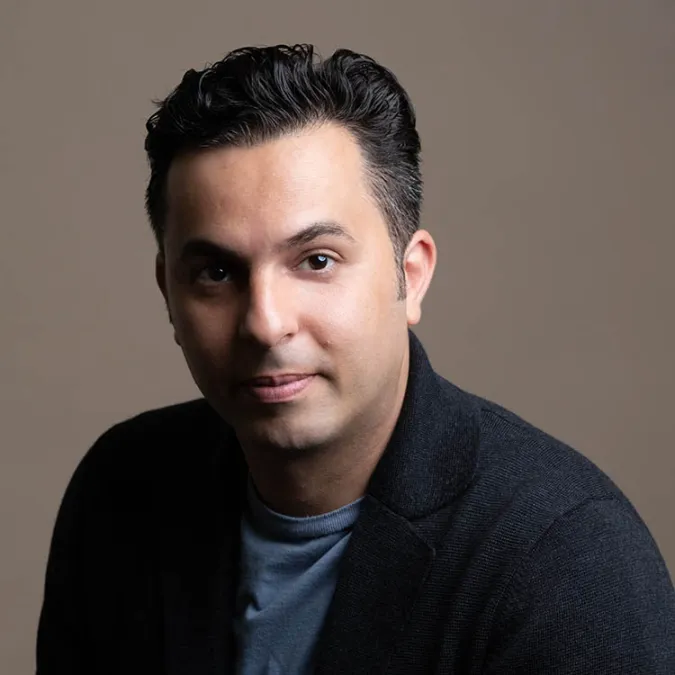
Farkhad Khudyev is the winner of the Gold Medal “Beethoven 250” at the 1st International Arthur Nikisch Conducting Competition; the Solti Foundation US 2018 and 2022 Career Assistance Award; the Best Interpretation Prize at the 1st International Taipei Conducting Competition; the 3rd prize at the 8th International Sir Georg Solti Conducting Competition; and the Gold Medal/Grand Prize at the 2007 National Fischoff Competition. Khudyev has worked with orchestras worldwide including the London Philharmonic Orchestra, Frankfurt Radio Symphony Orchestra, Frankfurt Opera Orchestra, Danish National Symphony Orchestra, Seattle Symphony, Dallas Symphony, Los Angeles Philharmonic, San Diego Symphony, Monterey Symphony, George Enescu Philharmonic Orchestra, Xi’an Symphony Orchestra and the State Taipei Chinese Orchestra. Farkhad was born in Turkmenistan, where he studied at the State Music School for gifted musicians, and then completed his studies at Interlochen Arts Academy, Oberlin Conservatory and Yale University. Khudyev serves as the Music Director of the University of Texas Symphony Orchestra in Austin, and the Orchestral Institute at the Hidden Valley Institute of the Arts in Carmel, California.
Chamber Orchestra
Violin I
Brandon Garza, concertmaster
Noah Briones
Jimmy Shim
Alice Pak
Georgia Halverson
Hanna Le
Violin II
Oliver Fiorello, principal
Peter Kim
Pedro Salas
Jackie Shim
Leiana Campanaro
Viola
Liam Cao, principal
Gwendolyn Lay
Harrison Knight
Cello
Seungyeon Oh, principal
Wesley Fu
William Pu
Zachary Houlton
Double Bass
Kaitlyn Ruiter, principal
Xingchang Ye
Flute
Patrick Umanzor1,3
Mia Rodriguez
Oboe
Zane Laijas1,2,3
Elena Van Ronk
Clarinet
Brynn Carl1
Natalie Eddings
Bassoon
Mallory Mahoney3
Ally Rogers1
Horn
Jordan Perkins2,3
Emily Quinn1
Andrew Ryan
Sam Stephenson
Trumpet
Cameryn Key1
Nathan Harward
Timpani
Brooks Bell
Assistant Conductor
Chris Tran
Principals
Beethoven
Mozart
Schubert
Upcoming Events
Mahler Symphony No. 2
Resurrection
Symphony Orchestra & Combined Choirs
Leah Crocetto, soprano
Sophio Dzidziguri, mezzo soprano
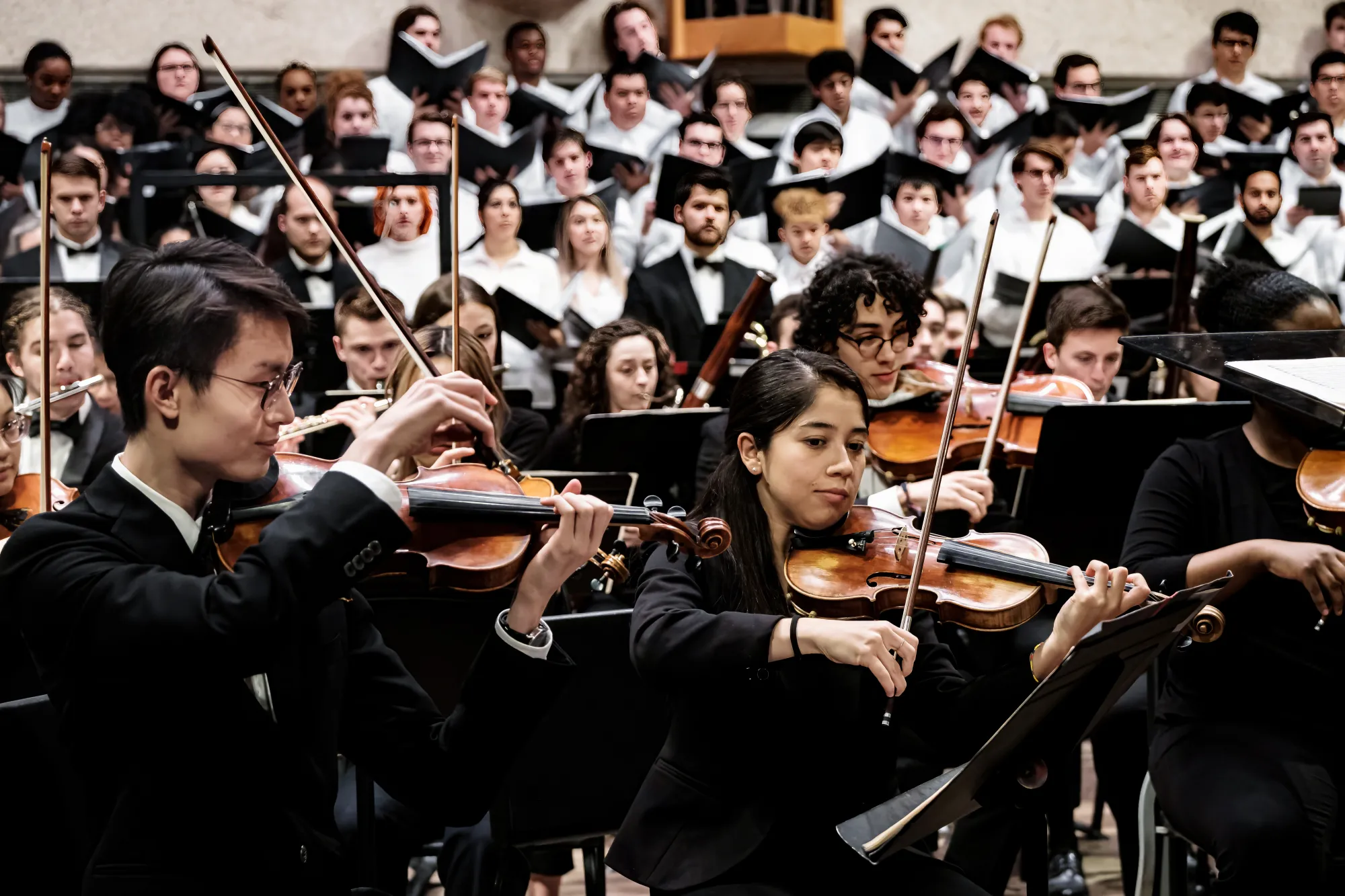
One of the most beloved symphonies in the canon, Mahler's "Resurrection" symphony boasts a large orchestra, mezzo and soprano soloists, and similarly to Beethoven's 9th Symphony, a large choir in the final movement. For this performance, the Butler School's Concert Chorale and University Chorus ensembles will join forces; they will be joined by Butler School alumni singers and community choral singers from around Austin.
Tuesday, March 31, 8:00 p.m.
Long Center for the Performing Arts
Event Details
Free admission