




Douglas Henderson, conductor
T.j. Anderson, conductor
Emily Warren, guest conductor
This concert will last about 90 minutes with one intermission.
Please silence your electronic devices.
Photography, video, or recording of any part of this performance is prohibited
Program
Symphony Band
T.j. Anderson, conductor
Sally Lamb McCune
Spiral
William Grant Still
arr. Dante Teter
Summerland
Michael Daugherty
Desi
Emily Warren, conductor
David Maslanka
Golden Light
intermission
Wind Symphony
Douglas Henderson, conductor
Joan Tower
Fascinating Ribbons
Joseph Schwantner
From A Dark Millennium
Zhou Tian
arr. Thornton & Tian
Nocturne
Omar Thomas
The Low-Down Brown Get-Down
About the Program
Program notes by Mark Bilyeu except where noted
Sally Lamb McCune
Spiral
Born 1966
Composed 2023
Premiered November 13, 2023, Eastman Wind Ensemble, Rochester, N.Y., Mark Scatterday, conductor
6 minutes
Composer Sally Lamb McCune’s music has been described as “contemporary, edgy, descriptive, and extremely soulful.” She has been awarded a Charles Ives Fellowship from the American Academy of Arts and Letters, as well as a Whitaker New Reading Session from the American Composers Orchestra. She has taught at Cornell University, Syracuse University and is currently on the faculty at Ithaca College in New York. “Spiral,” she writes “ is a short work that loosely explores some of the darker usages and meanings of its title: to spiral out of control, a death spiral, an anxiety spiral. Although the title came after the piece was underway, it draws from an article by science journalist Ed Yong, who likened modern times to the phenomenon of a death spiral (also called an ant mill) performed by army ants. When a group of ants is separated from the main group, the ants lose their pheromone track and begin following one another to form a continuous rotating circle. The concept articulates some of the mood of the work. The wind ensemble version is a modified transcription from the original version for chamber orchestra written in 2022.”
– Sally Lamb McCune
William Grant Still
Summerland
Born May 11, 1895, Woodville, MS
Died December 9, 1978, Los Angeles, CA
Composed 1935
6 minutes
William Grant Still, often referred to as the “Dean of African American Composers,” was the first Black composer to have a work performed by a major orchestra (his Afro-American Symphony) and was the first Black composer to conduct a major symphony orchestra (the Los Angeles Philharmonic). Much like other Black composers of the time — Margaret Bonds, Florence Price, and William Dawson — Still reflected the struggles, beliefs, and triumphs of his own Black experience in his compositions. His 1935 work Three Visions was originally a three-movement work for solo piano, written for his wife, the pianist Verna Arvey. According to Judith Anne Still, the composer's daughter, "The three segments of the suite, Dark Horsemen, Summerland, and Radiant Pinnacle, tell the story of the human soul after death: the body expires, and the soul goes on to an apocalyptic judgment. If it is seen that the past life has been a good one, the soul may enter “heaven,” or “Summerland”. After a period of time, the soul may reincarnate to learn additional earthly lessons on the human plane. Some souls reincarnate many times in a constant circular progress toward Godly perfection."
Michael Daugherty
Desi
Born April 28, 1954, Cedar Rapids, IA
1991
Premiered 1991, College Band Directors National Association Convention
6 minutes
Desi for symphonic winds was premiered at the 1991 College Band Directors National Association Convention in Kansas City. The composition is a tribute to Desi Arnaz, who played the Cuban bandleader Ricky Ricardo alongside his wife Lucille Ball in I Love Lucy, widely regarded as one of the most innovative television comedy shows of the 1950s. The opening rhythmic motive is derived from the Conga Dance made famous by Arnaz when he sang and played bongos in Hollywood film musicals in the 1940's. In Desi, the bongo soloist and percussion section provide a lively counterpoint to intricately structured canons and four-note cluster chords, creating polyrhythmic layers that intensify and build to a sizzling conclusion. Desi evokes a Latin sound punctuated by big band trumpets, trombone glissandi, and dazzling woodwind runs.
– Michael Daugherty
David Maslanka
Golden Light
I lived for many years in upper Manhattan — one block from the A train. One block the other way was Inwood Hill Park, a beautiful “wild” place that still contained old growth trees. It was there that I did my walking meditations. “Golden Light” refers to the quality of late afternoon sunlight that could be seen through the trees as I walked. It was a delicious “green-gold” color. My walking meditations are inward journeys which I use to find the impulse for a piece of music. In the meditation for this piece I was taken to the coast of Africa. It was a summer night and a community of people was engaged in a lively song and dance fest. I was allowed to join in. The dance rhythms and the joyous quality of the singing became the push for my music.
Golden Light is not African music, but the small, repetitive bits of tunes, the call-and-response patterns, and the layers of independent rhythms give it a distinctly African feel. It is a very difficult piece to perform because it asks each player to be rhythmically independent much of the time — each person contributing his or her separate voice to make the joyful sound of the community at play.
- David Maslanka
Joan Tower
Fascinating Ribbons
Born September 6, 1938, New Rochelle, NY
Composed 2001
Premiered 22 February 2001, Keystone Wind Ensemble, Jack Stamp, conductor
6 minutes
Joan Tower is widely regarded as one of the most important American composers living today. During a career spanning more than sixty years, she has made lasting contributions to musical life in the United States as composer, performer, conductor, and educator. Despite commissions from major ensembles, soloists, and orchestras from around the world, including the Emerson, Tokyo, and Muir quartets; soloists Alisa Weilerstein, Evelyn Glennie, Carol Wincenc, David Shifrin; and the orchestras of Chicago, New York, St. Louis, Pittsburgh, Baltimore, and Washington DC among others, it wasn’t until 2001 that she wrote her first work for wind band.
“I am happy to be finally entering the band world — a generous and hard-working world that has generated so many excellent wind, brass, and percussion players,” she wrote in her program note for Fascinating Ribbons. “It seems also to be a place of people that actually love living composers! Since this was my first foray into the band world, I decided that a short piece would be the wisest course. In naming the piece, I noticed that there are many contours of motives that are shaped in curved “ribbon” patterns. I immediately thought of the word “fascinating.” And the ending dotted-rhythm reminded me of Gershwin’s Fascinating Rhythms — hence the title. It is dedicated to Jack Stamp, that intrepid “stalker” of composers who will not give up until he gets a band piece from them. (I should know; it took him five years to get me to write one!)”
Joseph Schwantner
From a Dark Millennium
In 1980, the Mid-American Conference Band Directors Association commissioned Pulitzer Prize winner Joseph Schwantner to write a follow-up work to his landmark ...and the mountains rising nowhere of 1977. The resulting work, From a Dark Millennium, received its premiere by the University of Northern Illinois Wind Ensemble in 1981. A re-working of a material from his chamber work, Music of Amber, this marked the only occasion in which Schwantner borrowed earlier material for a subsequent work. Both works draw inspiration from Schwantner’s poetry:
Sanctuary...
deep forests
a play of shadows,
most ancient murmurings
from a dark millennium,
the trembling fragrance
of the music of amber…
From a Dark Millennium has come to be seen as the second movement in a trilogy of sorts for wind ensemble including …and the mountains rising nowhere (1977), and In evening’s stillness… (1996)—bookends to From a Dark Millennium (1981). Although Schwantner does not consider From a Dark Millennium to be programmatic, he does admit that, “the mysterious and shadowy atmosphere ... springs from images drawn from a brief original poem that forms the poetic backdrop for the work. The poem helped to stimulate, provoke, and enhance the flow of my musical ideas.”
As a composition, From a Dark Millennium is a model of economy, spun out from the material heard in the first measure: a re-ordered “octatonic scale” [F, F#, Ab, A, B, C, D, Eb]—a scale that ascends by alternating half-steps and whole-steps. The work features several of Schwantner’s “hallmark techniques,” the most apparent of which are a prominent, almost solisitc piano, and several large-scale percussion parts.
- Program Note from State University of New York, Potsdam, Crane Wind Ensemble concert program, February 14, 2018
Zhou Tian
Nocturne
Born 1981, Hangzhou, China
Composed 2000 / 2003
Premiered 22 March 2002, at The Curtis Institute of Music, Philadelphia, PA
At the age of 12, Chinese-born composer Zhou Tian was already working as a studio pianist and arranger alongside his father, who worked as composer for Chinese television shows. At the age of 19, Zhou moved to the United States and began his studies at the Curtis Institute, followed by The Juilliard School, and finally at the University of Southern California. Alongside his own cultural identity, his interests in jazz, dance, and film music combine to create sounds that have been described as “a prime example of 21st-century global multiculturalism.” In 2018, he became the first Chinese-born composer to be nominated for a GRAMMY Award in the Best Contemporary Classical Composition category for his Concerto for Orchestra. Nocturne is a chorale for strings arranged by the composer from a movement of his String Quartet No. 1, which he described as “the last work I composed in China before moving to the US to study at the Curtis Institute of Music. The work captures my state of mind of creating music as an 18-year-old — composing anything was exhilarating, and inspirations seemed coming from everywhere. I wanted to embed my love of music from the past and present — Bach, Ravel, Prokofiev, Chick Corea and more — into a fusion of my own taste.”
Omar Thomas
The Low-Down Brown Get-Down
Born 1984, Brooklyn, N.Y.
Composed 2020
12 minutes
A leader in both jazz and classical styles, composer and arranger Omar Thomas currently serves as assistant professor of composition at The University of Texas at Austin, while his music continues to be heard around the world. He writes: The end of the 60s into and through the 70s saw the era of the “blaxploitation” film — a genre of filmmaking aimed at African-American audiences which put us in leading roles of stories that often followed antiestablishment plots. These films were often controversial due to their exaggerated bravado, hypersexuality, and violence. Noticing the lucrative potential of blaxploitation films, Hollywood began to market these films to a wider audience. Though low budget, they possessed an exciting, raw, soulful quality unlike any other genre up until that time, and from these films were born some of the most iconic characters (Shaft, Dolemite, Foxy Brown, and Cleopatra Jones, to name a few) and soundtracks ever created, written by some of the biggest names in African-American popular folk music of the day and since, including Issac Hayes, Curtis Mayfield, James Brown, and Marvin Gaye.
The Low-Down Brown Get-Down is the soundtrack for a nonexistent blaxploitation film. It pulls from various sounds and styles of African-American folk music, such as funk, R&B, soul, early hip hop, the blues, and even film noir to stitch together its “scenes.” The title pulls from and is inspired by “post-jive” African-American Vernacular English (AAVE). The word “Brown” in the title, in addition to its reference to none other than the Godfather of Soul, James Brown, whose most-famous licks and bass lines pepper the intro and recur throughout the piece, also refers to the melanin of the people who created these sounds.
This piece unapologetically struts, bops, grooves, slides, shimmies, head bangs, and soul claps its way straight through its thrilling “chase scene” finale. It was my intention with the creation of this piece to go full steam ahead on bringing African-American folk music to the concert stage to take its place amongst all other types of folk music that have found a comfortable home in this arena. May this work push back against notions of “sophistication,” “appropriateness,” and “respectability” that have been codified in the concert music setting for a century and more.
About the Artists
Emily Warren
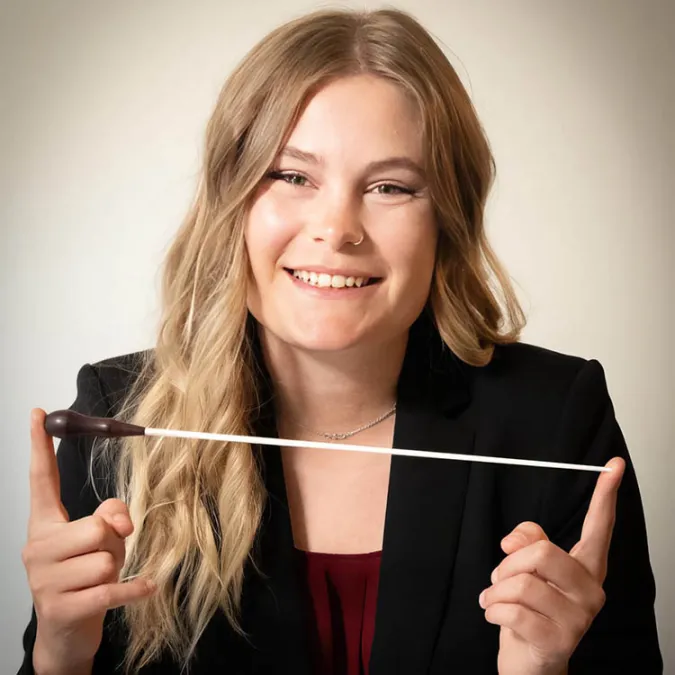
Emily Warren attends The University of Texas at Austin, where she is currently pursuing a doctor of musical arts degree in wind conducting. As a graduate teaching assistant, she works with the university’s athletic and concert bands, assisting with administrative duties and conducting the ensembles. Additionally, she teaches courses in conducting and wind band literature. Prior to her graduate studies, Emily lived in Massachusetts where she spent four years as a public school music educator. She is a specialist in electroacoustic repertoire for wind ensemble and has been invited to present her research internationally, most recently at the IGEB (International Society for the Promotion and Research of Wind Music) conference in Valencia, Spain. Emily holds a bachelor's degree in music education from Indiana University and a master's degree in wind conducting from the University of Kansas, where she studied under the direction of Dr. Paul Popiel. She is an active member of various professional music organizations, including CBDNA, TMEA, IGEB, and is an honorary member of Kappa Kappa Psi.
T.J. Anderson
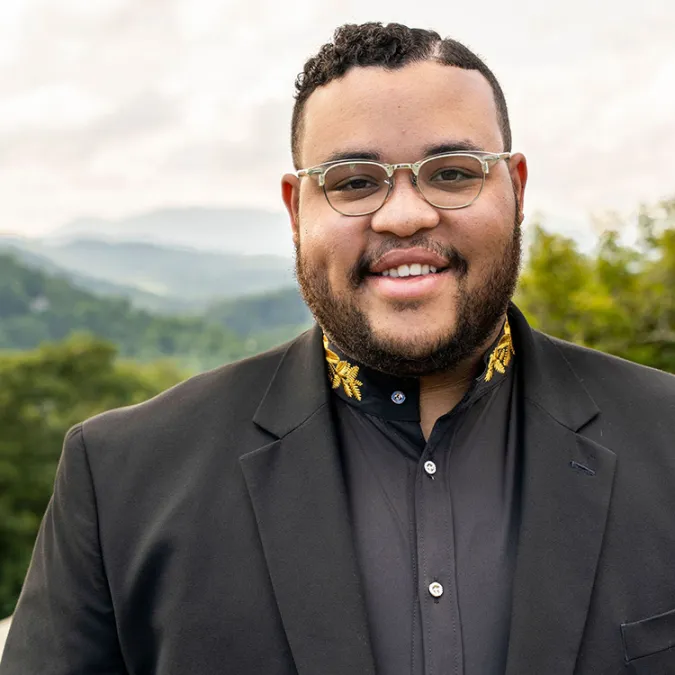
T.j. Anderson (he/him) is associate director of bands at The University of Texas at Austin. He earned his Bachelor’s Degree in Music at Coastal Carolina University, focusing on percussion under the mentorship of Dr. Jesse Willis. T.j. continued his education by pursuing a Master’s Degree in Instrumental Conducting at Appalachian State University. There, he studied primarily with Dr. John Stanley Ross. As a graduate teaching assistant, T.j. made contributions to university bands, teaching conducting, band literature, and band methods courses. He also worked with the Marching Mountaineers as a winds and percussion instructor/arranger and served as Musical Director for the Appalachian Concert Band. In addition to his academic pursuits, T.j. has held leadership roles as Artistic Director and Conductor of the Festive Brass and Assistant Conductor of the Carolina Master Chorale. He is an active member of various professional music and education organizations and has been recognized as an Honorary Brother of Kappa Kappa Psi, Phi Mu Alpha Sinfonia, and a Sigma Alpha Iota Friend of the Arts.
Douglas Henderson

Douglas Henderson serves as associate director of bands at The University of Texas at Austin, where his responsibilities include conducting the Wind Symphony, teaching advanced undergraduate and graduate conducting, and teaching band literature. Prior to joining the UT faculty, Dr. Henderson was an associate professor, associate director of bands, and director of athletic bands at Oklahoma State University. Dr. Henderson is active as a guest conductor, adjudicator, and clinician throughout the United States, and he has guest conducted in Austria and Japan. He is a frequent guest conductor of the World Youth Wind Orchestra Project (WYWOP), in Schladming, Austria. Dr. Henderson received his bachelor of music degree in music studies from The University of Texas at Austin, his master of music degree in wind conducting from Michigan State University, and his doctor of musical arts degree in wind conducting from The University of Texas at Austin. From 2003-2006, he was the associate director of bands at J.J. Pearce High School in Richardson, Texas.
Symphony Band
Flute
Ivanna Aleman-Coronado
Annnasophia Danao
Hailey Hickerson
Eunha Kim
Subin Oh
Elise Yuan
William Webb
Oboe
Bliss Peterson
Tara Tran
Bassoon
Elijah Bergstrom
Danny Frushour
Venuki Gamage
Benjamin Miller
Judith Salas
Darren Tea
Clarinet
Emely Flores
Michael Golston
Adelyn Rusli
Jasmine Salsman
Emelie Wu
Saxophone
Phoenix Alcera
Ben Crowley
Jonathan Dominguez
Nigel Duplessis
Joseph Girard
Brandon Kusaj
Thomas Nuttal
Jacob Otchis
Noah Philip
Matthew Puente
Andrew Schaffer
Eric Wei
Horn
Zachary Greer
Ellie Howard
Rosalie Jones
Sydney Lee
Eliud Pozos
Tomo Umetani
Carter White
Ashley Young
Trumpet
Dash Kostka
Brett Harrington
Scout Howard
Chase McCay
Christopher Ray
Trombone
Jan Campos
Luke Crwaford
Erick Galicia
Joshua Gault
Troy Teggatz
Bass Trombone
Nicholas D’andrea
Hudson Pedrotti
Euphonium
David Barragan
Casey Hawthorne
Sean Hokanson
Matthew Puente
Andrew Shaffer
Tuba
Blake Barngrover
Drake Boff
Andrew Bearse
Carter Eason
Leah Mullens
Antonio Musgrove
Ajeet Nagi
Michael Revilla
Ethan Seibert-Venable
Marco Vittoria
Mark Weston
Samantha Yanez
Percussion
Jackie Garcia
Victoria Garcia
Jacob Laguna
Joel Rodriguez
Cedrick Clark
Thomas Zach
Harp
Anjali Shivkumar
Alyssa Vought
Double Bass
Reilly Curren
Wind Symphony
Flute
Jane Anderson
Juan Fajardo
Koustubh Galagali
Oboe
Emma Ball
Spencer Dwyer
Luke Sanchez
Clarinet
Madison Bookman
Georgia Castillo
Caleb Healy
John Hill
David Leal Jr.
Darien Salter
Bassoon
AB Brown
Naomi Kitamura
Sabrina Pector
Saxophone
Quinlan Collins
Diego Cruz
Austin Davidson
Corey Gutierrez
Daniel Kim
Chantal Lee
Joseph Lowry
Sasha Sanchez
Horn
Benjamin Cummins
Kannon Gregg
Dylan Marquez
Timothy McCormick
Bianca Miller
William Nabors
Trumpet
Rowan Anthony
Adam Dimas
Matthew Nichols
Anthony Ramirez
Harrison Whitfield
Trombone
Lilli Bailey
Luis Cadena
Antonio Gamez
Hunter Irwin
Landon Reimer
Euphonium
Nicolas Love
Adrian Jimenez-Murat
Troy Rosales
Tuba
Chancellor Joseph
Troy Mackabee
Jayden Medina
Percussion
Zach Cunningham
Daniel Hernandez
Khaden Joyner
Kaiwen Luo
Michael Rivera Gonzalez
Antonio Valadez
Harp
Jordan Allen
Keyboard
Weizhen Lai
Bass
Reilly Curren
Event Details
Free admission