


Jerry Junkin, conductor
Cody Ray, guest conductor
James Dick, piano
This concert will last about one hour with one intermission.
Please silence your electronic devices.
Photography, video, or recording of any part of this performance is prohibited
Program
Sergei Rachmaninoff
arr. Patterson
Rhapsody on a Theme of Paganini
e Introduction. Allegro vivace — Variation I (Precedente)
Tema. L'istesso tempo
Variation II. L'istesso tempo
Variation III. L'istesso tempo
Variation IV. Più vivo
Variation V. Tempo precedente
Variation VI. L'istesso tempo
Variation VII. Meno mosso, a tempo moderato
Variation VIII. Tempo I
Variation IX. L'istesso tempo
Variation X. L'istesso tempo
Variation XI. Moderato
Variation XII. Tempo di minuetto
Variation XIII. Allegro
Variation XIV. L'istesso tempo
Variation XV. Più vivo scherzando
Variation XVI. Allegretto
Variation XVII. Allegretto
Variation XVIII. Andante cantabile
Variation XIX. A tempo vivace
Variation XX. Un poco più vivo
Variation XXI. Un poco più vivo
Variation XXII. Un poco più vivo (Alla breve)
Variation XXIII. L'istesso tempo
Variation XXIV. A tempo un poco meno mosso
James Dick, piano
intermission
Samuel Barber
ed. R. Anderson Collinsworth
Commando March
Cody Ray, conductor
Samuel Barber
arr. Patterson
Symphony No. 1 in One Movement, op. 9
About the Program
Program notes by Mark Bilyeu except where noted
Sergei Rachmaninoff
Rhapsody on a Theme of Paganini
Born April 1, 1873, Russia
Died March 28, 1943, New York, USA
Composed 1934
Premiered 1934 by the Philadelphia Orchestra, Sergei Rachmaninoff, piano, Leopold Stokowski, conductor
24 minutes
Rachmaninoff had already composed his four piano concerti when he began working on this concerto-like piece. The work is a set of 24 variations on Niccolò Paganini’s Caprice No. 24 for solo violin. The well-known violin theme had been referenced in music by other composers, notably Liszt and Brahms, and was typically used to signify the hyper-virtuosic style of performance with which Paganini was associated. The Rhapsody has only one movement, but follows the tempo pattern of a typical concerto with a brash opening, a slower lyrical middle section, and a vigorous conclusion. The best-known of the variations is the eighteenth, a beautiful lyrical theme that is simply the original melody in inversion. The Paganini theme is interspersed with quotations of the plainchant Dies irae (Day of Wrath) from the requiem mass. The piece was premiered in 1934 in Baltimore, Maryland with the composer at the piano and Leopold Stokowski conducting, and it was subsequently recorded by the same performers in Camden, New Jersey. The final variation is extremely difficult, and Rachmaninoff is reported to have broken his usual rule against drinking alcohol before a performance with a crème de menthe in order to steady his nerves, leading some to nickname the twenty-fourth the “Crème de Menthe” variation.
– Penny Brandt
Samuel Barber
Commando March
Born March 9, 1910, West Chester, PA
Died January 23, 1981, New York, NY
Composed 1942
Premiered May 23, 1943, Army Air Forces Tactical Training Command Band in Convention Hall, Atlantic City, N.J
4 minutes
"An old-fashioned quickstep sporting a crew cut,” is how the critic Fredric V. Grunfeld described Samuel Barber’s “Commando March,” the Pulitzer Prize–winning composer’s only work for wind band. Barber enlisted in the Army Air Force in 1942, and immediately began setting out to write music for the cause. He finished the work nearly immediately after his enlistment and it premiered in 1943. The work was the summer hit of 1943, and the famed conductor Serge Koussevitzky asked for Barber to adapt it for orchestra. The orchestral adaptation received its premiere with the Boston Symphony in October of that same year — a rather astonishing timeline! Although Barber’s commander requested the piece to utilize quarter-tones (to symbolize what the commander saw as the progressive nature of the air unit), Barber chose an alternate, more tonal, path to create this staple of the repertoire.
Samuel Barber
Symphony in One Movement
Composed 1935-1936
Premiered December 13, 1936, Philharmonic Augusteo Orchestra, Rome, Italy, Bernardino Molinari, conductor
20 minutes
Samuel Barber began work on his “Symphony in One Movement” in August of 1935. At the age of 25, he had already established himself as a force. He was the two-time winner of the Joseph H. Bearns Prize from Columbia University, which led to his symphonic work “Overture to The School for Scandal,” to be premiered by the Philadelphia Orchestra at the age of 21, and in 1934, he had graduated from the prestigious Curtis Institute of Music with degrees in composition, singing, and piano. Just before he began writing this symphony, he recorded his own work “Dover Beach” as the vocal soloist for NBC radio broadcast. He was living his best life, alongside his Curtis classmate and life partner, Gian Carlo Menotti, traveling through Europe with the prize money he had amassed. The work, which he dedicated to Menotti, premiered in Rome while on Fellowship at the American Academy of Arts and Letters, and was given its American premiere by the New York Philharmonic only 14 months later. He wrote his own program note for the New York premiere:
The form of my Symphony in One Movement is a synthetic treatment of the four-movement classical symphony. It is based on three themes of the initial Allegro non troppo, which retain throughout the work their fundamental character. The opens with the usual exposition of a main theme, a more lyrical second theme, and a closing theme. After a brief development of the three themes, instead of the customary recapitulation, the first theme in diminution [where the note values are shortened] forms the basis of a scherzo section (vivace). The second theme (oboe over muted strings) then appears in augmentation [where the note values are lengthened], in an extended Andante tranquillo. An intense crescendo introduces the finale, which is a short passacaglia based on the first theme (introduced by violoncelli and contrabassi), over which, together with figures from other themes, the closing theme is woven, thus serving as a recapitulation for the entire symphony.
About the Artists
James Dick
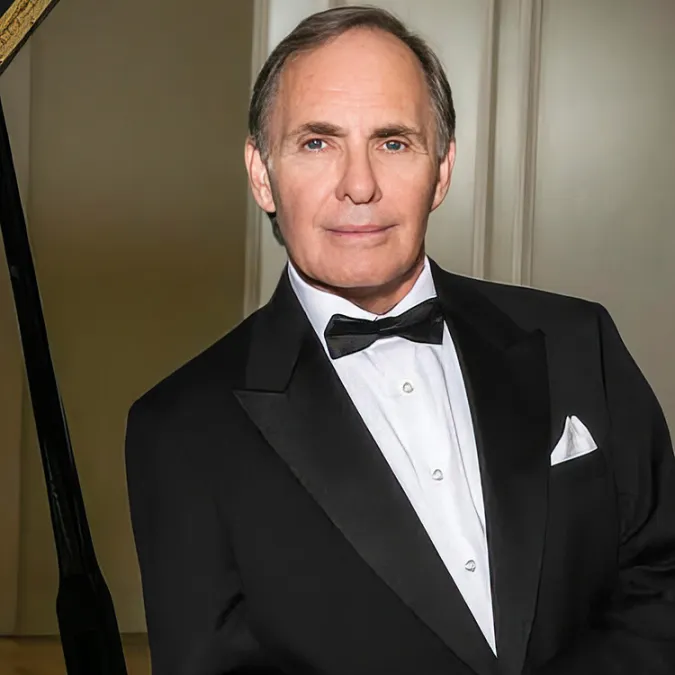
James Dick is recognized as one of the truly important pianists of his generation. As an internationally renowned concert pianist and Steinway artist, Dick brings keyboard performances that radiate intellectual insight and emotional authenticity. Raised in rural Kansas, his talent moved him from the farm to the University of Texas music building and then to the world’s great concert halls. He received a scholarship to The University of Texas at Austin and later was a Fulbright Scholar. Dick’s early triumphs as a major prizewinner in the Tchaikovsky, Bosni and Leventritt International Competitions were a prelude to an eminent career highlighted by acclaimed recitals and concerto performances in the world’s premier concert halls.
Dick has received numerous honors and commendations, including the Texas Medal of Arts, the Chevalier des Arts et Lettres from the French Ministry of Culture, and Honorary Associate of London’s Royal Academy of Music. He is a fervent supporter of new music, having commissioned Benjamin Lees, Dan Welcher, Malcolm Hawkins, and Chinary Ung to write, respectively, “Etudes”, “Shiva’s Drum”, “Rasmandala”, and “Rising Light” for piano and orchestra. In February 1998, James Dick premiered “Flight of Passage: From Silent Sun to Starry Night” by Claude Baker, inspired by the poems of Walt Whitman.
In addition to his schedule as a world-renowned guest artist, in 1971 Dick established the Round Top Festival Institute in Round Top, Texas to nurture and incubate aspiring young musicians. The institute, operated by the James Dick Foundation for the Performing Arts, has grown from a handful of gifted young pianists in a rented space on the town square of Round Top to a 210-acre European-styled campus. Each year, distinguished faculty teach nearly 100 young artists and the festival institute provides year-round education and performance programs for audiences. James Dick is well-known to music lovers as a man of great talent, vision, and refinement.
Cody Ray

Cody Ray is currently pursuing a doctor of musical arts in wind conducting at The University of Texas at Austin where he studies with professor Jerry Junkin and serves as a graduate teaching assistant for University Bands. He received his bachelor of arts in music education from the University of Alabama at Birmingham under the mentorship of Dr. Sue Samuels, Dr. Gene Fambrough, Dr. Cara Morantz, and Dr. Sean Murray, and a master of music in wind conducting from Tte University of South Carolina (’24) studying under Dr. Cormac Cannon, Dr. Jay Jacobs, and Dr. Quintus Wrighten. Prior to his graduate studies, Cody served as the assistant director of bands at Cairo High School in Cairo, GA from 2020-2022. Before coming to Cairo, he also served as director of bands at Sipsey Valley High/Middle School from 2019-2020 and director of bands at Sulligent High School from 2018-2019. His professional affiliations include the National Association for Music Education, the College Band Directors National Association, and the National Band Association.
Jerry Junkin
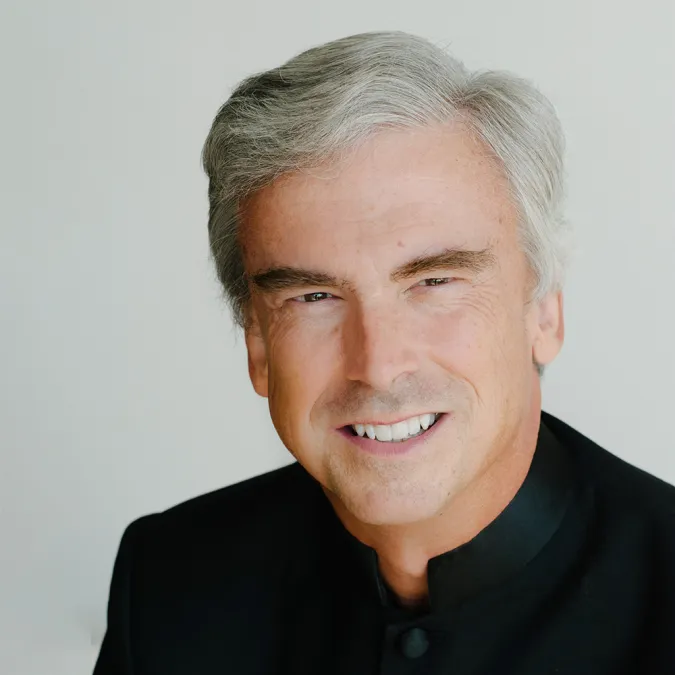
Serving since 1988 on the faculty of The University of Texas at Austin, where he holds the Vincent R. and Jane D. DiNino Chair for the Director of Bands, in addition to serving as a University Distinguished Teaching Professor, Jerry Junkin is recognized as one of the world’s most highly regarded wind conductors. Previously, he served on the faculties of both the University of Michigan and the University of South Florida. In addition to his responsibilities as professor of music and conductor of the Texas Wind Ensemble, he serves as head of the conducting division and teaches courses in conducting and wind band literature. He has served as music director and conductor of the Hong Kong Wind Philharmonia since 2003, and as artistic director and conductor of the Dallas Winds since 1993. He also serves as visiting professor at the Senzoku Gakuen College of Music Wind Ensemble in Tokyo, Japan. Mr. Junkin has conducted All-State bands and festivals in forty-eight states and five continents, and is a Yamaha master educator.
Wind Ensemble
Flute
Gianna Baker
Riley Bender
Kyndahl Britton
Juan Fajardo
Mercedes Gomez
Koustubh Galagali
David Ma
Mia Rodriguez
Oboe
Genevieve Britten
Ryan Hirokawa
Rachel Marquez
E.M. Shank
Clarinet
Madison Bookman
Brynn Carl
Connor Gibson
Caleb Healy
Sadie Murray
Kaitlyn Nohara
Maja Pechanach
Matthew Rockwell
Alayna Rosas
Alexander Vaquerizo
Alex Vo
Bassoon
Jose Gutierrez Martin
Thomas Klink
Rishabh Sajjan
Tucker Van Gundy
Saxophone
Ethan Ashley
Benjamin Kaplan
Matthew Meyers
Levi Peña
Jason Shimer
Andrew Stine
Horn
Daniela Garcia
Cheryll Huddleston
Andrew Ryan
Sam Stephenson
Austin Waldbusser
Tsai-Chen Wu
Trumpet
Samuel Acosta
Rowan Anthony
Jax Latham
William Paladino
Leland Rossi
Aiden Spicer
Jackson Wolf
Americo Zapata
Trombone
Cristian Cantu
Carlos Garcia
Brandon Reyes
Ryan Smalley
Joshua Stout
Euphonium
Miguel Gonzales
Henry Otts
Tuba
Ethyn Evans
Tyler Lane
Percussion
Marcus Alvarado
Colton Townsend
Matt Garcia
Randy Griner
Erika Lin
Harp
Tate Ahmann
Natalie Rochen
Double Bass
Shiying Feng
Eddie Otto
Event Details
$5 – 15
All University of Texas at Austin students are allowed one free ticket as long as they are available. Student tickets must be picked up at the Box Office with valid student I.D. Seating is unassigned.
If you are a patron with specific seating needs, please email tickets@mail.music.utexas.edu and we will reserve ADA seating for you.