




Jerry Junkin, conductor
Emily Warren and T.j. Anderson, guest conductors
Ebonee Thomas, flute
Seraph Brass
This concert will last about 80 minutes with one intermission.
Please silence your electronic devices.
Photography, video, or recording of any part of this performance is prohibited
Program
Lindsay Bronnenkant
Tarot
The Fool
The King of Cups
The Tower
Emily Warren, conductor
Anthony DiLorenzo
Chimera
Daydream
Illusion
Rygon
Seraph Brass
intermission
John Corigliano
trans. T.j. Anderson
The Pied Piper Fantasy
Sunrise and the Piper’s Song
The Rats
Battle with the Rats
War Cadenza
The Piper’s Victory
The Burgher’s Chorale
The Children’s March
T.j. Anderson, conductor
Ebonee Thomas, flute
About the Program
Program notes by Mark Bilyeu
Lindsay Bronnenkant
Tarot
Born 1988
Composed 2021
18 minutes
Gustav Holst was incredibly interested in Indian culture, going so far as to teach himself Sanskrit. Some evidence suggests that he tried to incorporate Indian rāgas into his works, and after investigating Holst’s resources and analyzing his Planets, I believe that Holst tried to reference rāgas that evoked similar characters to those of the planets in his suite. Holst’s access to authentic performance of Indian music was limited, however, and like many composers -- especially as a British composer entrenched in modal composition during the English folk song revival of the early twentieth century -- he took what he understood of rāgas and filled in the gaps with Western theoretical knowledge, resulting in the treatment of what were once rāgas as scales or modes.
I decided to compose a suite that traces Holst’s footsteps but applies his musical experimentation to a new topic: Tarot. Like astrology, Tarot cards have been used for divination, and as each planet in modern astrology represents specific characteristics and personality traits, so too does each Tarot card. Some elements of the Hindustani thāts, Karnātak mēlakarta rāgas, and pitch sets Holst references in his Planets are referenced in Tarot using a similarly Western approach to portray Tarot card analogs.
In Tarot, the Fool represents someone who dives head-first through open doors with enthusiasm (and sometimes with a blissful ignorance of any looming danger). The card represents new beginnings, playfulness, naïveté, and optimism. The first movement, The Fool, contains several intentionally comedic moments as the Fool, unaware of the luck manifesting from his will, manages to skip through a minefield unharmed. The movement references the pitches of the Kalyān that are found in Jupiter, a benefic planet of good fortune, to represent the Fool’s beginner’s luck. The movement also uses the whole-tone scale hinted at in some of Holst’s themes for Uranus, a chaotic and unpredictable planet, to depict the unintentional mayhem that inevitably follows each of the Fool’s steps.
In Tarot, the suit of cups corresponds with emotional energy and the element of water. A deeply empathic soul, the King of Cups tempers his emotions by balancing his heart with his head. The King leads diplomatically through compassion. The second movement, The King of Cups, references the pitches of mēlakarta rāga Dhavalāmbari from Neptune as a nod to a fellow intuitive and ruler of the sea, and additionally employs the pitches of the Bhairavī that are found in Venus to allude to the King’s kind and gentle countenance.The Tower represents surprise, upheaval, and destruction. It represents the collapse of structure, the crumbling of façades based on faulty foundations. The final movement references Mars, the Bringer of War with two similar pitch sets: the one Holst uses in Mars, as well as a theme that Holst may have meant to draw from, Bhairav.
– Lindsay Bronnenkant
Anthony DiLorenzo
Chimera
Born August 8, 1967, Stoughton, Mass.
Composed 2006
Premiered March 11, 2023, United States Army Band, Bruce R. Pulver, conductor, with Seraph Brass
20 minutes
Anthony DiLorenzo has a multi-faceted career as trumpeter, arranger, and composer of everything from original concert music which has been performed by the San Francisco Symphony, the New World Symphony, the Tokyo Symphony and the Boston Pops Orchestra, to movie trailers including Toy Story, Harry Potter, and Forrest Gump, to broadcast television themes for ABC’s College Football, Figure Skating and Horse Racing shows. As his publisher writes, “The Chimera was, according to Greek mythology, a monstrous fire-breathing hybrid creature of Lycia in Asia Minor (modern-day Turkey), composed of the parts of more than one animal. It is usually depicted as a lion, with the head of a goat arising from its back, and a tail that might end with a snake's head, and was one of the offspring of Typhon and Echidna and a sibling of such monsters as Cerberus and the Lernaean Hydra. The term chimera has come to describe any mythical or fictional animal with parts taken from various animals, or to describe anything composed of very disparate parts, or perceived as wildly imaginative, implausible, or dazzling. The seeing of a Chimera was an omen for disaster.”
John Corigliano
Pied Piper Fantasy
Born February 16, 1938, New York City, New York
Composed 1980-1982
Premiered February 4, 1982, James Galway, flute, Los Angeles Philharmonic, Myung-Whun Chung, conductor
38 minutes
When James Galway approached me in 1978 with the idea of writing a flute concerto for him, my initial reaction was, "Oh no, not another wind concerto!" I had already written two (oboe, clarinet) and had planned that my next work would explore quite different territory. I was in a quandary. While I postponed committing myself on the idea of a flute concerto, I decided to put
what I knew of the proposed event together to see if anything interesting and special would result.
So I looked further-particularly into the specialized techniques of the soloist, who also plays the tin whistle. This primitive form of the recorder (a close relative of the flute) is one of the many varieties of "pipes" that are found around the world, and I decided to investigate some of the legends surrounding them. Almost instantly, the tale of the Pied Piper of Hamelin came to mind.
But what was even more exciting was that this could offer me a new way of writing a wind concerto. The idea of a programmatic fantasy-concerto based on the Pied Piper legend became a fascinating structural challenge. I contacted Galway with the proposal of writing a Pied Piper Fantasy and, with his approval, started planning the work.
Robert Browning’s poem “The Pied Piper of Hamelin” is the best known telling of the legend, so I reread it and began to consider how the story could generate the architecture of a flute concerto. The biggest problem was that the legend per se had no elements of virtuosity in it; the Pied Piper played his song to charm the rats and lead them to destruction and piped a march to lead the children away from Hamelin, but there were no actual confrontations or tensions that could lead me to write virtuosically for the soloist. So I had to modify the story a bit, and I included battle scenes between the Piper and the rats and other elements that could set the soloist’s fingers racing.
In restructuring the legend I had to provide a logical continuity for this story, but I also had to produce a satisfying purely musical structure so that the piece worked as a concerto for flute and orchestra too. Inherent in my concept was the idea that the soloist would switch from flute to tin whistle for The Children’s March. I also wanted the march to include other flutes and drums played by children and led by the soloist. I used the jaunty march against an independent orchestral background that evoked the sense of loss generated by the departure of the Piper and children. A technical problem-the fact that two groups of performers each playing music extremely divergent in tempo ideally requires two conductors-thus provoked a theatrical solution: the separation and exit of one of the groups.
The children and the exit became an integral part of the score. While originally conceived for musical reasons, these elements started a chain of theatrical additions to the performance that followed the world premiere in Los Angeles. In London (Galway with the London Symphony) stage and house lights were slowly dimmed as follow-spots tracked the departure of the Piper and the children. In Puerto Rico the young soloist began the introduction to the opening Piper’s Song offstage and entered wearing a cloak. In Israel the performance began in darkness, the lights coming up and growing in brilliance with the orchestral sunrise.
– John Corigliano
About the Artists
Seraph Brass
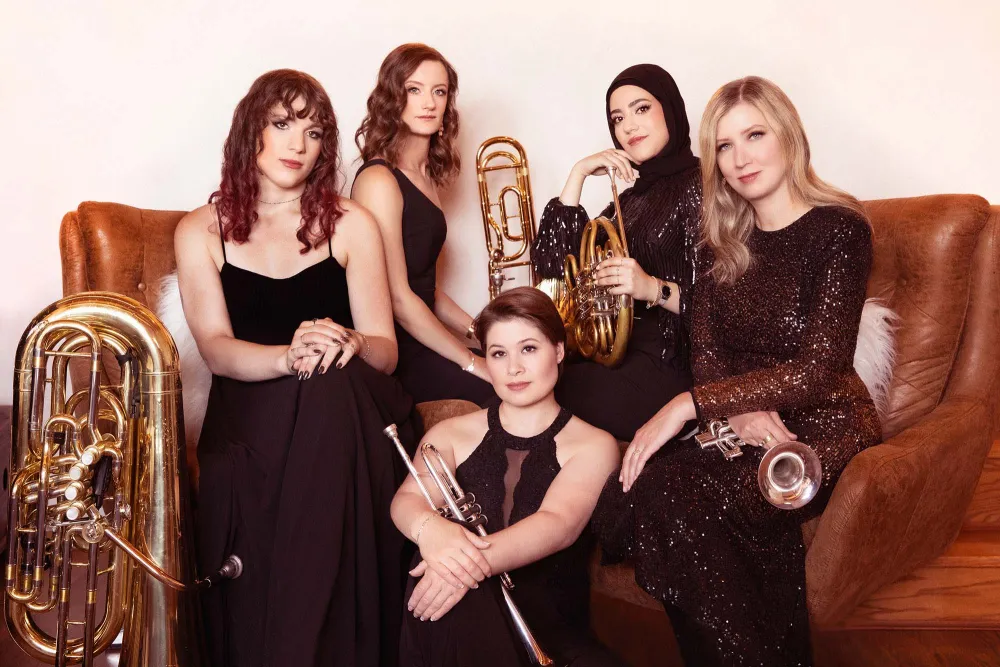
In its 11th season, Seraph Brass was founded by trumpet soloist Mary Elizabeth Bowden with a mission to showcase the excellence of women brass players. Winners of the American Prize in Chamber Music, the group has been praised for its “beautiful sounds" (American Record Guide), "fine playing” (Gramophone), and “staggeringly high caliber of performance” (Textura). Seraph Brass performs a diverse body of repertoire, ranging from original transcriptions to newly commissioned works and core classics. Members of Seraph Brass are passionate about music education and hold teaching positions at the University of North Texas, Shenandoah Conservatory, Texas State University, and Texas Lutheran University.
Seraph Brass: www.seraphbrass.com
Seraph Brass is managed by Reggie Bahl at Lyric Chamber Music Society of New York.
To learn more, please visit www.lyricny.org or call 212.496.9927
Emily Warren
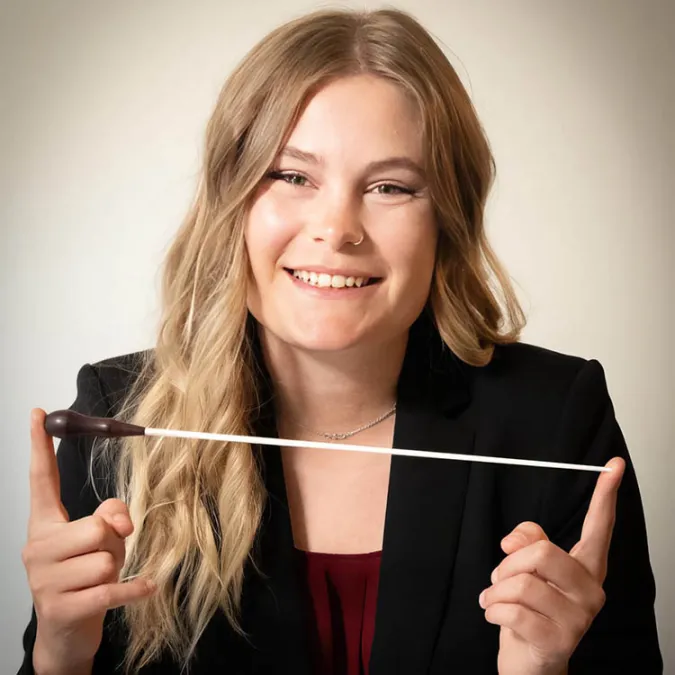
Emily Warren attends The University of Texas at Austin, where she is currently pursuing a doctor of musical arts degree in wind conducting. As a graduate teaching assistant, she works with the university’s athletic and concert bands, assisting with administrative duties and conducting the ensembles. Additionally, she teaches courses in conducting and wind band literature. Prior to her graduate studies, Emily lived in Massachusetts where she spent four years as a public school music educator. She is a specialist in electroacoustic repertoire for wind ensemble and has been invited to present her research internationally, most recently at the IGEB (International Society for the Promotion and Research of Wind Music) conference in Valencia, Spain. Emily holds a bachelor's degree in music education from Indiana University and a master's degree in wind conducting from the University of Kansas, where she studied under the direction of Dr. Paul Popiel. She is an active member of various professional music organizations, including CBDNA, TMEA, IGEB, and is an honorary member of Kappa Kappa Psi.
T.J. Anderson
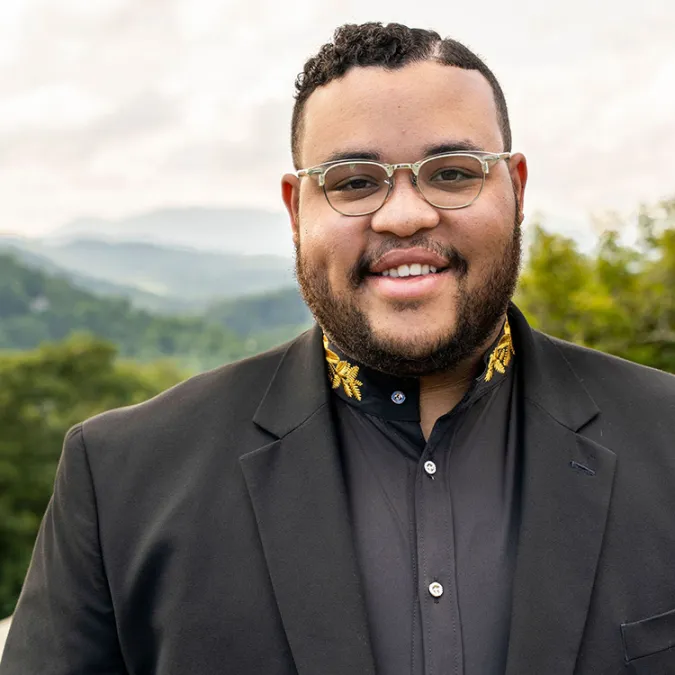
T.j. Anderson (he/him) is associate director of bands at The University of Texas at Austin. He earned his Bachelor’s Degree in Music at Coastal Carolina University, focusing on percussion under the mentorship of Dr. Jesse Willis. T.j. continued his education by pursuing a Master’s Degree in Instrumental Conducting at Appalachian State University. There, he studied primarily with Dr. John Stanley Ross. As a graduate teaching assistant, T.j. made contributions to university bands, teaching conducting, band literature, and band methods courses. He also worked with the Marching Mountaineers as a winds and percussion instructor/arranger and served as Musical Director for the Appalachian Concert Band. In addition to his academic pursuits, T.j. has held leadership roles as Artistic Director and Conductor of the Festive Brass and Assistant Conductor of the Carolina Master Chorale. He is an active member of various professional music and education organizations and has been recognized as an Honorary Brother of Kappa Kappa Psi, Phi Mu Alpha Sinfonia, and a Sigma Alpha Iota Friend of the Arts.
Ebonee Thomas

Thomas is the second flute and piccolo for The Dallas Opera, and has previously served as principal flute of the Knoxville Symphony, principal flute of the Florida Grand Opera, and second flute of the Houston Symphony. She spends her summers as a flutist at Lakes Area Music Festival and Music in the Mountains, and has been guest principal with symphonies and opera companies across the country. A passionate pedagogue, Thomas served as a member of the board of the Greater Dallas Youth Orchestras and is on the national advisory board of the Memphis Youth Symphony Program. She is also currently the piccolo committee chair for the National Flute Association. An avid chamber musician, Thomas has worked with the Austin Chamber Music Society and Voices of Change, a new music ensemble in Dallas. She recently made her debut performance with the ensembleNEWSRQ, a contemporary ensemble highlighting living and underrepresented composers. Thomas received her Bachelor of Music in flute performance from Southern Methodist University and her Master of Music from New England Conservatory of Music. She is a Burkart Piccolo Artist and plays on a Burkart Elite piccolo and 998 flute.
Jerry Junkin
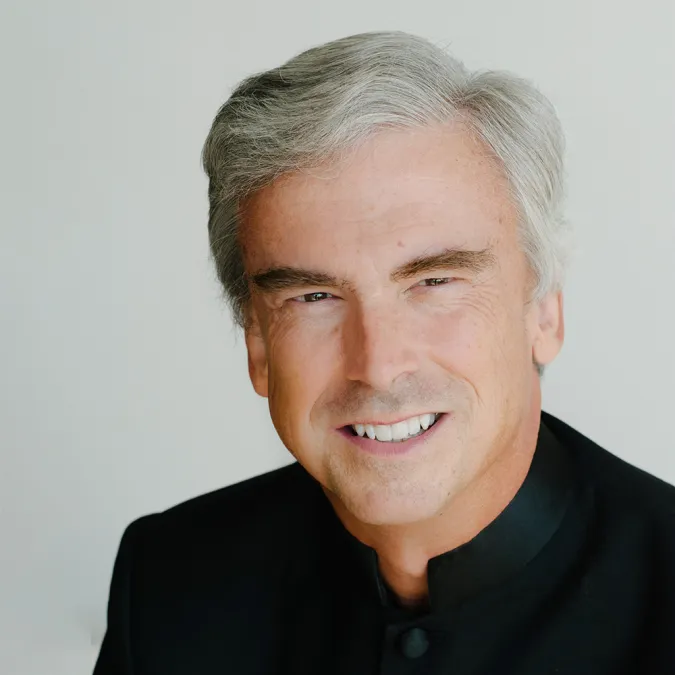
Serving since 1988 on the faculty of The University of Texas at Austin, where he holds the Vincent R. and Jane D. DiNino Chair for the Director of Bands, in addition to serving as a University Distinguished Teaching Professor, Jerry Junkin is recognized as one of the world’s most highly regarded wind conductors. Previously, he served on the faculties of both the University of Michigan and the University of South Florida. In addition to his responsibilities as professor of music and conductor of the Texas Wind Ensemble, he serves as head of the conducting division and teaches courses in conducting and wind band literature. He has served as music director and conductor of the Hong Kong Wind Philharmonia since 2003, and as artistic director and conductor of the Dallas Winds since 1993. He also serves as visiting professor at the Senzoku Gakuen College of Music Wind Ensemble in Tokyo, Japan. Mr. Junkin has conducted All-State bands and festivals in forty-eight states and five continents, and is a Yamaha master educator.
Wind Ensemble
Flute
Elizabeth Alsenz
Mercedes Gomez
David Ma
Nichole Thompson
Oboe
Mary Creel
Lademi Davies
Noah O’Brien
Clarinet
Andrew Battaglia
Chase Cano
Brynn Carl
Sarah Darragh
John Hill
Katelyn Nguyen
Kaitlyn Nohara
Natalie Eddings
Alex Vo
Bassoon
Daniel Alvarez
José Gutiérrez Martínez
Mario Rios Valverde
Saxophone
Ethan Ashley
Benjamin Kaplan
Matthew Meyers
Levi Peña
Jason Shimer
Andrew Stine
Horn
Stephanie Chiang
Owen Clark
Andrew Clarkson
Andrew Ryan
Tsai-Chen Wu
Trumpet
Harmon Byerly
Jax Lathan
Enrique Lopez
Will Paladino
Leland Rossi
Ayden Spicer
Trombone
Jace Byrd
Cristian Cantu
Brandon Reyes
Ryan Smalley
Konner Wetterstrom
Euphonium
Miguel Gonzales
Henry Otts
Tuba
Jeffrey Fields
Tyler Lane
Percussion
Aaryn Avila
Spencer Frismanis
Ashley Hsu
Marcos Jurado
Ty Keller
Erika Lin
Bella Scotti
Harp
Jordan Allen
Kirsten Karamihan
Keyboard
Claire Chiang
Shao-Chu Pan
Double Bass
Shiying Feng
Eddie Otto
Pied Piper Fantasy Audience Ensemble
Flute
Eunha Kim
Mia Rodriguez
Lizz Han
Nichole Thompson
Mananya Gupta
Patrick Umanzor
Koustubh Galagali
Will Webb
Ai Ni Wu
Percussion
Gabe Boyer
Antonio Valadez
Zach Cunningham
Kaiwen Luo
Upcoming Events
Mahler Symphony No. 2
Resurrection
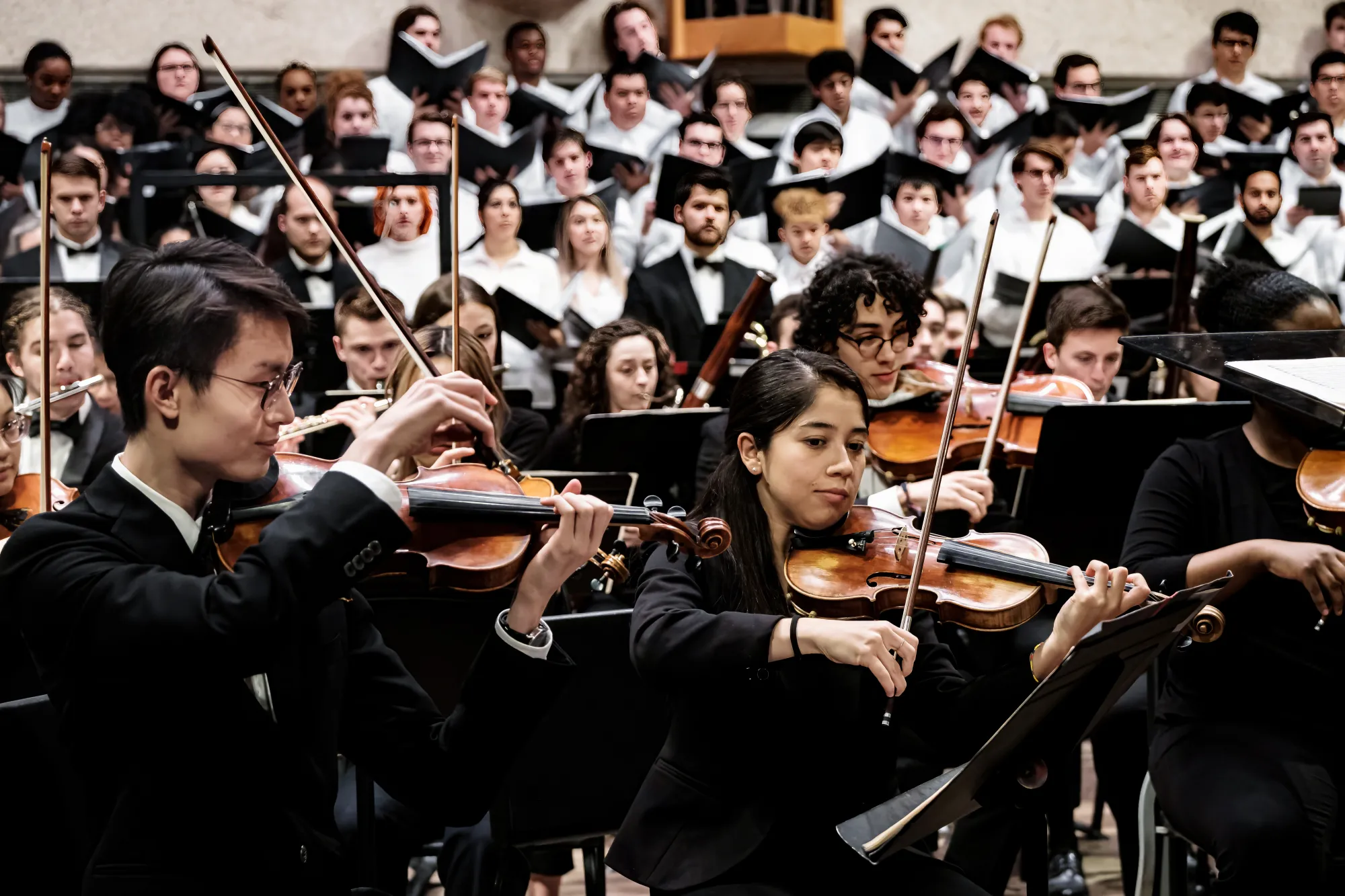
Symphony Orchestra & Combined Choirs
Leah Crocetto, soprano
Sophio Dzidziguri, mezzo soprano
One of the most beloved symphonies in the canon, Mahler's "Resurrection" symphony boasts a large orchestra, mezzo and soprano soloists, and similarly to Beethoven's 9th Symphony, a large choir in the final movement. For this performance, the Butler School's Concert Chorale and University Chorus ensembles will join forces; they will be joined by Butler School alumni singers and community choral singers from around Austin.
Tuesday, March 31, 8:00 p.m.
Long Center for the Performing Arts
Event Details
$5 – 15
All University of Texas at Austin students are allowed one free ticket as long as they are available. Student tickets must be picked up at the Box Office with valid student I.D. Seating is unassigned.
If you are a patron with specific seating needs, please email tickets@mail.music.utexas.edu and we will reserve ADA seating for you.