




Farkhad Khudyev, conductor
Behzod Abduraimov, piano
This concert will last about 90 minutes with one intermission.
Please silence your electronic devices.
Photography, video, or recording of any part of this performance is prohibited
Program
Pyotr Ilyich Tchaikovsky
Polonaise from Eugene Onegin, op. 24
Margaret Bonds
The Montgomery Variations
Decision
Prayer Meeting
March
Dawn in Dixie
One Sunday in the South
Lament
Benediction
intermission
Tchaikovsky
Piano Concerto No.1 in B-flat Minor, op. 23
Allegro non troppo e molto maestoso
Andantino semplice
Allegro con fuoco
Behzod Abduraimov, piano
About the Program
Program notes by Mark Bilyeu except where noted
Pytor Ilyich Tchaikovsky
Polonaise from Eugene Onegin
Born May 7, 1840 Votkinsk, Russia
Died November 6, 1893 Saint Petersburg, Russia
Composed 1877-1888
Premiered March 29, 1879, Maly Theatre in Moscow, Russia
5 minutes
“An artist lives a double life: an everyday human life and an artistic life, and the two do not always go hand in hand,” Tchaikovsky once wrote, and this was never more true for the artist than in 1877. Immersed in the writing of his opera Eugene Onegin, he received a letter from a woman named Antonina Ivanovna Milyukova declaring her love for the composer. After receiving no response, she sent several more, eventually threatening suicide if he refused to meet her. A month later they met, and the composer tried to explain that he could not love her as she wanted (Tchaikovsky’s sexuality and same-sex attractions are known, despite his own—necessary—discreet communications, and the Soviet efforts to expunge all references to homosexuality so they might portray this Russian hero as heterosexual). Yet, he was so affected by the similarities between Onegin’s rejection of Tatyana and his own situation that he proposed to Milyukova a week later, with her clear understanding that their marriage would never be consummated. A month later, they were married, and within two weeks, Tchaikovsky escaped to Kiev, and their marriage dissolved. It was shortly after his travels to Kiev that he began orchestrating his opera, which included the opening music to Act III: the robust Polish dance of the polonaise.
Margaret Bonds
Montgomery Variations
Born March 3, 1913, Chicago, IL
Died April 26, 1972, Los Angeles, CA
Composed 1964
30 minutes
Margaret Bonds composed her “Montgomery Variations” in the wake of the 1963 firebombing of Birmingham, Alabama’s 16th Street Baptist Church, a target of white nationalists, as Birmingham had become a center of Black organizing for equal rights.
The Montgomery Variations is a group of freestyle variations based on the Negro Spiritual theme, “I want Jesus to Walk with Me.” The treatment suggests the manner in which Bach constructed his partitas—a bold statement of the theme, followed by variations of the theme in the same key—major and minor. The words are as follows:
I want Jesus to walk with me.
All along my pilgrim journey,
Lord, I want Jesus to walk with me.
In my trials, Lord, walk with me.
When my heart is almost breaking,
Lord, I want Jesus to walk with me.
When I’m in trouble, Lord, walk with me.
When my head is bowed in sorrow,
Lord, I want Jesus to walk with me.
Because of the personal meanings of the Negro spiritual themes, Margaret Bonds always avoids over-development of the melodies.
“The Montgomery Variations” were written after the composer’s visit to Montgomery, Alabama, and the surrounding area in 1963 (on tour with Eugene Brice and the Manhattan Melodaires).
In December 1960, “The Ballad of the Brown King” was dedicated to Martin Luther King, Jr., and presented at Clark Center, YWCA in New York, by the Church of the Master and Clark Center as a benefit to Southern Christian Leadership Conference. Langston Hughes, the author of the text, was present on this occasion.
Decision
Under the leadership of Martin Luther King Jr. and SCLC, Negroes in Montgomery decided to boycott the bus company and to fight for their rights as citizens.
Prayer Meeting
True to custom, prayer meetings precede their action. Prayer meetings start quietly with humble petitions to God. During the course of the meeting, members seized with religious fervor shout and dance. Oblivious to their fellow worshippers they exhibit their love of God and their Faith in Deliverance by gesticulation, clapping and beating their feet.
March
The Spirit of the Nazarene marching with them, the Negroes of Montgomery walked to their work rather than be segregated on the buses. The entire world, symbolically with them, marches.
Dawn in Dixie
Dixie, the home of the Camellias known as “pink perfection,” magnolias, jasmine and Spanish moss, awakened to the fact that something new was happening in the South.
One Sunday in the South
Children were in Sunday School learning about Jesus, the Prince of Peace. Southern “die-hards” planted a bomb and several children were killed.
Lament
The world was shaken by the cruelty of the Sunday School bombing. Negroes, as usual, leaned on their Jesus to carry them through this crisis of grief and humiliation.
Benediction
A benign God, Father and Mother to all people, pours forth Love to His children – the good and the bad alike.
– Margaret Bonds
Pytor Ilyich Tchaikovsky
Piano Concerto No. 1 in B-flat Minor, Op. 23
Composed 1874-1875
Premiered October 13, 1875
30 minutes
Before the world universally loved Tchaikovsky's first piano concerto, Nikolai Rubinstein hated it. Really hated it. On Christmas Eve of 1894, Tchaikovsky went over to Rubinstein’s home, and as he recounted: “I played the first movement. Never a word, never a single remark. Do you know the awkward and ridiculous sensation of putting before a friend a meal which you have cooked yourself, which he eats—and then holds his tongue? Oh, for a single word, for friendly abuse, for anything to break the silence! For God’s sake say something! But Rubinstein never opened his lips.”
‘Well?’ I asked, and rose from the piano. Then a torrent broke from Rubinstein’s lips, gentle at first, gathering volume as it proceeded, and finally bursting into the fury of a Jupiter. My concerto was worthless, absolutely unplayable; the passages so broken, so disconnected, so unskillfully written, that they could not even be improved; the work itself was bad, trivial, common; here and there I had stolen from other people; only one or two pages were worth anything; all the rest had better be destroyed. I left the room without a word. Presently Rubinstein came to me and, seeing how upset I was, repeated that my concerto was impossible but said if I would suit it to his requirements he would bring it out at his concert. ‘I shall not alter a single note,’ I replied.
Tchaikovsky then took his (unedited) score to the German pianist and conductor Hans von Bülow, particularly known as an advocate for the Wagnerian movement, who immediately agreed to premiere the work in Boston. The first movement’s combination of lush orchestrations and virtuosic pianism culminate in the work’s iconic cadenza. The second movement utilizes the tune of a popular French tune "Il faut s’amuser, danser et rire", a favorite tune of Désirée Artôt, a Belgian soprano whom Tchaikovsky courted briefly about five years earlier. The final movement’s freewheeling finale incorporates the Ukrainian folk tune most often sung by blind beggars.
Bülow gave the first performance on October 13, 1875 to great acclaim (the program also included Beethoven’s Moonlight Sonata and Liszt’s version with orchestra of Schubert’s Wanderer Fantasy), and he sent a telegram to Tchaikovsky back in Russia to inform him of the success. It was to be the first cable sent from Boston to Moscow.
About the Artists
Behzod Abduraimov
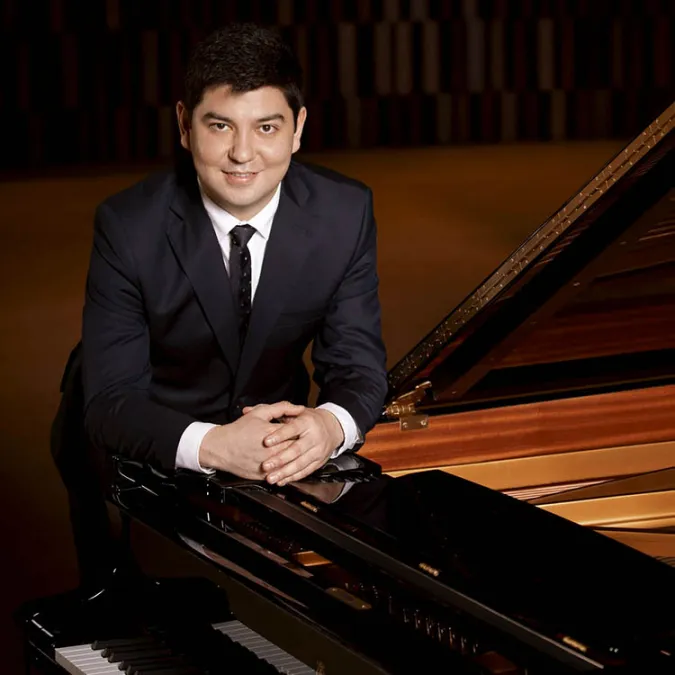
Abduraimov’s performances combine an immense depth of musicality with phenomenal technique and delicacy. He performs with many of the world’s leading orchestras and conductors, and his critically acclaimed recordings have set a new standard for the piano repertoire. Behzod has a number of notable debuts in the 2025/26 season including with the New York Philharmonic and National Symphony Orchestra (Washington, D.C.), both with Gianandrea Noseda. Other concerto performances include Houston and Pittsburgh Symphonies as well as Orchestra dell’Accademia Nazionale di Santa Cecilia, Frankfurt Opern- und Museumsorchester and Hong Kong Philharmonic. Behzod Abduraimov (born 11 September 1990) is an Uzbek pianist. A former student of Van Cliburn International Piano Competition and gold medalist Stanislav Ioudenitch at Park University's International Center for Music (ICM), he has been described by The Independent as "the most perfectly accomplished pianist of his generation."
Farkhad Khudyev
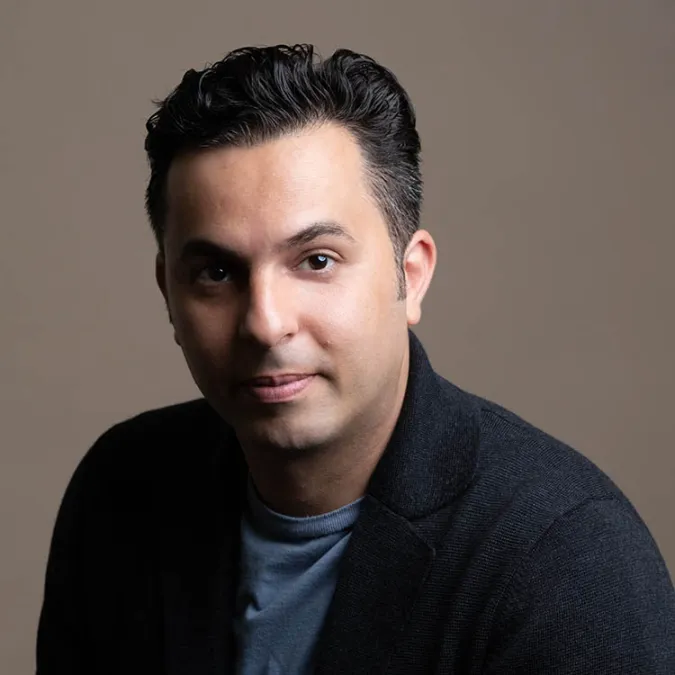
Farkhad Khudyev is the winner of the Gold Medal “Beethoven 250” at the 1st International Arthur Nikisch Conducting Competition; the Solti Foundation US 2018 and 2022 Career Assistance Award; the Best Interpretation Prize at the 1st International Taipei Conducting Competition; the 3rd prize at the 8th International Sir Georg Solti Conducting Competition; and the Gold Medal/Grand Prize at the 2007 National Fischoff Competition. Khudyev has worked with orchestras worldwide including the London Philharmonic Orchestra, Frankfurt Radio Symphony Orchestra, Frankfurt Opera Orchestra, Danish National Symphony Orchestra, Seattle Symphony, Dallas Symphony, Los Angeles Philharmonic, San Diego Symphony, Monterey Symphony, George Enescu Philharmonic Orchestra, Xi’an Symphony Orchestra and the State Taipei Chinese Orchestra. Farkhad was born in Turkmenistan, where he studied at the State Music School for gifted musicians, and then completed his studies at Interlochen Arts Academy, Oberlin Conservatory and Yale University. Khudyev serves as the Music Director of the University of Texas Symphony Orchestra in Austin, and the Orchestral Institute at the Hidden Valley Institute of the Arts in Carmel, California.
Symphony ORchestra
Violin I
Yida An, concertmaster
Chloe Yofan
Mei Liu
Yusong Zhao
Wells Gjerlow
Jordan Bartel
Zi Wang
Suhyun Lim
Kai Lindsey
Emma Thackeray
Cade Carter
Dyer McLeod
Violin II
Summer Bradshaw, principal
Shijie Li
Misa Stanton
Brandon Garza
Evelyn Lee
Jackie Shim
Eric Wang
Sui Shimokawa
Lamu Zhaxi
Mia Zajicek
Qiyan Xing
Ivan Arras
Viola
Jason Lan, principal
Thomas Gougeon
Nelle Joung
Cecilia Nguyen
Kyle Adams
Grace Dias
Gwendolyn Lay
Cello
Aidan Bolding, principal
Javy Liu
Katsuaki Arakawa
Savva Wagner
William Han
Nicole Parker
Christopher Tran
Selina Xu
Kyra Hong
Arturo Gonzalez
Double Bass
Will Penn, principal
Andres Hernandez
Lucas Scott
Aizza Guerrero
Ema Deguchi
Natalia Guerra
Lydia Chen
Mirabai Weatherford
Piccolo
Elizabeth Alsenz
Flute
Elizabeth Alsenz
Diego Arias2,3
Nichole Thompson1
Oboe
Mary Creel1
Noah O’Brien2
E.M. Shank3
English Horn
E.M. Shank
Clarinet
Sarah Darragh3
Kaitlyn Nohara2
Mason Smtih1
Bass Clarinet
Mason Smith
Bassoon
George Alazar2,3
Daniel Alvarez
Mario Rios Valverde1
Contraassoon
Mario Rios Valverde
Horn
Charlotte Allen
Andrew Clarkson
Daniela Garcia2
Cheryll Huddleston3
Austin Waldbusser1
Trumpet
Harmon Byerly1
Jax Latham3
JT Wolf2
Trombone
Cristian Cantu1, 2
Brandon Reyes3
Konner Wetterstrom
Bass Trombone
Ryan Smalley
Tuba
Jeffrey Fields
Timpani
Sean Simpson1
Ashley Hsu2
Percussion
Ashley Hsu
Ty Keller
Sean Simpson
Assistant Conductors
Chris Tran
Matthew Pavon
1. Tchaik Polonaise
2. Bonds
3. Tchaik Piano Concerto
Upcoming Events
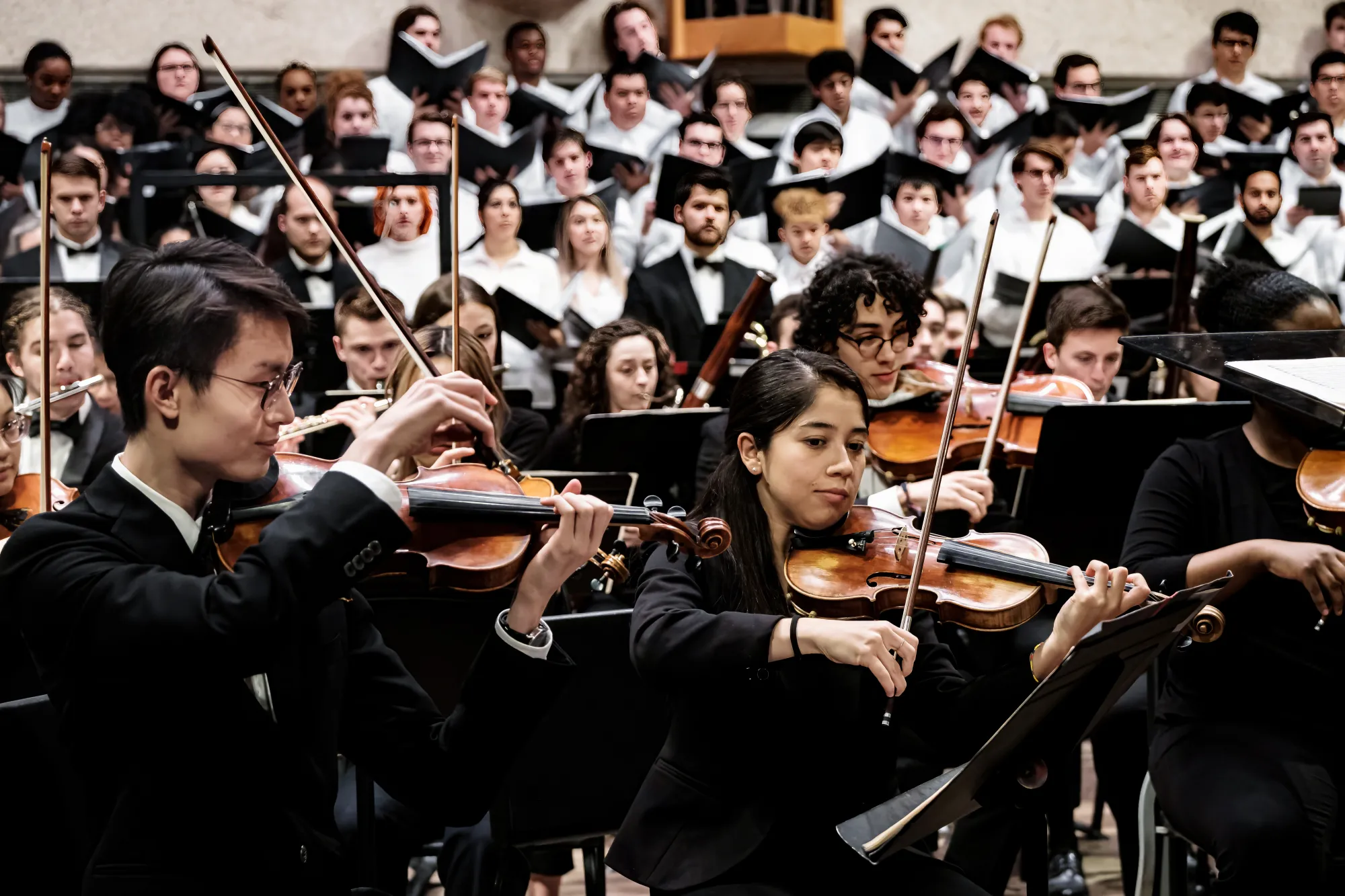
Mahler Symphony No. 2
Resurrection
Symphony Orchestra & Combined Choirs
Leah Crocetto, soprano
Sophio Dzidziguri, mezzo soprano
One of the most beloved symphonies in the canon, Mahler's "Resurrection" symphony boasts a large orchestra, mezzo and soprano soloists, and similarly to Beethoven's 9th Symphony, a large choir in the final movement. For this performance, the Butler School's Concert Chorale and University Chorus ensembles will join forces; they will be joined by Butler School alumni singers and community choral singers from around Austin.
Tuesday, March 31, 8:00 p.m.
Long Center for the Performing Arts
Event Details
$5 – 15
All University of Texas at Austin students are allowed one free ticket as long as they are available. Student tickets must be picked up at the Box Office with valid student I.D. Seating is unassigned.
If you are a patron with specific seating needs, please email tickets@mail.music.utexas.edu and we will reserve ADA seating for you.