




This concert will last about 70 minutes without intermission.
Please silence your electronic devices.
Photography, video, or recording of any part of this performance is prohibited
Program
Gustav Holst
Jupiter, from The Planets
Muzio Clementi
Sonata in B-flat, Op. 12 No. 5
Allegro assai
Andante espressivo
Presto
Claude Debussy
arr. Ravel
Nocturnes
Nuages
Fêtes
Sirènes
Leonard Bernstein
arr. Brownell
Three Dance Episodes from On the Town
The Great Lover Displays Himself
Lonely Town: Pas de deux
Times Square: 1944
About the Program
Gustav Holst
Jupiter from The Planets
Born September 21, 1874 Cheltenham, UK
Died May 25, 1934
Composed between 1914-1917
Premiered Sept 29, 1918
8 minutes
On September 29, 1918, Gustav Holst attended the premiere of his newest work, The Planets, at Queen’s Hall, London, in front of an invited audience of about 250 people. A hundred years later, he could have never imagined how influential, widely-performed, and ubiquitous this music would be. Holst described the seven-movement cycle as “a series of mood pictures,” which acted as “foils to one another.” Holst himself was fascinated with astrology, and became known as “a remarkably skilled interpreter of horoscopes,” according to author Clifford Bax. Holst’s daughter, Imogen Holst, recalled the private premiere, writing, “Even those listeners who had studied the score for months were taken aback by the unexpected clamour of “Mars”. During “Jupiter” the charwomen working in the corridors put down their scrubbing-brushes and began to dance. In “Saturn” the isolated listeners in the dark, half-empty hall felt themselves growing older at every bar. But it was the end of “Neptune” that was unforgettable, with its hidden chorus of women's voices growing fainter and fainter in the distance, until the imagination knew no difference between sound and silence.”
“Jupiter, the Bringer of Jolity,” is the fourth movement of this cycle, and was so popular that it was later used as the melody for the patriotic hymn “I Vow to Thee, My Country,” only two years after that initial premiere. Originally a symphonic work, the movements “Jupiter” and “Mars” were immediately arranged for wind band by two students, who were likely supervised by Holst himself. It was Merlin Patterson who made a complete transcription of the suite (heard today), taking everything from the original orchestral work, and representing it in its original key, with nothing omitted or changed.
Muzio Clementi
Duet in B-Flat Major, op. 12, no. 5
Born January 23, 1752, Rome
Died March 10, 1832, Evesham, Worcestershire, England
Published 1784
20 minutes
Muzio Clementi had a wide ranging career as a pianist, pedagogue, composer, publisher, and innovator. His playing might be best remembered for the 1781 Christmas Eve duel he had with Mozart for the entertainment of the Roman Emperor Joseph II (a tie was declared). The lineage of pupils he left behind was impressive: Ignaz Moscheles, Therese Jansen Bartolozzi, Johann Nepomuk Hummel, and John Field to name just a few, and his compositions were wildly popular, having written over 100 keyboard sonatas. These compositions developed from harpsichord works to works intended for fortepiano—a trajectory which, along with his innovative mechanical advancements for the instrument, garnered him the name “Father of the Piano.” Early on, he was very interested in piano duets; the genre had been quite en vogue as Clementi was being introduced to the public—it was in 1765 when the young Mozart and his sister Nannerl had performed (according to their father) the first sonata of the genre (Mozart K. 19d). This caused a public demand for music of this type from the publishers, and Clementi was eager to deliver. His duet from op. 12 is the final entry in this opus, and the only duet of the set. It was the first to be labeled “for two pianofortes,” which brought the use of keyboard writing into a new level of dynamic variation. It was also the first duet he published to include a slow movement.
Claude Debussy
Trois Nocturnes
Born August 22, 1862, Saint-Germain-en-Laye, France
Died March 25, 1918 , Paris, France
Composed 1892-1899
Premiered December 9, 1900 (Nuages, Fêtes); October 27, 1901, (Sirènes), Lamoureux Orchestra, Camille Chevillard, conductor
25 minutes
Inspired by the poetry of French symbolist Henri de Régnier, Debussy first had the idea to create a dusky triptych in 1982. The idea resulted in his Trois Scènes au Crépuscule ("Three Scenes at Twilight"), and after several iterations, new inspirations, and re-imaginings, became his Nocturnes. After his initial draft of the work, Debussy pivoted, and in 1894 described his new idea to the violin maverick Eugène Ysaÿe as "an experiment in the different combinations that can be achieved with one colour—what a study in grey would be in painting." He had told Ysaÿe this as a way to entice him into committing to a version for violin and orchestra, which never manifested, and in 1897, Debussy decided to craft his set of three nocturnes for full orchestra. Debussy himself wrote an introduction in the program for the work’s premiere:
The title 'Nocturnes' is to be interpreted here in a general and, more particularly, in a decorative sense. Therefore, it is not meant to designate the usual form of the Nocturne, but rather all the various impressions and the special effects of light that the word suggests. Nuages renders the immutable aspect of the sky and the slow, solemn motion of the clouds, fading away in grey tones lightly tinged with white. Fêtes gives the vibrating, dancing rhythm of the atmosphere with sudden flashes of light. There is also the episode of the procession (a dazzling fantastic vision), which passes through the festive scene and becomes merged in it. But the background remains resistantly the same: the festival with its blending of music and luminous dust participating in the cosmic rhythm. Sirènes depicts the sea and its countless rhythms and presently, amongst the waves silvered by the moonlight, is heard the mysterious song of the Sirens as they laugh and pass on.
Ten years after its premiere, Maurice Ravel andIn 1910, Maurice Ravel and Raoul Bardac (Debussy’s pupil and stepson) created a transcription of the work for two pianos and gave the premiere in 1911. A review by Pierre de Bréville in the Mercure de France described the work as "pure music, conceived beyond the limits of reality, in the world of dreams, among the ever-moving architecture that God builds with mists, the marvelous creations of the impalpable realms."
Leonard Bernstein
Three Dance Episodes from On the Town
Born Month, August 25, 1918, Lawrence, MA
Died Month, October 14, 1990, New York, NY
Composed 1944
Premiered February 3, 1946, San Francisco Symphony, Leonard Bernstein, conductor
10 minutes
The idea for Leonard Bernstein’s On the Town emerged in 1944, just one year after choreographer Jerome Robbins crafted a ballet he called Fancy Free, which he had set to Bernstein’s music. The ballet scene involved three male sailors in search of companionship from the opposite sex while they are back on land for a short period. After the ballet’s success, Bernstein and Robbins convinced their friends, the writing duo of Betty Comden and Adolph Green, to craft a book and write song lyrics. What resulted was the Broadway musical On the Town, which was later adapted into a 1949 movie starring Gene Kelly and Frank Sinatra. Bernstein crafted three dance episodes from the original Broadway score for concert use:
The first episode is Dance of the Great Lover, in which the romantic sailor Gabey falls asleep on the subway and dreams of sweeping Miss Turnstiles off her feet; the effervescent music underlines Gabey’s naiveté as well as his determination.
In the second episode, Pas de Deux, Gabey watches a scene, “both tender and sinister, in which a sensitive high-school girl in Central Park is lured and then cast off by a worldly sailor.” This is set to Lonely Townthsp—thspone of Bernstein’s greatest tunes, worthy of his friend and mentor Aaron Copland in its air of reflective melancholy.
The finale, Times Square Ballet is described by Bernstein as “a more panoramic sequence in which all the sailors congregate in Times Square for their night of fun.” Part of the action takes place in the Roseland Dance Palace, with music to match. The famous “New York, New York, it’s a helluva town” theme makes a cameo appearance.
About the Artists
Patti Wolf
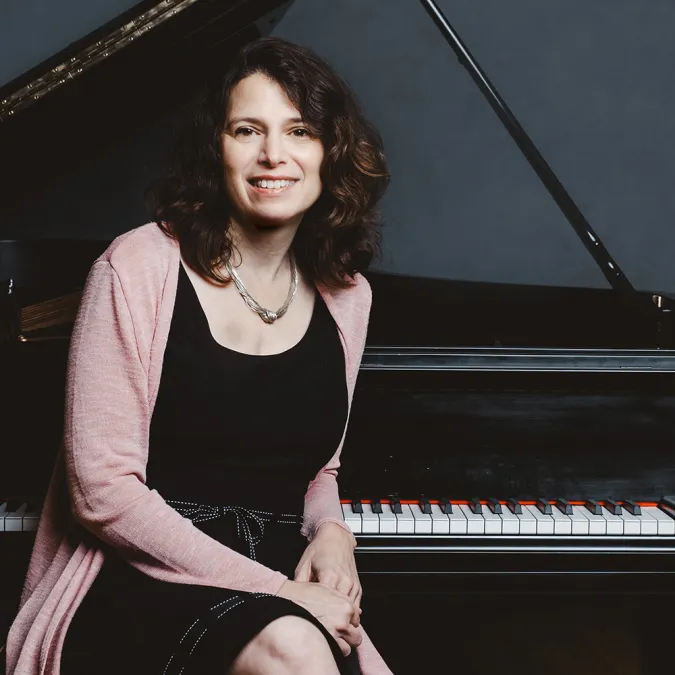
Since being chosen at age nineteen as the youngest competitor of the 1985 Van Cliburn Competition, Patti Wolf has performed as a soloist, recitalist, and chamber musician. She has collaborated in recital with many of the world’s most distinguished musical artists, such as cellist Lynn Harrell, pianist Jon Kimura Parker, flutist Carol Wincenc, violinist Ilya Kaler, concertmasters Glenn Dicterow, Andrés Cárdenas, David Halen and Nina Bodnar, soprano Erin Wall, Chicago Symphony principal horn Dale Clevenger, and renowned German horn soloist and recording artist Hermann Baumann. In 2017, Ms. Wolf joined the faculty at the University of Texas, Austin, Butler School of Music, where she is assistant professor of practice in collaborative piano. She performs regularly with faculty members and has been a guest recently with the Austin Symphony, San Antonio Symphony, Lyrica Baroque in New Orleans, and HeightsArts in Cleveland, Oh, performing with musicians of the Cleveland Orchestra.
Andrew Brownell
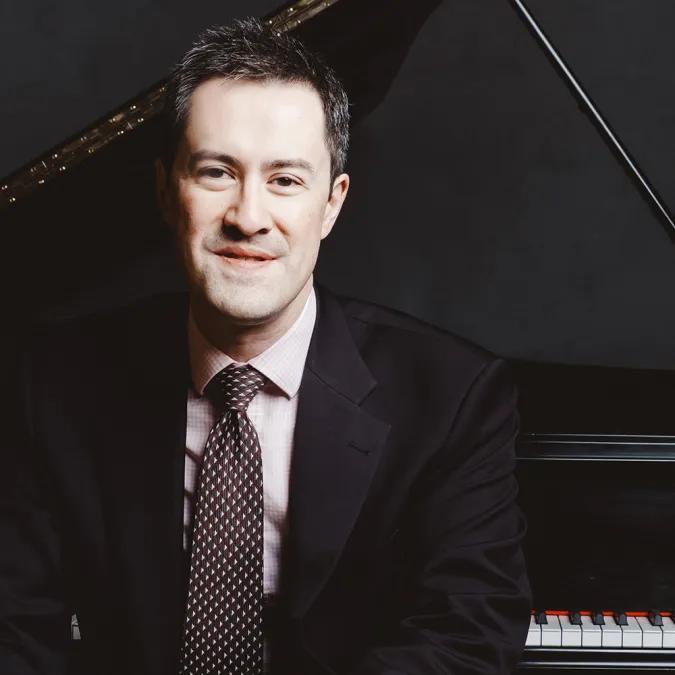
Andrew Brownell is a laureate of several major international competitions, having won 2nd Prize at the 2006 Leeds Competition, 2nd Prize ex aequo at the 2002 International J. S. Bach Competition (Leipzig), and 1st Prize at the 2005 J.N. Hummel Competition (Bratislava). Mr. Brownell’s performances have aired on BBC radio and television, Classic FM (UK), NPR, CBC, Mitteldeutscher Rundfunk, and RBB KulturRadio. His teachers have included Nancy Weems and Horacio Gutiérrez at the University of Houston, John Perry at the University of Southern California, and Joan Havill at the Guildhall School of Music in London. An enthusiastic collaborative artist, Andrew Brownell has performed with principals of orchestras such as the Philharmonia, Amsterdam Concertgebouw, and Vienna Philharmonic. He was made a Fellow of the Royal College of Organists in 2010.
Upcoming Events
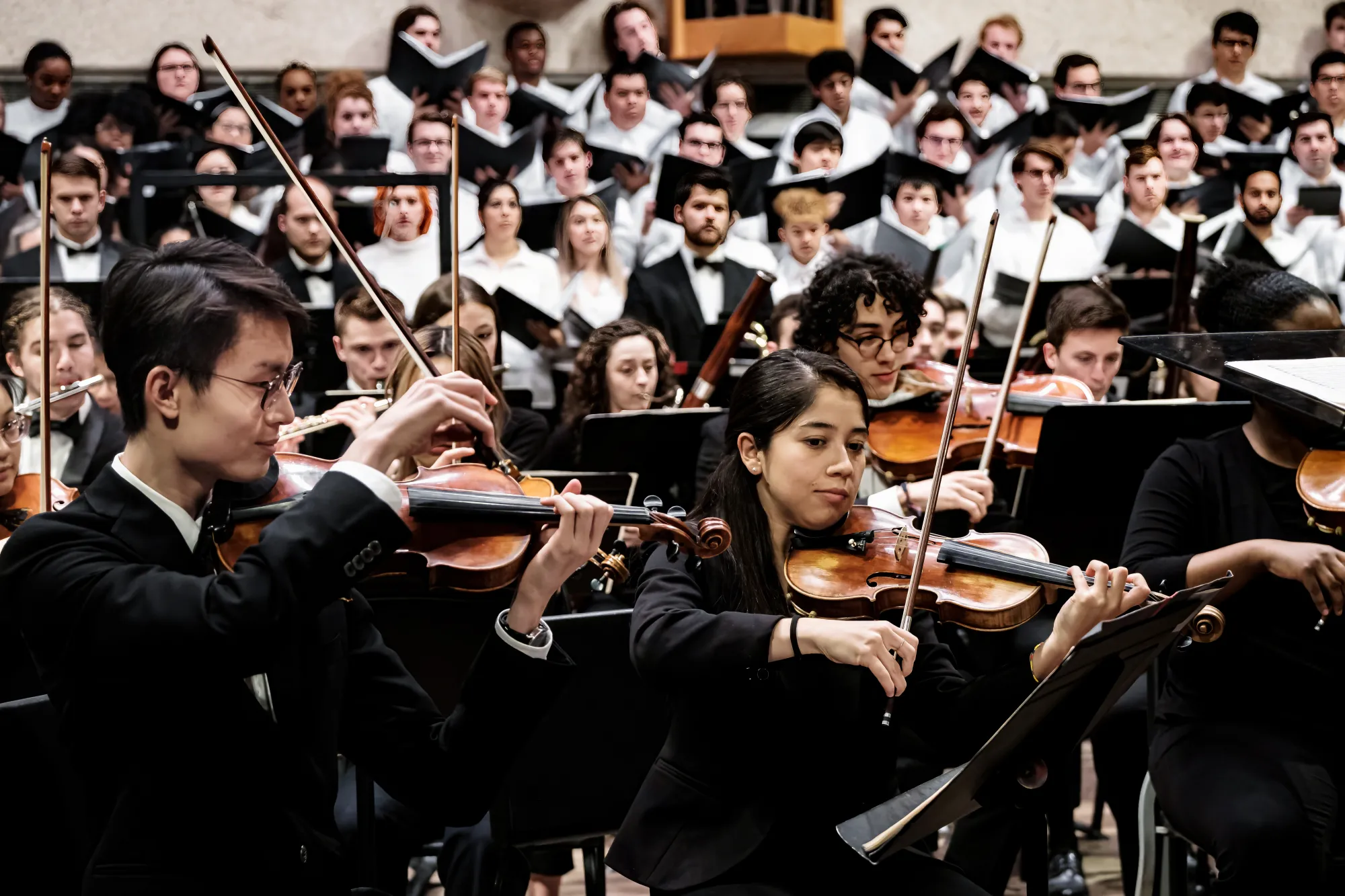
Mahler Symphony No. 2
Resurrection
Symphony Orchestra & Combined Choirs
Leah Crocetto, soprano
Sophio Dzidziguri, mezzo soprano
One of the most beloved symphonies in the canon, Mahler's "Resurrection" symphony boasts a large orchestra, mezzo and soprano soloists, and similarly to Beethoven's 9th Symphony, a large choir in the final movement. For this performance, the Butler School's Concert Chorale and University Chorus ensembles will join forces; they will be joined by Butler School alumni singers and community choral singers from around Austin.
Tuesday, March 31, 8:00 p.m.
Long Center for the Performing Arts
Event Details
$10 – 20
All University of Texas at Austin students are allowed one free ticket as long as they are available. Student tickets must be picked up at the Box Office with valid student I.D. Seating is unassigned.
If you are a patron with specific seating needs, please email tickets@mail.music.utexas.edu and we will reserve ADA seating for you.