



October 17, 2026

By Andrew Battaglia
Anton Nel prefaced his chamber recital on Oct. 12, 2026, with a spoken dedication to the memory of Joe R. Long, who passed away earlier this month. The Austin-based philanthropist and arts patron created the Joe R. and Teresa Lozano Long Chair in Piano, currently held by Anton, and was a dear friend of Nel’s. The recital proved to be a fitting musical tribute to a steadfast supporter of the arts in Central Texas.
The recital began with W.A. Mozart’s Piano Quartet in E-flat Major, K.493, a work that explores joy, virtuosity, and lyricism. Nel was joined by Sandy Yamamoto on violin, Wilhelm Magner on viola, and Bion Tsang on cello. As Nel explored the subtleties of the first movement’s softer resolutions, Yamamoto seamlessly interwove violin lines into the texture, adding a beautiful lyricism. Magner and Tsang crafted a velvety blend of tone as the ensemble explored the introspective moods of the second movement. The varying textures of Mozart’s writing were continually illuminated by Nel, who spun out filaments of pure delicacy.
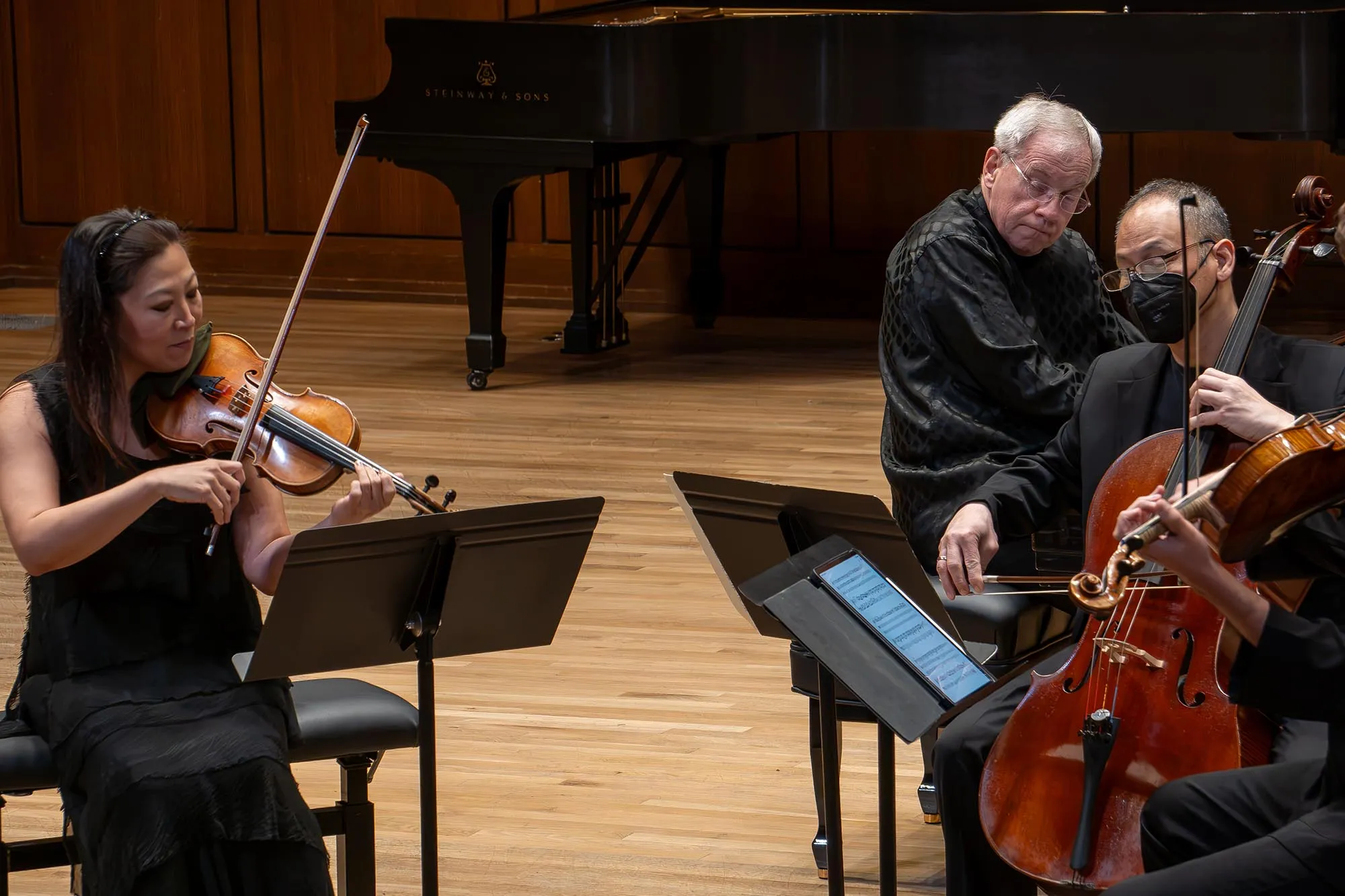
Mozart’s Piano Quartet in E-flat Major, K.493, performed by Anton Nel, Sandy Yamamoto, Wilhelm Magner and Bion Tsang
In the next set, Nel was joined by clarinetist Jonathan Gunn for a performance of Francis Poulenc’s Sonata for Clarinet and Piano. Gunn captured the nostalgic and colorful beauty of Poulenc’s writing with his resonant and shimmering tone. Both performers shaped their phrases with an unspoken understanding, bringing each musical thought to a natural close before introducing the next color and emotional hue in Poulenc’s score. The clarinet seemed to emerge from nowhere in the second movement, and together with Nel’s sensitive voicing, created a colorful wash of sound.
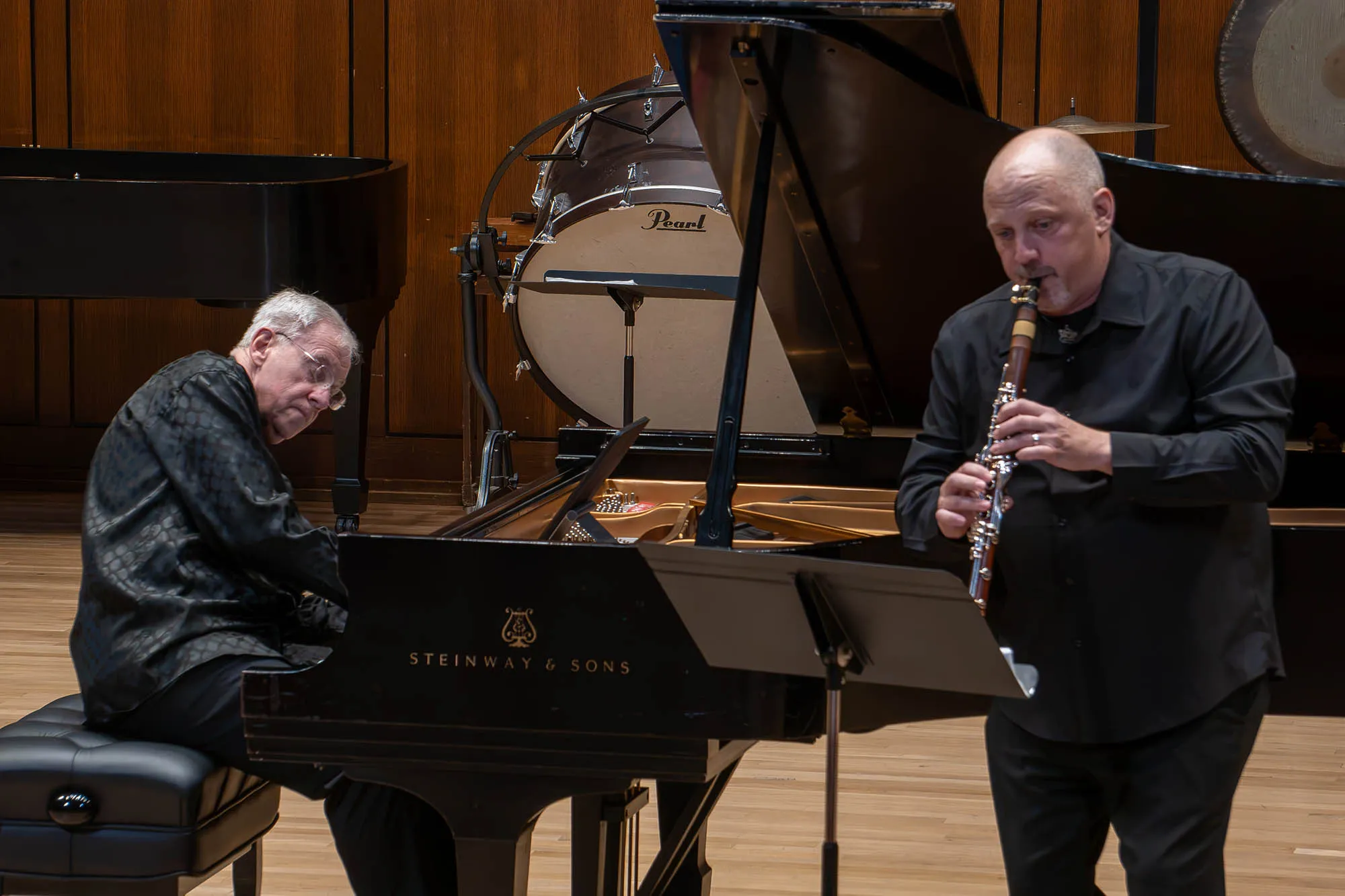
Francis Poulenc’s Sonata for Clarinet and Piano performed byAnton Nel and Jonathan Gunn
Nel continued to draw out subtle textures in the next work, Claude Debussy’s Première Rhapsodie for clarinet and piano. He created a soft, cloudlike cushion for Gunn’s singing tone to rest upon before the music grew increasingly animated, culminating in an energetic conclusion.
For the final work, the additional piano and percussion instruments waiting backstage were brought forward to close the evening. Béla Bartók’s Sonata for Two Pianos and Percussion featured Anton Nel and Colette Valentine on piano, and Thomas Burritt and Arlo Shultis on percussion. The work’s pointillistic nature was striking as the larger portrait unfolded across the stage through the ensemble’s cohesive attention to passing rhythmic motives. The dexterity displayed by Burritt and Shultis was impressive as they traversed their setups to play drums, a xylophone, a triangle, tam-tam, cymbals, and timpani.
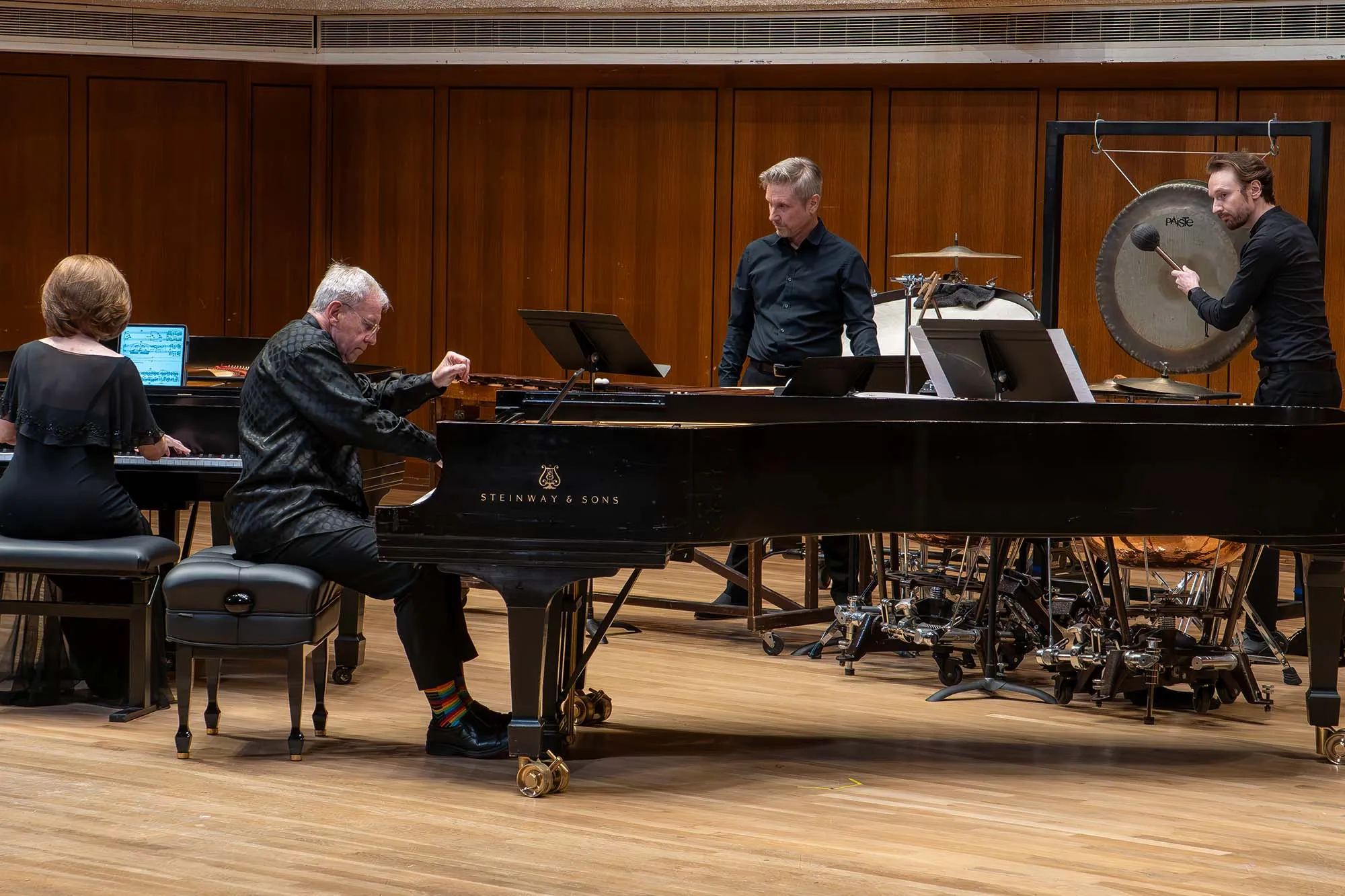
Béla Bartók’s Sonata for Two Pianos and Percussion performed by Anton Nel, Colette Valentine, Thomas Burritt and Arlo Shultis
In essence, this piece explores the percussive possibilities of the two pianos alongside the percussion instruments, blurring the boundaries between melody, harmony, and rhythm. The seamless piano lines and glissandi woven by Valentine and Nel captured the essence of true collaboration in this work. The performers exchanged rhythmic motives, built and dismantled textures, and pushed their instruments to their limits, bringing Bartók’s compositional vision vividly to life.
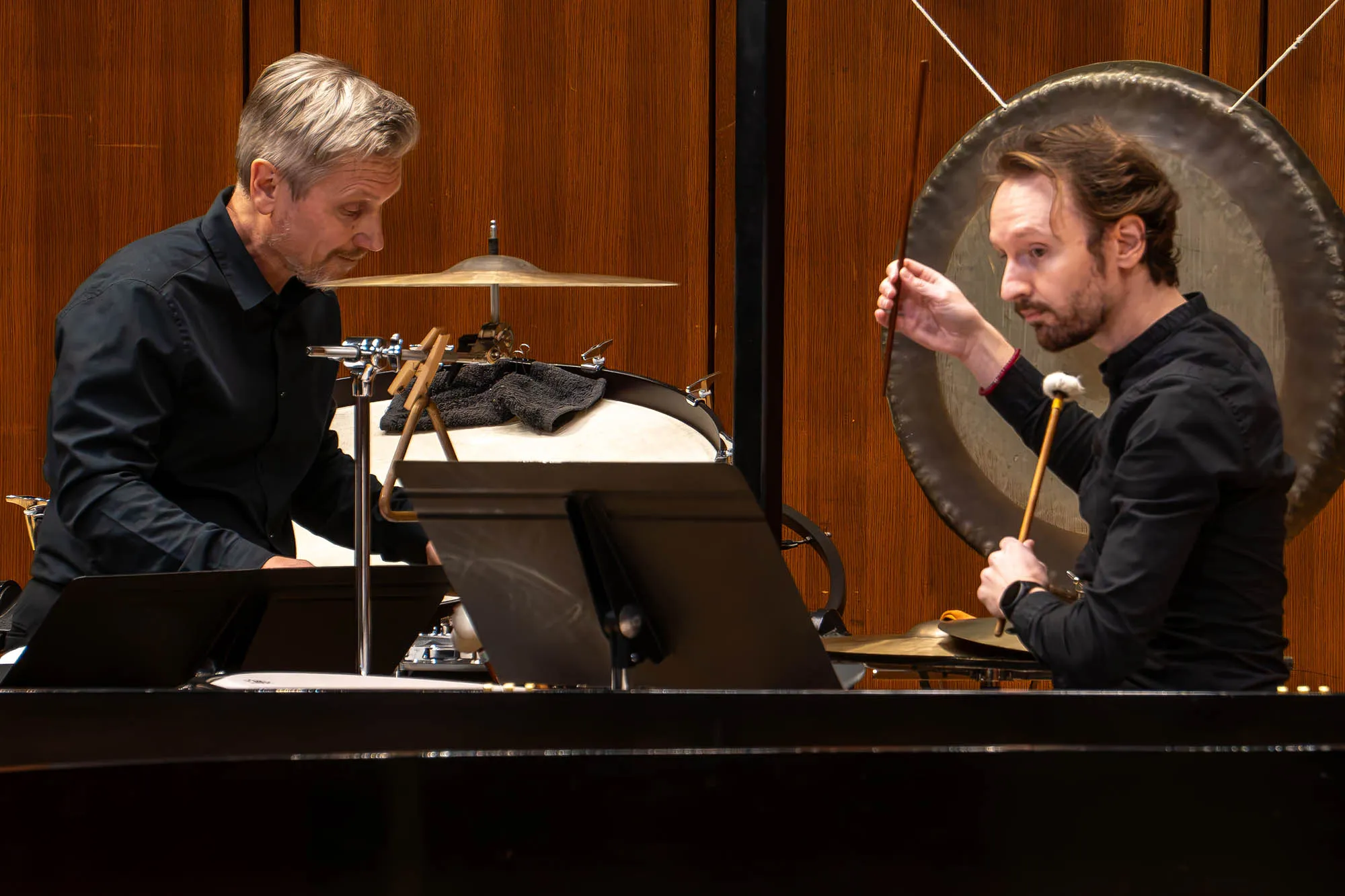
Thomas Burritt and Arlo Shultis perform Béla Bartók’s Sonata for Two Pianos and Percussion
When asked about his favorite piece on the program, Anton Nel said “I chose them all because I love them.” Reflecting on the opportunity to collaborate with friends and colleagues at the Butler School of Music, he added, “We’re so lucky here at the Butler School to have such great performers that we can team up with because there is nothing better.”