


Cliff Croomes, conductor
Cody Ray, associate conductor
This concert will last about one hour without intermission.
Please silence your electronic devices.
Photography, video, or recording of any part of this performance is prohibited
Program
Ron Nelson
Lauds (Praise High Day)
Charles Gonoud
Petite Symphonie
Adagio, Allegro
Adante Cantabile
Scherzo: Allegro Moderato
Finale: Allegretto
Libby Larsen
Strut
J.S. Bach
trans. Holst
Fugue à la Gigue, BWV 577
David Maslanka
Give Us this Day
Moderately Slow
Very Fast
About the Program
Program notes by Mark Bilyeu except where noted.
Ron Nelson
Lauds (Praise High Day)
Born December 14, 1929
Died December 24, 2023
Composed 1991 / 2008
Premiered January 24, 1992, United States Air Force Band, Lt. Col. Alan L. Bonner, conductor
6 minutes
Ron Nelson undertook his entire musical training at The Eastman School of Music, studying with Louis Mennini, Bernard Rogers, and Howard Hanson. After completing further studies at the Ecole Normale de Musique in Paris, he returned to the United States where he taught composition at Brown University for nearly forty years until his retirement in 1993. His compositional style was eclectic, ranging from aleatory to Renaissance-inspired dances. Nelson writes “Lauds (Praise High Day) is an exuberant, colorful work intended to express feelings of praise and glorification. Lauds is one of the seven canonical hours that were selected by St. Benedict as the times the monks would observe the daily offices. Three (terce, sext, and none) were the times of the changing of the Roman guards and four (matins, lauds, vespers, and compline) were tied to nature. Lauds, subtitled Praise High Day, honors the sunrise; it is filled with the glory and excitement of a new day.”
Charles Gonoud
Petite Symphonie
Born June 17, 1818, Paris, France
Died October 18, 1893, Saint-Cloud, France
Composed 1885
Premiered April 30, 1885, Salle Pleyel, Paris, France
20 minutes
It was the french flutist Paul Taffanel who commissioned the great Charles Gounod to write a work for winds. At this point in his life, he had already written two full symphonies, several oratorios, and over ten operas, including Faust and Roméo et Juliette. Gounod accepted the commission, and crafted an elegant four movement work that hearkens back to Classical Era sensibilities at a time when the Romanticism of Brukner, Brahms and Verdi were on the rise. Scored for pairs of clarinets, horns, oboes, and bassoons—with the addition of solo flute for commissioner—the opening movement begins with a slow introduction before its lively allegretto. The second movement is a flute feature, followed by a scherzo that is sure to make you feel like you are on a hunting expedition with its opening horn calls. The final movement is another allegretto, which the commentator Diether Stepphun describes as having "cheerfully contemplative and gallant wit, with all the experience of human and musical maturity."
Libby Larsen
Strut
Born December 24, 1950, Wilmington, DE
Composed 2003
Premiered January 25, 2004, St. Olaf College Band, Timothy Mahr, conductor
8 minutes
When Tim Mahr invited me to compose a work for the St. Olaf Band, a work to celebrate 100 years of the department of music at St. Olaf College, I was immediately honored and intrigued with the possibilities that music offers a composer to “honor” music making and the tremendous talent and vigor of St. Olaf’s professional and student musicians over the past century. For some reason, the phrase “strut your stuff” exploded into my mind and I recognized that this new work, Strut, had to spring from that inspiration.
‘Strut.’ What a word! Writers such as Dickens, Shakespeare, and Nobokov employ the word ‘strut’ to capture the essence of their subjects. Traced back to its Old High German roots its meaning is “to stand out, project”. Traced to its old Norwegian roots, its meaning is “obstinate resistance.” Traced to its American English roots, its meaning is “to display one’s ability with a certain attitude.” The Webster’s New Twentieth Century Dictionary defines the word ‘strut” as “to walk with a lofty, proud gait;” while the American Heritage Dictionary of the English Language states, “IDIOM: strut (one's) stuff. Slang: To behave or perform in an ostentatious manner; show off.”
‘Strut’ is a noun: a dance, a brace, a support; a verb with many synonyms including swell, bulge, thrust forth, stick out, contend, strive, quarrel, and bluster as well as exult, swagger and “to stand erect at one’s full height.” One might say that precision is the full height at which a world class concert band stands. I took this to heart and build the music of Strut around the idea of the ability of the band to play precisely within an unerring beat while rarely hearing it articulated. The conductor holds the beat and the ensemble must feel it and its subdivisions exactly in order to realize the precision and flow of the music.
All of these meanings—nouns, verb, and attitudes—are at the heart of this new celebratory work ... All that remains is for the band to do what it does so well—strut its stuff.
–Libby Larsen
J.S. Bach
Fugue à la Gigue, BWV 577
Born March 31, 1685, Eisenach, Germany
Died July 28, 1750, Leipzig, Germany
1707 / 1928 / 2008
Published 1928
3 minutes
When Gustav Holst was commissioned to write Hammersmith for the BBC Wireless Military Band in 1928 he felt rather out of practice in orchestrating for the medium. For some years he had had the idea of arranging some Bach fugues for brass and military band, so he set himself the task of scoring the Organ Fugue in G Major BWV 577 (from Preludes, Fugues and Fantasias). He, rather than Bach, called it Fugue à La Gigue.
The piece made an ideal exercise and Holst’s brilliant dovetailing of the counterpoint between different instruments shows his mastery. The piece is technically demanding and the characteristic unison clarinet writing suggests the orchestral conception of a large wind ensemble rather than a band. It was this conception which the composer carried forward into Hammersmith.
– from the publisher
David Maslanka
Give Us this Day
Born August 30, 1943, New Bedford, Massachusetts
Died August 7, 2017
Composed 2006
Premiered February 17, 2006, Rancho Buena Vista High School Wind Ensemble, Eric Weirather, conductor, 2006 California Band Directors Association convention
15 minutes
The words “Give us this day” are, of course, from the Lord’s Prayer, but the inspiration for this music is Buddhist. I have recently read a book by the Vietnamese Bhuddist monk Thich Nhat Hahn (pronounced “Tick Nat Hahn”) entitled For a Future to be Possible. His premise is that a future for the planet is only possible if individuals become deeply mindful of themselves, deeply connected to who they really are. While this is not a new idea, and something that is an ongoing struggle for everyone, in my estimation it is the issue for world peace. For me, writing music, and working with people to perform music, are two of those points of deep mindfulness. Music makes the connection to reality, and by reality I mean a true awakeness and awareness. Give Us This Day gives us this very moment of awakeness and awareness so that we can build a future in the face of a most dangerous and difficult time. I chose the subtitle, “Short Symphony for Wind Ensemble,” because the music is not programmatic in nature. It has a full-blown symphonic character, even though there are only two movements. The music of the slower first movement is deeply searching, while that of the highly energized second movement is at times both joyful and sternly sober. The piece ends with a modal setting of the choral melody “Vater Unser in Himmelreich” (Our Father in Heaven)—No. 110 from the 371 four-part chorales by Johann Sebastian Bach.
– David Maslanka
About the Conductor
Cliff Croomes
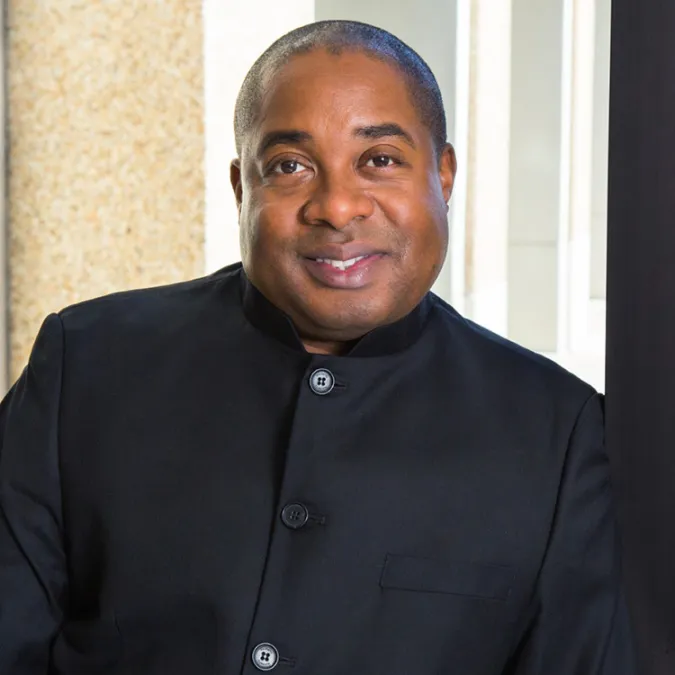
Cliff Croomes serves as the associate director of bands and director of the Longhorn Band at The University of Texas at Austin. Prior to this appointment, Croomes was the assistant director of bands at Louisiana State University and the music director and principal conductor of the Civic Orchestra of Baton Rouge. Previous to his appointment the faculty he studied at LSU for his Master of Music and Doctor of Musical Arts degrees. Dr. Croomes earned his Bachelor of Music Studies from The University of Texas at Austin and is an alumnus of the Cavaliers Drum and Bugle Corps from Rosemont, Illinois. He has performed with ensembles throughout the United States, London, Paris, Switzerland, Germany, Italy and consulted throughout Japan. Dr. Croomes holds an endorsement with Innovative Percussion Inc. and is a founding board member of the composer diversity initiative “And We Were Heard” as well as a member of the Dr. William P. Foster Project advisory board. Croomes also holds an honorary membership in Kappa Kappa Psi.
Symphony Band
Flute
Lily Bednar
Dayanara Carrasco
Claire Chang
Amy Martinez-Figueroa
Kamila Merchan-Liu
Isabella Rosales
Sophia Wu
Oboe
Max Johnson
Reagan Tompkins
Clarinet
Jorge Canas
Louis Hatten
Isaac Joo
Zeynep Ozgun
Bassoon
Flavio Gabriel
Darren Tea
Saxophone
Ernesto Canales III
Ben Crowley
Alexis Cuellar
Brandon Garcia
Brady Ginsberg
Daniel Kim
Brandon Kusaj
Sasha Sanchez
Horn
Zachary Greer
Caleb Sain
Ashley Young
Trumpet
Jason Gonzales
Cooper Maberry
Hagan Mosley
Steven Streetman
Trombone
Jan Campos
Nicholas D’Andrea
Antonio Gamez
Hunter Irwin
Euphonium
David Barragan
Madalynne Chan
Casey Hawthorne
Andrew Shaffer
Tuba
Carter Eason
Jayden Medina
Nathan Walters
Samantha Yanez
Percussion
Reid Hamilton
Bryan He
Daniel Hernandez
Kailyn Link
Double Bass
Andrés Hernández
Keyboard
Yoojin Choi
Upcoming Events

Ring in the season with the Butler School’s annual Holiday Concert with music for everyone to enjoy. You’ll hear traditional holiday carols and winter favorites across many genres, including excerpts from Bach’s Magnificat, jazz standards like “I’ll Be Home for Christmas,” and Hanukkah songs from Sephardic and Mizrahi Jewish traditions.
Featuring
Chamber Orchestra
Concert Chorale
University Chorus
Longhorn Singers
Bereket Middle Eastern Ensemble
Soha Quartet
Horn Choir
Bassoon Ensemble
Musical Theatre Workshop
Jazz Combos
Gregory Eaton, organ
Saturday, December 5, 7:30 p.m.
Sunday ,December 6, 4:00 p.m.
Bates Recital Hall
WIND ENSEMBLE
Adam Schoenberg, visiting composer
Sunday, February 7, 4:00 p.m.
Bates Recital Hall
WIND SYMPHONY & SYMPHONY BAND
Free Admission
Monday, February 8, 7:30 p.m.
Bates Recital Hall
WIND SYMPHONY
Free Admission
Monday, March 8, 7:30 p.m.
Bates Recital Hall
WIND ENSEMBLE
with Epoch Percussion Quartet
Wednesday, March 10, 7:30 p.m.
Bates Recital Hall
SYMPHONY BAND
Mother Nature
Free Admission
Monday, March 29, 7:30 p.m.
Bates Recital Hall
Event Details
Free admission