




Cliff Croomes, conductor
Jimmy Santos-Rivera, guest conductor
Artie Henry Middle School Honors Band
Katherin Norris, director
This concert will last about 90 minutes with one intermission.
Please silence your electronic devices.
Photography, video, or recording of any part of this performance is prohibited
Program
Percy Grainger
Irish Tune from County Derry
Ed. Rogers
with the Artie Henry Middle School Honors Band
Katherine Norris, director
Jaime Theirman
The History of the Universe
Mark Wolfram
Overture Ciné Noir
Peter Van Zandt Lane
Astrarium
Jimmy Santos-Rivera, conductor
Tomohito Matsushita
Elegy to the Moon
Traditional
arr. Drew Dickey
Second Line
Just a Closer Walk with Thee
When the Saints Go Marching In
About the Program
Program notes by Mark Bilyeu except where noted
Percy Grainger
Irish Tune from County Derry
Irish Tune from County Derry (published 1918) is based on earlier settings that date back as early as October 1902 with an essentially identical setting of this melody for wordless mixed chorus. Later versions for solo piano (1911) and string orchestra with two optional horns (1912) followed. The wind band setting is cataloged as British Folk Music Setting Nr. 20, and like all his settings of British folk music is “lovingly dedicated to the memory of Edvard Grieg.” The composer’s brief program note states, “This tune was collected by Miss J. Ross, of New Town, Limavady, Co Derry, Ireland and published in The Petrie Collection of the Ancient Music of Ireland, Dublin, 1855.”
Jaime Theirman
The History of the Universe
Composed 2024
Premiered December 2, 2024
3 minutes
This is the first piece written for “History of Something in 3 minutes” series. The series began as the “The History of Something in 60 Seconds,” but quickly upgraded to “The History of Something in 90 Seconds.” And though I gave it a good try, 90 seconds just wasn’t sufficient for the entire universe’s backstory. I dabbled in 120 seconds for a moment, but ultimately settled on 3 minutes for a perfect and concise sketch of all of material creation. The piece starts off with a pretty literal big bang, and then stays for as long as it can in the realm of hot and dense atoms bumping into each other. After that, the music is all about expansion. Intervals get bigger and bigger and the randomness gradually organizes itself into recognizable rhythms and motifs. The melody in the brass at the very end is simply an interval that widens further and further up to the last note. I purposefully did not end this piece with a resolved chord, as the history of the universe is not over yet.
–Jaime Theirman
Mark Wolfram
Overture Ciné Noir
Born March 20, 1955, Hibbing, Minnesota
Composed 2012
7 minutes
Mark Wolfram began his music education with piano and violin, but switched to trombone at age 10, being mentored by Earl Benson, Vaclav Nehlybel, and Alfred Reed. He attended Northwestern University where he earned a Bachelor of Music degree and studied arranging, conducting and band techniques with John P. Paynter and trombone with the Chicago Symphony Orchestra's Frank Crisafulli. He has since built a career writing and arranging for musicians and organizations from Diana Ross & The Supremes to Chris Isaak, and from ABC-TV’s Monday Night Football to Hanna-Barbera cartoons. His Overture Ciné Noir is a musical homage to the Film Noir era of the 1940s and 1950s. As the publisher describes it: “with sweeping melodies and dark harmonic material, Overture Ciné Noir moves through a series of musical vignettes, always maintaining its introspective and brooding nature.”
Peter Van Zandt Lane
Astrarium
Born May 13, 1985, Port Jefferson, New York
Composed 2015
Premiered April 24, 2015, Emory University Wind Ensemble, Nikk Pilato, conductor
6 minutes
I think of this piece as a fantasy, with a very short, heroic brass fanfare wedged in the center of a larger, more ornamented musical frame. I began sketches for Astrarium in June 2014 while on a residency at MacDowell Colony, an arts colony in Peterborough, New Hampshire. In the studios at MacDowell, it has become customary for artists to sign their names on planks of wood, keeping a log of each studio’s history of visiting artists. Coincidentally, I came across Joseph Schwantner’s name in my studio, dated 1978, and discovered that he had composed a song cycle in the same room more than 35 years earlier. I couldn’t help but use a small quote from his piece in mine; thus, the opening vocal phrase of Schwantner’s cycle Wild Angels of the Open Hills makes a subtle appearance as an oboe solo in Astrarium, and is later used as the subject for a fugue section just after the fanfare.
The title refers to a complex astronomical clock invented by Giovanni de’ Dondi in the 14th century, one of the earliest contraptions resembling mechanisms of modern clocks. The more I thought about connecting my own musical ideas to an earlier time and place—perhaps to Schwantner three-and-a-half decades ago, or to myself playing bassoon in Nikk Pilato’s wind ensemble as a freshman in high school—the more the sonic imagery of clockwork became central to the piece.
Astrarium was composed for the Emory University Wind Ensemble, at the request of my friend and former teacher, Nikk Pilato. The piece was commissioned as a concert opener for the premiere of Joseph Schwantner’s Concerto for Wind Orchestra.
– Peter Van Zandt Lane
Tomohito Matsushita
Elegy to the Moon
Born 1984, Kochi, Japan
Composed 2021
7 minutes
After graduating from the Department of Music at Tokyo University of the Arts, Japanese composer Tomohito Matsushita completed the master's program in 2009, receiving the Doseikai Award upon graduation. He completed a Masters degree at the accompaniment department of the Tokyo College of Music in 2014, and has won several prizes, including the 37th All Shikoku Piano Composition Grand Prize, and the Japan Symphony Foundation’s 29th Composition Award. He currently is a lecturer at Tokyo College of Music and Senzoku Gakuen College of Music. He explains that his work Elegy to the Moon is based upon a children's book The Red Candles and the Mermaid. Originally for woodwind octet, it has been rescored for wind band by commission from Fukiage Jr. HS for performance at the 19th East Japan School Band Competition.
Traditional/arr. Drew Dicky
Second Line
Dr. Christopher (Drew) Dickey joined the faculty at Texas Christian University after serving as the associate director of the Longhorn Band and assistant director of bands at the Butler School of Music. In addition to his academic posts, he serves as the Music Design Coordinator with the Pacific Crest Drum and Bugle Corps in Diamond Bar, California, and as the brass educational lead with The Bluecoats Drum and Bugle Corps in Canton, Ohio.
About the Artists
Jimmy Santos-Rivera
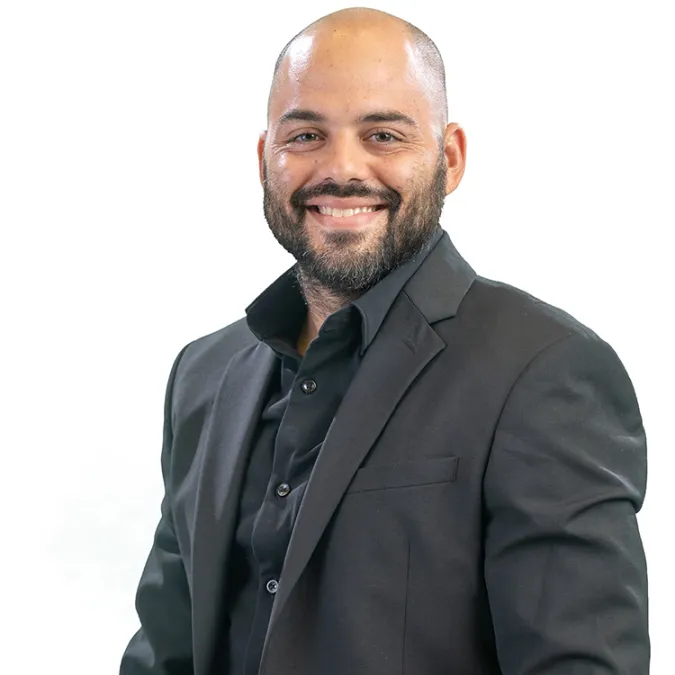
Jimmy Santos-Rivera (he/him) is currently pursuing a master of music in wind conducting at The University of Texas at Austin, where he serves as a graduate teaching assistant. In this role, he assists in conducting and managing the university’s concert bands, athletic bands, and conducting courses. He earned his bachelor of arts in music education, with a minor in percussion, from the University of Puerto Rico, Río Piedras. Born and raised in Puerto Rico, his career has been deeply rooted on the island. Prior to moving to Austin, Santos-Rivera spent eight years teaching concert band, percussion, and music theory at Escuela Especializada en Bellas Artes Pablo Casals. As a performer, he has played in the percussion section of the Puerto Rico Symphony Orchestra, the Puerto Rico Wind Symphony, and the Puerto Rico Philharmonic Orchestra. In 2019, he joined the 248th Army Band in San Juan, Puerto Rico, where he currently serves as a percussionist in various ensembles and as the principal conductor of the concert band. His mentors include Carlos Ávila, Eddy Marcano, Karlo Flores, and Carmen Acevedo.
Cliff Croomes

Cliff Croomes serves as the associate director of bands and director of the Longhorn Band at The University of Texas at Austin. Prior to this appointment, Croomes was the assistant director of bands at Louisiana State University and the music director and principal conductor of the Civic Orchestra of Baton Rouge. Previous to his appointment the faculty he studied at LSU for his Master of Music and Doctor of Musical Arts degrees. Dr. Croomes earned his Bachelor of Music Studies from The University of Texas at Austin and is an alumnus of the Cavaliers Drum and Bugle Corps from Rosemont, Illinois. He has performed with ensembles throughout the United States, London, Paris, Switzerland, Germany, Italy and consulted throughout Japan. Dr. Croomes holds an endorsement with Innovative Percussion Inc. and is a founding board member of the composer diversity initiative “And We Were Heard” as well as a member of the Dr. William P. Foster Project advisory board. Croomes also holds an honorary membership in Kappa Kappa Psi.
Symphony Band
Flute
Ivanna Aleman-Coronado
Annnasophia Danao
Hailey Hickerson
Eunha Kim
Subin Oh
Elise Yuan
William Webb
Oboe
Bliss Peterson
Tara Tran
Clarinet
Emely Flores
Michael Golston
Adelyn Rusil
Jasmine Salsman
Emlie Wu
Bassoon
Elijah Bergstrom
Danny Frushour
Venuki Gamage
Benjamin Miller
Judith Salas
Darren Tea
Saxophone
Phoenix Alcera
Ben Crowley
Jonathan Dominguez
Nigel Duplessis
Joseph Girard
Brandon Kusaj
Thomas Nuttal
Jacob Otchis
Noah Phillip
Matthew Puente
Andrew Schaffer
Horn
Zachary Greer
Ellie Howard
Rosalie Jones
Sydney Lee
Eliud Pozos
Tomo Umetani
Carter White
Ashley Young
Trumpet
Dash Kostka
Brett Harrington
Scout Howard
Chase McKay
Christopher Ray
Trombone
Jan Campos
Luke Crwaford
Erick Galicia
Joshua Gault
Troy Teggatz
Bass Trombone
Nicholas D’andrea
Hudson Pedrotti
Euphonium
David Barragan
Casey Hawthorne
Sean Hokanson
Matthew Puente
Andrew Shaffer
Tuba
Blake Barngrover
Drake Boff
Andrew Bearse
Carter Eason
Leah Mullens
Antonio Musgrove
Ajeet Nagi
Michael Revilla
Ethan Seibert-Venable
Marco Vittoria
Mark Weston
Samantha Yanez
Percussion
Jackie Garcia
Victoria Garcia
Jacob Laguna
Joel Rodriguez
Cedrick Clark
Thomas Zach
Harp
Anjali Shivkumar
Alyssa Vought
Double Bass
Reilly Curren
Event Details
Free admission