


Chris Tran, conductor
Matthew Pavon, conductor
This concert will last about 1 hour without intermission.
Please silence your electronic devices.
Photography, video, or recording of any part of this performance is prohibited
Program
Antonín Dvořák
Carnival, op. 92, B.169
Chris Tran, conductor
Jean Sibelius
Symphony No. 1 in E Minor, op. 39
I. Andante, ma non troppo – Allegro energico
II. Andante (ma non troppo lento)
Chris Tran, conductor
III. Scherzo: Allegro
IV. Finale (Quasi una Fantasia)
Matthew Pavon, conductor
About the Program
Antonín Dvořák
Carnival Overture, op. 92
Born September 8, 1841 Nelahozeves, Bohemia
Died May 1, 1904, Bohemia
Composed 1891
Premiered April 28, 1892, Orchestra of the National Theatre in the Rudolfinum, Prague, Antonín Dvořák, conductor
9 minutes
At fifty years old, Antonín Dvořák set out to write a triptych of orchestral overtures he intended to publish as his op. 21; they were to be called Nature, Life, and Love. He completed the cycle in sequence, beginning in March of 1891 and finishing the three in January 1982. In these, he sought to be what he described to a friend as “a poet as well as musician.” Dvořák conducted the premiere of these works the evening before setting sail for a trip to America, which left Brahms to correct the proofs of the scores for the publisher Simrock. (Brahms had been an important figure in the trajectory of Dvořák’s career, having been on a panel which awarded him an Austrian State Stipend for “young, poor, and talented musicians in the Austrian half of the [Hapsburg] Empire,” and having introduced his works to Simrock years earlier.) In the first performance, the titles of the three overtures were printed as Nature, Life (Czech carnival), and Love (Othello), and it was decided that in the final printing, each be given its own opus number, and the more programmatic titles be used. Hence, we now can enjoy Dvořák’s “Carnival Overture, op. 92,” which the biographer Otakar Šourek calls, the “impression of a man seized into the joyous vortex of life.”
Jean Sibelius
Symphony No. 1 in E Minor, op. 39
Born December 8, 1865, Hämeenlinna, Finland
Died September 20, 1957, Järvenpää, Finland
Composed 1899-1900
Premiered April 26, 1899, Helsinki Orchestral Society, Jean Sibelius, conductor
40 minutes
“Whereas most other modern composers are engaged in manufacturing cocktails of every hue and description, I offer the public cold spring water,” wrote Sibelius about his symphonic writing. And while that was in direct reference to his sixth symphony, the same can rightly be said of his first official symphony, written twenty years earlier at the turn of the twentieth century. When the composer had set out to craft his earliest symphony, he already had several large-scale symphonic works to his credit: tone poems depicting Finland’s national epic Kalevala (En Saga, Lemminkäinen, and Kullervo), and this first symphony shows a level of maturity and clarity not often found in initial symphonic offerings. The work opens with a stoic clarinet before opening up into the luxury of Russian-inspired orchestrations. The second movement spins variations on the main theme, with Sibelius layering texture and counterpoint until the movement’s pianississimo conclusion. Most everyone, including Sibelius scholar Erik Tawaststjerna, agrees that the third movement falls directly in line with the symphonic scherzos of Anton Bruckner. The final movement is subtitled “quasi una fantasia,” making use of the first movement’s melodies, and — like the first movement — concludes with pizzicato and the ominous rolling of the timpani.
The Helsinki Orchestra programmed this work on their first international tour, performing it in Stockholm, Oslo, Hamburg, Amsterdam, and at the 1900 Paris World Exhibition. Each time, with Sibelius on the podium.
About the Artists
Chris Tran

Chris Tran is co-director of The University of Texas University Orchestra, graduate teaching assistant for the University of Texas Orchestras, and is currently pursuing a doctor of musical arts in orchestral conducting with Farkhad Khudyev at The University of Texas at Austin. Mr. Tran has been an invited conductor at several masterclasses and workshops in Boulder, Los Angeles, Eugene, St. Andrews (Scotland), as well as the Cabrillo Festival of Contemporary Music with Cristian Măcelaru, Thomas Sleeper, and Leonard Slatkin, and the International Conducting Workshop and Festival with the late Larry Rachleff and Donald Schleicher. He has also worked with conductors Neil Thomson, Jeff Grogan, and Sian Edwards. Mr. Tran earned a master of music in orchestral conducting from the University of Colorado Boulder with Gary Lewis, and a bachelor of music in music education from Southern Methodist University. His conducting mentors include Nicholas Carthy and Paul Phillips. He studied violin with Charles Wetherbee, former concertmaster of the Boulder Philharmonic, and Diane Kitzman, former principal violin of the Dallas Symphony.
Matthew Pavon
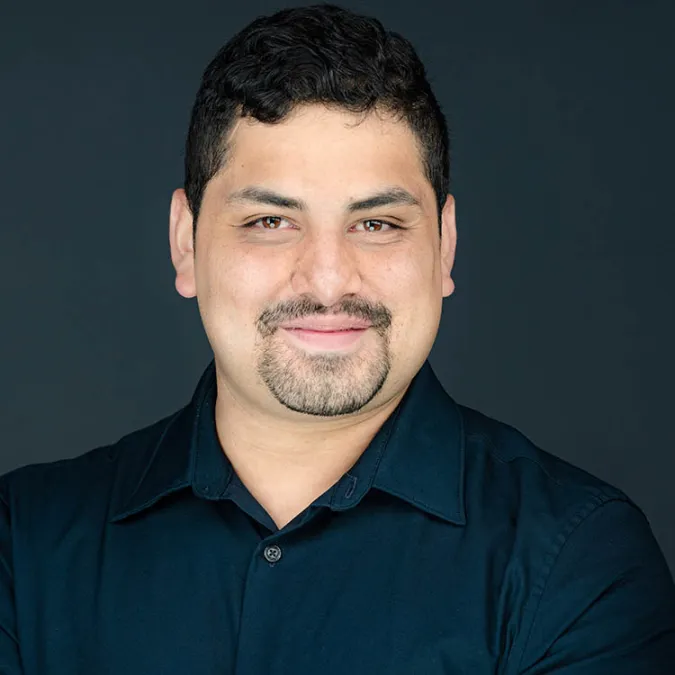
Matthew Pavon is a conductor and violist studying orchestral conducting under Farkhad Khudyev at The Butler School of Music. In his role as assistant instructor for university orchestras, Matthew is an active conductor and administrator for Symphony Orchestra. He also serves as Co-Director for University Orchestra. Matthew holds viola performance degrees from Evangel University (B.M. '19) and Missouri State University (M.M. '22). Guest conducting appearances have included concerts with the Austin Civic, Kansas City Civic, Missouri State University Symphony, Drury University, and Kansas City Youth Symphony, and Missouri Philharmonic Orchestras. As a violist, he was an active member of the Springfield Symphony Orchestra for seven years and a substitute violist for the Symphony of Northwest Arkansas. Matthew’s passion is connecting with people of all ages and backgrounds through music. He lives in Austin, TX, with his wife, Leianna, and their two mini-Australian Shepherds, Koda and Ellie.
University Orchestra
Violin I
Evelyn Lee, concertmaster
Emily Tando
Felipe Benitez
Brandon Mendoza
Thomas Feng
Jeffery Li
Quan Dau
Joaquin Alvarez
Cannon Bates
Jasmine Chou
Peter Stone
Joseph McPeek
Ursula Weissfeld
Holden Tom
Violin II
Kylie Hung, principal
Angelica Sharma
Rudhran Sathish
Jailyn Barnuevo
Jessica Lin
Lauren Heyde
Eric Liang
Mohini Bhave
Jacob Hanson
Ximena Cazares
Jack Johnson
Sonya Shah
Page Tan
Viola
Amy Ning, principal
Rachel Su
Shota Sawada
Wonkuk Lee
Audrey Sohn
Ash Roberts
Edward Visaya
Randy Guo
Gauri Binup
Daniel Kim
Caroline Hughes
Jaela Barrera
Angela Zhang
Cello
James Tabanado, principal
Michael Chung
Anthony Hermez
Daniel Tepedino
Rei Iwahara
Irene Benavides-Perez
Kunal Manish
Emile Meyrat
Allison Tseng
Drew Warninghoff
Double Bass
Dezhou Gao, principal
Chloe Mamitag
Brandon Chiu
Ryan Webster
Aravind Shandilya
Emily Layton
Piccolo
Anna Tumanova
Flute
Ethan Sarwar, principal
Camilar Martinez
Anna Tumanova
Oboe
Noah Bihan. principal
Kyra Ullman
Vibha Immedisetty
English Horn
Vibha Immedisetty
Clarinet
Jusun Chung, principal
Brian Kim
Bassoon
Owen Shaefer, principal
Gavin Remo
Horn
David Finecy, principal
Uriel Reyes
Dhanush Jain
Charlotte Allen
Trumpet
Harmon Byerly, principal (Sibelius)
Americo Zapata, principal (Dvořák)
Sam Acosta
Trombone
Erick Galicia, principal
Jingchun Liu
Bass Trombone
Hudson Pedrotti
Tuba
Chancellor Joseph
Harp
Kirsten Karamihan
Timpani
Philip Kaufinger
Percussion
Matt Garcia
Michael Stephens
Aizen West
Upcoming Events
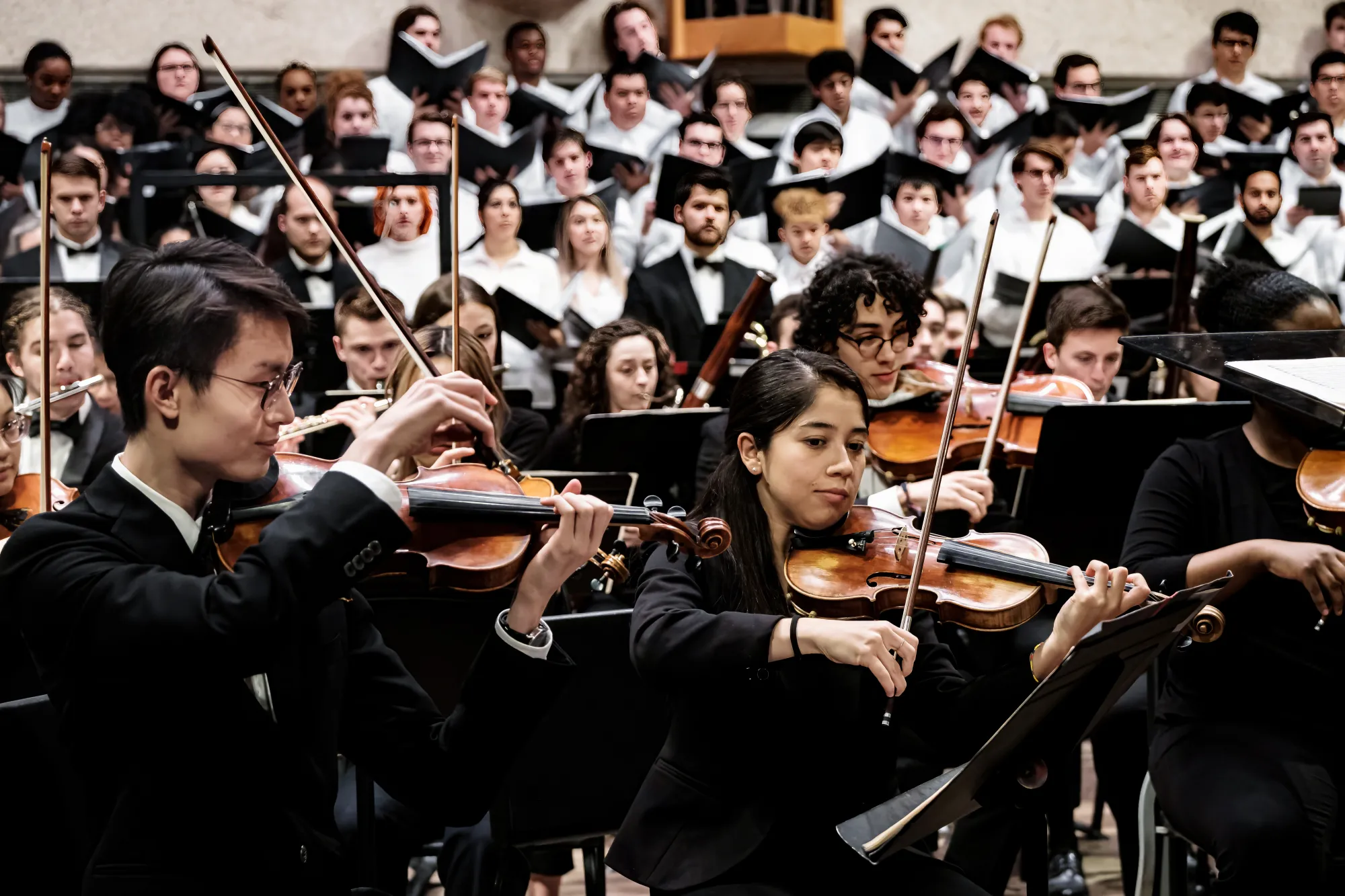
Mahler Symphony No. 2
Resurrection
Symphony Orchestra & Combined Choirs
Leah Crocetto, soprano
Sophio Dzidziguri, mezzo soprano
One of the most beloved symphonies in the canon, Mahler's "Resurrection" symphony boasts a large orchestra, mezzo and soprano soloists, and similarly to Beethoven's 9th Symphony, a large choir in the final movement. For this performance, the Butler School's Concert Chorale and University Chorus ensembles will join forces; they will be joined by Butler School alumni singers and community choral singers from around Austin.
Tuesday, March 31, 8:00 p.m.
Long Center for the Performing Arts
Event Details
Free admission